Attracted to the Colors of Summer

Despite an atypically mild winter and early spring, it seems like it took longer this year to find color;
but as this pickerelweed demonstrates, the summer colors of the marsh have arrived

As promised, here are some additional shots of color from my photo-monitoring this past week. The theme seemed to be bright blooms, deep greens, and vibrant pollinators. This little camera is pretty good at catching about everything but the sometimes oppressive heat and humidity!


If this doesn't scream summer, I don't know what does -- a monarch on (swamp) milkweed;
sadly, this is getting to be a much less common sight; monarch numbers are down as much as 90% globally

This butterfly -- the red admiral -- is one of Ohio's most common; while conservation strives to improve the plight of endangered and threatened species, it also needs to provide safe havens to keep "common" species common

I don't know my bumblebees, but I do know that even they are starting to receive attention due to new research that shows
dramatic declines in many populations regionally, nationally, and globally -- never underestimate the importance
of our pollinators (this one finds a home on chicory, a Mediterranean relative of the dandelion) 

I need help identifying this water lily; I'm confident that it is an introduced species, but the good news is
(1) it is isolated to a small area on one of our ponds adjacent to the marsh (it doesn't seem aggressive),
(2) it is beautiful, and (3) the bees seemed to be loving it in the heat of the afternoon sunshine

As this great golden digger wasp demonstrates, it's not just monarch butterflies
that are attracted to milkweed; this docile and vibrant critter seemed
to prefer the underside of every cluster of blooms


Photo Monitoring with the Critter Getter

My nine year old son was so inspired by Rare (see July 11th) that we decided we need to start putting together our own
"photo ark" of unique species for the property; he helped me capture this image of a Wandering Glider
Yesterday proved to be one of -- if not the -- most satisfying days I've had in the field so far this field season. Practically speaking, I was able to complete my newly established photo-monitoring on the eastern half of the property effectively and efficiently (in about four hours) to visually capture changes related to our drawdown. But personally, I had the satisfaction of sharing the time with my nine-year-old son, Anderson.

Despite 85+ degrees and plenty of intense and sustained sunshine, my faithful companion did not miss a beat. He had the option of staying in town for a pool party with a good group of friends, or putting on jeans and work cloths for a day at the marsh. He didn't hesitate -- when given the option to come, or when shown what the day's project would entail. He was all in.

Anderson is what I call a "critter getter," meaning he is always game to chase whatever there is to pursue. Whether it be frogs (perhaps his favorite pursuit), turtles, minnows, butterflies, or lizards (on trips south), Anderson tends to have a bit of a one-track mind. Like father, like son, I guess.

Yesterday, we both had the distinct pleasure of witnessing an explosion of life from a fascinating group I've had my mind on a lot lately -- Odonata. Odonates are an order of carnivorous insects, encompassing the dragonflies and the damselflies. With informal grouping names like dancers, skimmers, cruisers, darners, bluets, spreadwings, forktails and clubtails, meadowhawks and pondhawks, it's hard not to be intrigued.

I am a complete rookie when it comes to identifying this general taxon. I'm already anticipating a new passion/obsession because chasing these guys with a decent camera is kind of like pursuing songbirds for the first time with a good pair of binocs. The Canon was a window into a whole new world, and Anderson and I found ourselves routinely interrupted from our landscape monitoring in pursuit of the perfect insect photo. Many "got away," but as the images here demonstrate, we "caught" a fair number on camera, too. Anderson routinely corralled the fast-fliers toward me, served as my spotter as they jumped from stem to leaf, and then highfived me in congratulations each time I got the shot.

We ended up with about sixty wildlife images to go with the 59 monitoring photos we needed. I obviously don't have space to show them all (even the best of them all) here, so I'll try to post again later this week with some more cool plants and insects. I postulate that our drawdown coupled with recent high temps has lead to a proliferation of "dragons" and damselflies, so I'll try to get back out soon to capture more. Based on preliminary reading, it looks like 160+ species live in or migrate through Ohio . . . and not surprisingly, wetlands along the Lake Erie coast tend to be a hotbed. I'm pretty familiar with their complex life cycles (mostly spent in water), but I have a lot to learn in terms of diversity. I'm hoping it's something the kids and I can learn together.

We enjoyed watching these Eastern Pondhawks all day long

Thanks to Linda Gilbert of the Geauga Park District for properly identifying this female Widow Skimmer;
the yellow in this photo appeared even more gold in person

Thanks again to Linda Gilbert (Geauga Park District) for clarifying that this is an orange-form female Eastern Forktail;
they may be small, but their color packs a punch

I spent a good deal of time yesterday trying to get classic poses for identification and reference, but in some (rare) cases, the subjects were so cooperative, that I had to try to get in for a closer look. Make sure you click on the images below to appreciate some of the detail. And trust me, there are images out there that make these look like finger paintings. Still, these macro shots really have me curious to observe, photograph, and learn more.


Note remnant of an insect meal on the front, left leg -- hopefully what's
left of a mosquito!


Anderson at work in the East Marsh


The seed that falls on good ground will yield a fruitful harvest (Lk 8:8)

If you haven't already, take a peek back at posts from the last two weeks and you'll better appreciate the significance
of this image; the millet was flown in this morning by the good folks at Gibbs Aero Spray

Thought I'd just provide some visual confirmation. The balance of this season's millet seed order -- all 1,500-lbs of 2,500-lbs total -- was dropped over a 50 acre area of newly exposed mudflat this morning. One major management goal for this year officially completed. We targeted about 40 acres in our eastern-most "Dinky Track" unit and then put the balance over about 10-acres of the east side of the Tower Marsh (although there may have been twice as much mud showing in this unit by the time the plane arrived).

Our primary focus with the millet is in the ~100-acre Dinky Marsh. This morning's seeding in the Tower was more to augment natural annual and perennial plant growth in what we anticipate to be a more fertile seed bed. Time will tell whether our hunch is accurate. If it is, we'll continue to let it grow; if it isn't we can isolate the Tower and re-flood.

I didn't actually make it out to the property this morning. I was out last night to survey the situation, and I opted to join the family at church just as the plane was doing its work. I had to smile when I heard this morning's readings:

Is 55:10-11
Ps 65:10, 11, 12-13, 14
Mt 13:1-9

Pretty apropos.

P.S. Thunderstorms are in the forecast again for this afternoon.


We Finally Have Mud Showing; It's Millet Time

I don't know what I like most about this image from Nate: the expanding exposed mud, the hundred or-so egrets
happily feeding in the receding water, or the dragonfly that got caught flying away from the camera lens (click image to zoom)
-- today, I think I have to vote for the mud

Well, we reached two important milestones today: (1) we got to turn our air conditioning off in the house after what seemed like forever (I'm not a big fan of AC, but I have a low threshold for tropical humidity); and, (2) WE FINALLY GOT TO SHUT OFF THE DIESEL PUMP! That's right, the stars finally aligned. Because of truly tireless vigilance on the part of Roy . . . and Nate . . . & neighbors, as needed, the pumps kept running. And despite more than 6" of rain over an 18 day period, we finally brought water levels down enough to expose mud and aerially seed millet.

In truth, the millet won't be flown on till tomorrow or maybe even Sunday -- just because of scheduling conflicts with the pilot. And we may run the pumps (diesel and stationary electric) a bit more over the weekend, just for extra insurance. More thunderstorms are already on the horizon by the end of the weekend.

Twelve-spotted Skimmer, Libellula pulchella
But what we've pulled off thus far (literally, pulled off) is pretty amazing. I tracked rainfall and water levels very carefully since June 27th. This was the day that we could shift gears from about two months of effort on the neighboring marsh to our own water management. Even using conservative pumping rates (3,000-gal/min, average, combined between both pumps), we are looking at tens of millions of gallons of water moved from a ~140-acre area of our East Marsh in under three weeks. 

To put this volume in perspective, here's a visual. I was fortunate enough to grow up on a 10-acre lake/pond in south Toledo. While there are isolated areas of the pond that are 10-14' deep, most of the basin is more like 8' deep (excluding the side slopes to the bank). If we assume the basin averages 8' deep, which is probably about right, we just conveyed the equivalent of that entire pond, every last drop -- TWICE!

You may be able to sense the exuberance and relief I feel today. Why is this so important? How did two archaic pumps keep up with all this precipitation to set the stage for this? How do these management steps encourage natural processes? 

I go into decent detail in the recap of last year's efforts on a 40-acre unit on our West Marsh. But essentially, this allows for the introduction of a plant that can help reset the clock and re-calibrate a habitat. Because of decades (like 4-5 decades) of suffocating infestations of invasive plants, it will be a challenge. But the introduction of millet should help promptly create micro-habitats, provide a carbohydrate-rich food source, stabilize a water column, introduce a fresh layer of "clean" compost (once dead), and help introduce seeds of desirable aquatic plants (thanks to visitors on the wing) that will put these acres on a much more diverse and productive path moving forward.

This feels like the end of a chapter, and the beginning of another for much of the east side of the property. As with this entire project, time will tell how it is ultimately to be written.

SYRIAN BROWN BEAR -- Animal portraits © Joel Sartore

P.S. I participated in the first of two premiere showings of Rare last evening at Wildwood. My wife joined, and I couldn't agree more with her comment: This is not your typical nature show. It really raises awareness, and stirs a desire to do more for conservation.

We are doing another showing this Sunday afternoon at 2:00 at Wildwood Metropark. It's free and open to the public. See the post from earlier this week to learn more. I will also be participating again in a panel discussion on how to bring conservation to your own backyard. Whether you can make it Sunday or not, please check out the 3-part series on WGTE. You'll be glad you did.


Join Us at Wildwood! -- Collaboration with Public Television Continues


You've got to love YouTube . . . of hundreds of discrete images to choose from in a 4:00+ video segment, this is the one that is selected as a teaser to WGTE's recent production. I look like I've just gotten away with something, but in truth, this was just a candid interview through our UTV's rear view mirror. And it was just a small part of a very enjoyable evening we spent with the public television production crew back on June 15th.

As I explained then, the raw footage may serve a variety of functions. But for now, the several minute segment above will be one of three used to setup a speaking panel that I'll be a part of this Thursday and Sunday at Wildwood Metropark. It is all part of WGTE's premiere of Rare: Creatures of the Photo Ark. These are free events and are open to the public.

Here are some more details and a few of my favorite photos from this unique National Geographic project. Hope you can join us either Thursday night or Sunday afternoon!


DESCRIPTION:

Join WGTE for a special preview of the first episode of the three-part series Rare: Creatures of the Photo Ark, learn more from local experts about how you can create habitats to preserve and conserve our own endangered species, pick up a free packet of native plant seeds, win door prizes and more! Light refreshments will be provided.

Experts from the Black Swamp Bird Observatory, Standing Rush, and Metroparks Toledo will be hand to share tips on creating habitats and answer your questions.

Rare is on the mission to save the world, one species at a time, through the lens of renowned National Geographic photographer Joel Sartore. Joel captures intimate portraits of some of the world's most fascinating endangered animals - building a connection between these animals and the people who can save them.

NILE CROCODILE -- Animal portraits © Joel Sartore
DATES/TIMES:

Thu, July 13, 2017
6:30 PM – 8:30 PM EDT
or
Sun, July 16, 2017
2:00 PM – 4:00 PM EDT

TANZANIAN PINK LEGGED MILLIPEDE -- Animal portraits © Joel Sartore
LOCATION:

Wildwood Park - Ward Pavilion
5100 W. Central Ave.
Toledo, OH 43615
Reservations (free)

PERSIAN LEOPARD -- Animal portraits © Joel Sartore

Rare: Creatures of the Photo Ark airs on WGTE HD July 18, July 25 and August 1 at 9 p.m.


Starting to Sound Like a Broken Record

Hard to figure out where to put the Standing Rush watermark on this image without covering up tools, pieces, and parts;
Roy is a miracle worker

A lot can happen in a few short days -- much less a few long, summer days. Roy returned from a week of vacation late last Thursday night to two pumps running, water levels continuing to drop, and a dry weekend forecast. The stars were finally seeming to align for our second round of millet seeding early this week.

But when he checked on the diesel pump early Friday morning, the motor was running but that was about it. We had thrown a main bearing sometime overnight and the results weren't pretty. Five broken belts lay strewn on the ground, and as a result, there was no water to be found running through the discharge pipe.

Roy and Nate spent all day and some of their evening on Friday taking things apart and tracking down parts. While some good luck and a few well-placed favors got us very close, they couldn't get things going before nightfall. The only good news was (1) that they were very close, and (2) that they had successfully opened a pipe on the other side of the East Marsh that had been stuck (closed) since we took over the property. This newly opened conduit allowed for a much more consistent feed of water to our electric pump, so at least we continued to head in the right direction -- albeit with one pump instead of two.

Amazingly, Roy had the diesel going again by mid-morning on Saturday, and it's still going strong as of today. Unfortunately, so is the rain. After an absolutely picture-perfect weekend of dry, sunny weather, we have had near-constant rain since before sunrise this morning. A large cell of "torrential" rains just passed, with some areas receiving rain at a rate of more than 3" per hour. That's an absolute deluge! It looks like the rain is going to be with us for at least another few hours, so we'll just have to see how it all plays out.

As of this morning, Roy was finally seeing the mudflats we have been working toward for weeks (months). The plan as of 9:00 am was to call for the plane to fly in the millet tomorrow morning. With more than 1" on the ground thus far (according to the electronic rain gauge), I have my doubts . . .

(P.S. Truth be told, we expected this bearing to go out long ago. Roy thought it might only last a couple hours once we got the motor running for the first time. It lasted for a couple weeks. This will be another expensive setback, it time and in dollars. But such is life when operating equipment that has sat idle for years. We just have to keep pressing on.)


Good News for the Newly Rehabbed West Marsh Dike

West Marsh Photo Location #14A, facing northwest
(Click to enlarge and then click quickly through the series to gain a panoramic view)
West Marsh Photo Location #14B, facing northeast
West Marsh Photo Location #14C, facing east
West Marsh Photo Location #14D, facing southeast
West Marsh Photo Location #14E, facing southwest
West Marsh Photo Location #14F, facing northwest

The six images above represent a single photo location recently established on the West Marsh. This specific site is positioned on the center of the dike that was rehabilitated last summer. The best way to gain perspective is to click on the top image and then "scroll" through all six from left to right. If physically (or electronically) interwoven this provides a 360-degree view from the established vantage point.

I chose to post these particular images for a couple reasons. First, it offers an example of what I've been working on over several recent days in the marsh. Twenty-four similar photo locations have been established on the East Marsh, each marked with a hardwood stake driven into the ground. This way, we can return to the exact same locations at regular (e.g. monthly) intervals and capture photos of the exact same perspectives over time. Not all photo locations have a full 360-degree vista (in fact, very few do), so I think we have something like 60 discrete images captured as reference on the East Marsh. I am only about half way through the West Marsh, and the way it's looking we could have something more like forty photo locations and 100+ individual photo perspectives.

It's a lot of work, but I'm confident that gathering these "baseline" photos will be very valuable as the months and years pass. Whenever possible, I've established formal photo locations in spots where I've already been capturing photos over the last 2.5 field seasons. In many cases, the changes are profound even over a series of months. It's already amazing to compare 2015 to 2016 to 2017. That fun will continue into the future. It's very gratifying to see the positive physical changes through time.

The other reason that I chose to include the series above is that it is tied to some good news that we received yesterday. For the second year in a row, the Ohio Department of Natural Resources Division of Wildlife's Private Lands program has selected Standing Rush as the recipient of their largest restoration grant. We found out definitively yesterday that they are doubling down on the earthwork that they helped fund last year (the dike restoration in the images above) and are going to provide additional money so that we can armor and protect the investment. Their contribution will cover more than 50% of the total project cost.

Essentially, we will be placing "D-rock" (softball to melon-sized limestone) along as much as 3,500-linear feet of the new dike to protect against wind and wave erosion. Most of the work will take place along the ~3,000' south bank (the one that has standing water on it in the photos), but we may also choose to rip rap a small (400-500') segment of the north-facing slope (depending on how the work goes compared to the budget).

The south slope is the most critical because it will have standing water against it much more regularly as compared to the north slope, which should support vegetation right up from the toe (base) of the dike. This is a critical management step not only because it will protect the dike that allows for crucial water level manipulation. It will also allow us to hold more water in the main South Unit -- thus reducing the impact and prevalence of Phragmites and other invasive species.

We are very appreciative of Private Lands continued support and look forward to getting the project underway. If all goes well, we'll be protected by the end of next month!


When It Rains, It Pours

This screen grab was taken from historical radar data from last Friday evening -- June 30, 2017. This and a tremendous amount of other unique weather-related information is accessible through a really neat tool called the Interactive Map Viewer, an online tool made available by NOAA. While it is difficult to make out with all the rain, this is a view of NW Ohio, from the Indiana line (left) to Sandusky (right).

I signed off just before the holiday weekend with a lot of "ifs." If the pumps continued to run without a major mechanical malfunction . . . and if the surrounding dikes continued to hold . . . and if the major storms didn't form (or at least didn't form over the marsh) . . . then we could finally shut off our auxiliary diesel pump (which is costing us hundreds of dollars/day to run) and finally fly in the final 50 acres of millet we originally planned to sow on the East Marsh.

Well, most of the stars aligned, but we missed on one of the critical "ifs" . . . As the image above makes pretty clear, we didn't escape the rain last Friday evening. The darkest red (under the word "States" overlaying Lake Erie) was the first blast of extremely heavy rain sitting over the marsh. The bad news got worse though when the heavy rain continued to intensify, back-fill from the west (all the way to Illinois), and march methodically due-east.

When all was said and done, much -- maybe most -- of the red on the map above found its way to Bay View. And somewhere between 3.5" and 4" of water fell in less than 12 hours . . . probably in less than 6 hours, actually. It ended up being the second largest rainfall we've endured since we took possession of the property. Talk about bad timing.

Dinky Track staff gauge as of late
this afternoon
But as is so often the case, it could have been way worse. At least the seed wasn't already sown -- and now flooded or adrift. Plus, we were relatively dry prior to the rains (the farmers needed the water; just not all at once). And there was nothing severe except for the intensity of the rain (no major wind, no tornadoes, not even that much lightning). And the dikes did continue to hold. And the pumps did continue to run (thanks to the vigilance of our intern, Nate, and our neighbor, Joe).

And through it all, the pumps did continue to bring the water down. Water levels on the staff gauge to the right read 2'2" on 6/20/17, and 1'2" one week later. As of this afternoon, we're reading more like 6". This means we were able to manage another ~8" of drawdown on an area the size of about 200 football fields (200 acres) during the last eight days, despite a 3.5"+ rain. That's a lot of water passing through a couple pipes!

And so we adjust. The new goal is to pump tomorrow and through this coming weekend. We'd ultimately like the water down to the bottom of the gauge, or below. I hesitate to even use the word, but . . . if we can accomplish all that and avoid another "frog-strangler," then we have the pilot penciled in for early next week. It's becoming a mantra, but time will tell.

P.S. Today, much of my energy was focused on starting the formal photo-documentation of our West Marsh. It was hot -- a lot hotter
than I expected -- but I got some good photos. More on that to come, but in the meantime I couldn't help taking (and sharing)
this simple image of cattail and soft-stemmed bulrush (the inspiration for the name Standing Rush). These two are crucial perennials;
it has gratifying to see their footprint continuing to grow within the marsh over the last few seasons.


480,000 gallons/day Still Not Enough

The tiny blooms of the common bladderwort (Utricularia macrorhiza) may be the size of your pinkie nail,
but they still proved to be a bright spot in an otherwise sobering few days in the marsh

While I signed off earlier in the week with high hopes of large expanses of newly sown millet in our East Marsh, the last couple days have demonstrated how challenging it is to take feet of water off hundreds of acres -- especially when it has to happen fast. This is been an ongoing saga all spring, but now we are truly running out of time (millet needs 60 days to fully mature). Despite the fact that both of our pumps devoted to the east side continue to move water 24 hours per day (at an estimated 480,000 gallons per hour), we just didn't get enough water off our eastern-most unit to give the pilots the green light to come broadcast more seed.

A view of newly exposed mud in our eastern-most unit (the 100-acre "Dinky Track") as of Wednesday afternoon;
while there is a lot more "dry" ground compared to just a few days prior, there is still a good amount of area (80 acres+)
with 4-12" of water remaining
Constant monitoring this week has lead to the conclusion that we have to continue to pump through the holiday weekend -- maybe not through the 4th (next Tuesday), but close. At this point, it all comes down to pumps continuing to run and major thunderstorms continuing to miss the marsh. We got about 0.4" of rain overnight last night. At this point, no rain is best, but we were still able to drop another 4" or so in the last 24 hours. We just have to pray that daytime heat doesn't build to the point that a 2-3" rain falls directly on the site.

I have to admit that it is hard to keep my morale up under these situations. We know that the millet seeding would (will) make for some major improvements if we can get it sown and growing, but we are already thousands of dollars into a contingency budget labeled as the "unexpected," and each day of pumping costs hundreds of dollars more. This is yet another lesson in patience.

P.S. The bladderwort photographed on the top of the page is totally worth its own post. The submerged macrophyte (mostly underwater plant) is carnivorous . . . think Venus flytrap . . . but it does its dirty work under the surface of the water. I will collect more photos next week and provide more detail soon.

Happy 4th of July!


Formal Photodocumentation

What's cooler than capturing this level of detail of a white water lily in bloom from 25 yards?
Realizing after the fact that a fly had a much closer view!
I spent much of the day today tackling a task that I've said I would do for over two years now: I established "permanent" photo locations via 4' oak stakes strategically placed in nineteen locations around the East Marsh. I then labeled each according to a newly created reference map and took a series of photos from each location. The ~55 photos will be printed and assembled in a 3-ring binder for reference so that photos from the exact same location and vantage point can be collected on a regular (e.g. monthly basis). Tomorrow, I will turn my attention to the West Marsh.

We have been informally following this procedure since day one. But the advantage of a more rigid system like this is that we really can visually depict landscape-scale changes through time -- both in the short-term (month-to-month) and over multiple years.

A neighboring lily from a different perspective;
note the detail in the reflection that somehow can't even
be seen in the bloom itself
The photos I took today can largely serve as the baseline for the "before" photos on the East Marsh. While there are certainly areas that have changed dramatically since we took possession of the property in early 2015 (e.g. the Tower Woods and the recently drawn-down Central Unit), much of the east side of the property has been comparably hands-off until now. Our efforts during the 2016 field season were focused largely on the West Marsh. But with Pumpzilla (our recently acquired diesel pump) tagteaming with our stationary pump for more than a week now, water levels are hitting critical new lows, and we should hopefully be able to start a new chapter of active management by the end of this week.

If everything keeps pumping for another 24-36 hours and the weather cooperates (two big "ifs"), we should achieve our primary objective of introducing Japanese millet to as much as 80 acres of newly exposed mudflat. We have 30 complete (Central Unit) and if all the stars stay aligned, we'll have 50 more flown in on Thursday morning.

While Nate and Roy continued to tend to the pumps, I not only established our photodocumentation methodology, I also took the liberty to take in the wildlife. Here's a sampling of what I saw -- through the camera, at least.

Ducklings, like these 2-3 week-old wood ducks, are a fairly common site, but they are skittish and quick,
typically making them difficult to photograph

This critter -- the double-crested cormorant -- probably deserves its own post. But for now, I'll just include it visually. While extremely common in the region and around the marsh, these water birds have also proven to be pretty camera shy. I was pleased to be able to capture this adult (left) and juvenile (right) preening on two clumps of dead loosestrife.

By contrast, this muskrat was uncharacteristically happy to pose for me in the afternoon sunshine;
he almost looked sheepish though, like he knew I didn't approve of him eating so close to the dike
This mature baldy was keeping a pretty watchful eye on me from a dead willow that almost always seems to serve as a perch for eagles;
he did let me get surprisingly close and even capture some cool video of his feathers dancing in the breeze


Not Just Poisonous But Stubborn & Spreading

A closeup may be attractive, but this plant is trouble

Parsley, celery, carrots, anise, fennel, cilantro, and POISON hemlock – as they say, “One of these things is not like the other.” All are members of the carrot family (Apiaceae, formerly known as Umbelliferae), and all but one are – not only non-toxic –  but edible.

One significant challenge comes when poison hemlock, an arguably visually appealing plant, is misidentified. If ingested, as few as a handful of leaves – or any of the other anatomy, including the seeds and roots – can incapacitate an otherwise healthy adult in a matter of seconds. The potent toxin causes permanent paralysis of the muscles, including those used for breathing. Remarkably, this plant is truly lethal (ask Socrates), and there is no known antidote.

Another significant challenge is that beyond the extreme toxicity of this outwardly innocuous carrot-like impostor, poison hemlock joins a growing list of invasive plants as a true nuisance in the marsh community. Europe was home originally, but now the plant is increasingly common along roadways, railways, field edges, disturbed sites, wet areas, streambanks, pastures, and even ag land in much of the United States. According to the Ohio State University Extension program (2012), "The population of poison hemlock along field edges, in fence rows, around barn lots, and now even growing throughout hay fields seems to have reached new proportions," in the state, and its versatility is making it a rampant invader in Ohio (and beyond).

When I first sat down to write this post, I thought I’d have to commission Roy to procure some photos. There is no shortage of photo-documentation online, but I wanted images from our specific property. What I found in looking back at just about any landscape shot we’ve taken in the last three weeks is that poison hemlock is at least present just about everywhere there is relative high ground. It loves the dikes, particularly in areas where cool season grasses are thin and/or Phrag is or was recently prevalent.

Poison hemlock lining both sideslopes of the dike where the portable pump is now installed; these plants are a modest 3-6' tall, but prolific flowering means prolific seed production if we don't get ahead of them

We can attest that this plant readily grows in excess of 10 feet tall in moist, fertile conditions. A subtle side note from an Illinois source says it “likes calcium-rich substrates.” We fit that bill, too – our marl-rich soils certainly qualify.

By way of identification, the plant produces small white flowers that are typical of the carrot family, and has a smooth, hairless purple-spotted stem and dark, glossy-green, fern-like triangular leaves in addition to a fleshy, white taproot.

To confuse things further, poison hemlock is often mistaken for another noxious and toxic invasive plant called giant hogweed. It exhibits many crude similarities in form and is one that is also spreading rapidly across Ohio.

Although poison hemlock is more known for poisonings as a result of ingesting (particularly by an unsuspecting cow), I've found evidence that the plant’s natural oils may absorb through the skin. According to the University of Illinois Extension, simply handling the plant seldom causes a toxic reaction in humans, but “ingesting” it even through the eyes or open wounds can cause poisoning. For this reason, I’m now in the habit of wearing a mesh face shield and safety glasses when I’m encountering the plant with our bladed power trimmer.

Where's Waldo? Can you find the
swallowtail caterpillar happily
munching away on this hemlock?
(click to enlarge)

I just received the bill for our second mowing of the season, and couldn’t help but notice the note added IN BOLD to the invoice, “HEMLOCK BECOMING A PROBLEM” – Joe is being kind; that’s an understatement. We are trying to mow and trim more often so that grasses might outcompete. Mowing after the hemlock has bolted and before seed set will prevent seed production. But because this relative newcomer hasn't historically been prevalent enough to be problematic, we're still developing a more comprehensive management strategy.

While poison hemlock can be partially managed by mowing and tilling, it seems the most effective control approach involves properly timed applications of selective post-emergent herbicides. Flowering begins in early to mid-May and really seems to hit its stride in June on our property. It is a prolific seed producer, so applications of herbicides made now should reduce seed production.

Based on OSU Extension recommendations, there are several herbicide options. Crossbow, Banvel and 2,4-D are all thought to be fairly effective on small poison hemlock in the spring. Taller plants may can be controlled with glyphosate (Roundup) during the summer months, so we may start experimenting with selective spraying soon. Being a biennial, however, poison hemlock is perhaps most effectively controlled late in the fall. We'll be experimenting with a variety of tactics, and we're certainly open to suggestions! Eventually, I hope to be able to report back with some success stories.


Dike Maintenance: Kindly Replace Your Divots

Dike Repair: Our ever-dependable contractor (Buehler Excavating of Oak Harbor) was on-site this AM with excavator in toe.
A couple hours and a fair amount of compacted clay was all it should take to put us back on the right path. We should know 
a lot more by morning, provided the pumps continue to run and we don't get a significant thunderstorm (a low probability).

It was a busy day on the marsh. As is so often the case, there were several things going on all at once. Much of our activity was driven by dike maintenance and the ongoing effort to bring the water levels down on the neighboring marsh so that we can circle back on our final push to draw down on an additional 100-200 acres of own east side (before it gets too late in the "early" drawdown season). [NOTE: Because of stress on dike stability, it's not advisable to draw down one unit while leaving an adjacent unit in a high-water condition. Differences in head pressure tend to wreak havoc.]

After several consecutive days of dedicated searching, Roy and Nate were finally able to turn up the primary source of our neighbor's problem (and by association, ours): a significant hole . . . well, three holes, actually. Pumpzilla has been churning out 5,000-gal/min for several days in a row on the neighbor's 65-acre unit to supplement his ~1,500-gal/min pump, and we still weren't making any measurable headway. The math suggests we should be dropping 4-6" of water per day. We obviously knew there was a problem, but despite the tireless (tiring) search, they just couldn't seem to pinpoint the problem until late yesterday. Fortunately, all the hard work paid off, and Buehler Excavating came to our rescue -- as they so often do!

Meanwhile, I was showing a local fence company around an area on the north side of the property that we're considering doing some work on. I then met with the County road mowing crew and tag-teamed to get the shoulders around our entrances cleaned up. They did a great job and things look as good as they have since we moved in.

I probably moved a couple/few cubic yards of clay. I'll feel it tomorrow, but it will make for a much smoother ride atop the dike, and it will also help reduce the likelihood of a small nuisance from becoming a big problem.
Finally, I focused my attention on a remote interior dike on the West Marsh to do some much more modest hand repairs of my own. I felt like I was channeling my inner Bill Murray as I identified small (softball- to basketball-sized) holes, sinks, and slumps caused by some of the same culprits that forced the excavator repair. As critical as muskrats are to the broader marsh ecosystem, they can also be a burrowing nuisance to put it modestly. Groundhogs and beaver can also be devastating. Fortunately, the biggest of these excavating rodents, the beaver, are not very common in the immediate area.

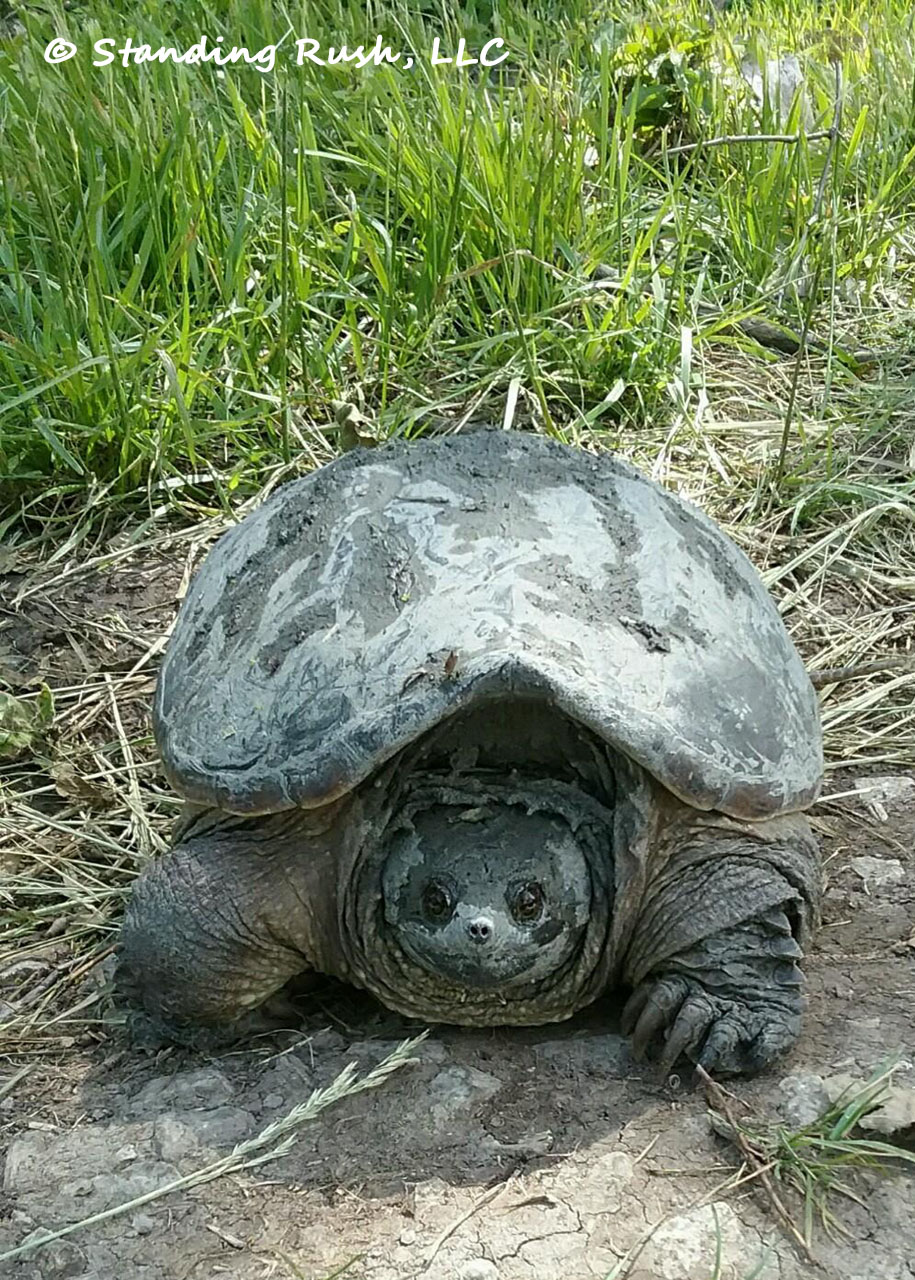
Julie caught this snapper up on the dike recently.
She was likely seeking high ground to lay eggs.
Another source of some of the smaller "potholes" that I encountered today likely came from still other digging mammals -- namely raccoons and opossums. Roy has seen this time and time again over his years in the marsh, but he has recently been pointing out these shallow depressions all over the tops of the dikes where clay had remained exposed (devoid of vegetation).

These locales are magnets for a broad diversity of nesting turtles like the snapper shown to the left. This is especially true on warm, rainy nights in the spring and early summer, when many turtles make their way out of nearby water, dig shallow holes, and lay several to several dozen round eggs that are then recovered with a few inches of soil to incubate (much like sea turtles).

Unfortunately, opossums and even more so raccoons are very wise to this behavior, so much so that coons are known to dig on fresh clay without any other visual or olfactory cue. They are unbelievably adept at raiding nests, and when you witness the quantity of destroyed sites, just on our property, it seems a miracle any single turtle prevails. But they do. And to a certain extent, this is just a natural part of nature's "checks and balances" system.

A raided turtle nest. Note dark hole right off the point of the burdock leaf and the small, broken shells to the upper left of the hole
(they look almost like dried white rose petals).

ASIDE: Ohio is home to 10-12 species of turtle (depending on interpretation of "wild" vs. "introduced") and as many as eight of them likely call our marsh home. We hope to focus on turtle monitoring over the balance of the summer to document as many as possible. Our #1 MOST WANTED is the Blanding's turtle -- hopefully more on them soon!


Bowfin: Built to Last

Bowfin (Amia calva) displaying spring/early summer spawning colors; the vibrant turquoise of a mature male
can be difficult to fully capture on camera, especially from above

A couple months back, I briefly introduced the bowfin, a truly prehistoric fish that is actually fairly common on our marsh and throughout the backwaters of the Western Basin of Lake Erie. Thanks to a GoPro camera, I captured some underwater footage of a decent-sized female which I shared on April 12 -- to much fanfare, I might add! I promised more information, so having just stumbled onto the photo above (somehow taken a few weeks ago already), I'm making good on my promise.

Incredibly, bowfins are the only remaining survivor of an otherwise extinct group of ancient fishes that first arose more than 150 million years ago. I'm amazed in doing just a little research at how much is available online in images and in writing about a species that seems very much overlooked in the field.

But I guess it kind of makes sense. While somewhat secretive and most active at night, these relics are anything but inconspicuous. Males are smaller than females, but I'm most accustom to seeing them both in excess of 4-5 pounds -- and on the marsh and in the adjacent estuary females routinely grow to 8-10 pounds or more. Male are easily identified by a distinctive, dark "eye" spot on their caudal/tail fin (a evolutionary distraction technique also seen in moths and butterflies), and their coloration can truly look like something rendered by a Sci-Fi artist or camo designer.

Other endearing nicknames for the bowfin include, but certainly are not limited to: dogfish, mudfish, grinnel, and my favorite
-- the swamp-muskie (photo courtesy of the Ohio Department of Natural Resources, Division of Wildlife)

Additionally, "swamp-muskies" have many characteristics in common with ancient fish. Like members of the gar family, they have a "primitive" skeleton (part bone, part cartilage) and a "double skull" (an inner layer of cartilage wrapped in bone). By contrast, modern and more recently evolved fish have skeletons made entirely of bone.

Bowfins also provide parental care for their young, an unusual characteristic in modern fish. They are nest builders and voracious nest protectors (guarding eggs and then their tightly schooled offspring longer than any other fish in North America -- often for several months).

Fingerlings and juveniles, like adults, are relentless predators with a hearty appetite. Their preferred forage seems to be crayfish and other crustaceans, but they have been proven to be opportunists -- taking down, invertebrates, leeches, frogs, snakes, small rodents, birds, other fish, and even their own. That said they are not thought to be overly detrimental to the "sport fish" commonly pursued with hook and line. (Although I have heard they can be tasty to eat themselves!)

One final evolutionary adaptation of note: when the oxygen level in waters become depleted, as often happens in warmer shallow water, bowfins will rise to the surface and gulp air into their swim bladder. This organ is uniquely lined (in the bowfin's case) with blood vessels and can serve as a primitive type of lung, aiding in survival until oxygen availability improves.

P.S. Bowfins (without question, a native species) are often mistaken for northern snakeheads (another ominous invasive species). If you encounter one or the other, please make sure you understand and appreciate the difference, so that bowfins can continue to thrive in our waters.

One of my goals for myself and the kids this summer is to net and photograph some of this year's hatch. I'd love to rear young bowfins in an aquarium for a bit. There is so much more to  learn about this amazing critter. If you want more info, the best article I've found thus far comes from a post doc who works at the Shedd Aquarium in Chicago: Adventures with Bowfin, North America’s Underdog(fish) -- great photos and it is truly worth the read.