Top Ten

The Mallard or "Greenhead" is perhaps the most identifiable duck, and it has served as the foundation for waterfowl
hunting for generations

Considering recent posts and repeated reference to teal and "big ducks," I thought it would make sense to provide some visual context. We've already seen more than twenty-five species of waterfowl (ducks, geese, swans) on the property, but those included here probably represent the ten most common duck species.

All but the teal (top right and middle right below) are what we would consider "big ducks." I am collecting a growing portfolio of reference photos, but for consistency, I created this page from stock images available through www.allaboutbirds.org, an incredible online tool produced by the Cornell Lab of Ornithology. If you like (or love) birds and are unfamiliar or haven't spent much time on this website, you need to get acquainted. It's a treasure trove of information.


Night Show

100-150 ducks making their way back into the food and refuge of the West Rest Pond just before sunset
(click to enlarge)

People will often ask, what is your favorite time of year in the marsh? That's a difficult question to answer, because I genuinely love all four seasons. Yes, even winter! In fact, I love all different times of day (and night) within each season. [Sure, I could do without high noon on the 100 degree days with 98% humidity without a hint of a breeze to ease the relentless mugginess . . . but this is <1% of the experience.]

This habitat is about as dynamic as it gets. I always tell people how difficult it is to give one tour of the property. How do you best convey something that is ever-changing and so full of life in a single day -- much less in a single window of an hour or two? The marsh is different today than it was yesterday; different this evening than it was this morning. All I can share is a snapshot in time.

But if I had to choose one single shutter capture, we might be getting close to when I'd choose to have my camera ready. As September transitions to October, day length shortens (always a bummer), but I rarely feel more alive. Low to mid-70s in the dry sunshine still feels warm -- even hot -- on the skin, but a touch of shade (even from a passing cloud), an otherwise inconsequential breeze, and/or a low sun in the sky all hint at the cold to come.

Beyond general comfort of classic autumn, I'm always inspired by the wildlife. Seasons -- particularly spring and fall -- are about transitions. And we see so many alive in the marsh. Each evening this time of year, just as the sun is loosing its punch for the day, we can sit back and enjoy what Roy likes to call the "night show" -- a daily routine in the fall (and to a certain extent, the spring) that has become increasingly awe-inspiring over these last few years on this property.

If you have a ticket for the "show," you should be in your seats (in our case right now, somewhere on a West dike) at least an hour before sunset. Plan on it lasting till dark, and be prepared to see birds -- lots of birds. I've experienced a good number of recent viewings while working and playing in the marsh. I'm struck that even a person like Roy (who has seen a heck of a lot of ducks in his lifetime) is compelled to be in attendance. The fact is, he -- and often his wife -- are apt to take in the show multiple times per week.

But again, its almost a spiritual experience. Seeing hundreds, sometimes thousands, of ducks of a variety of makes and models all somewhat predictably descending on the same specific area of land and water at the same time -- it's just special. My hope is that if you haven't already, you get the chance to experience it yourself.


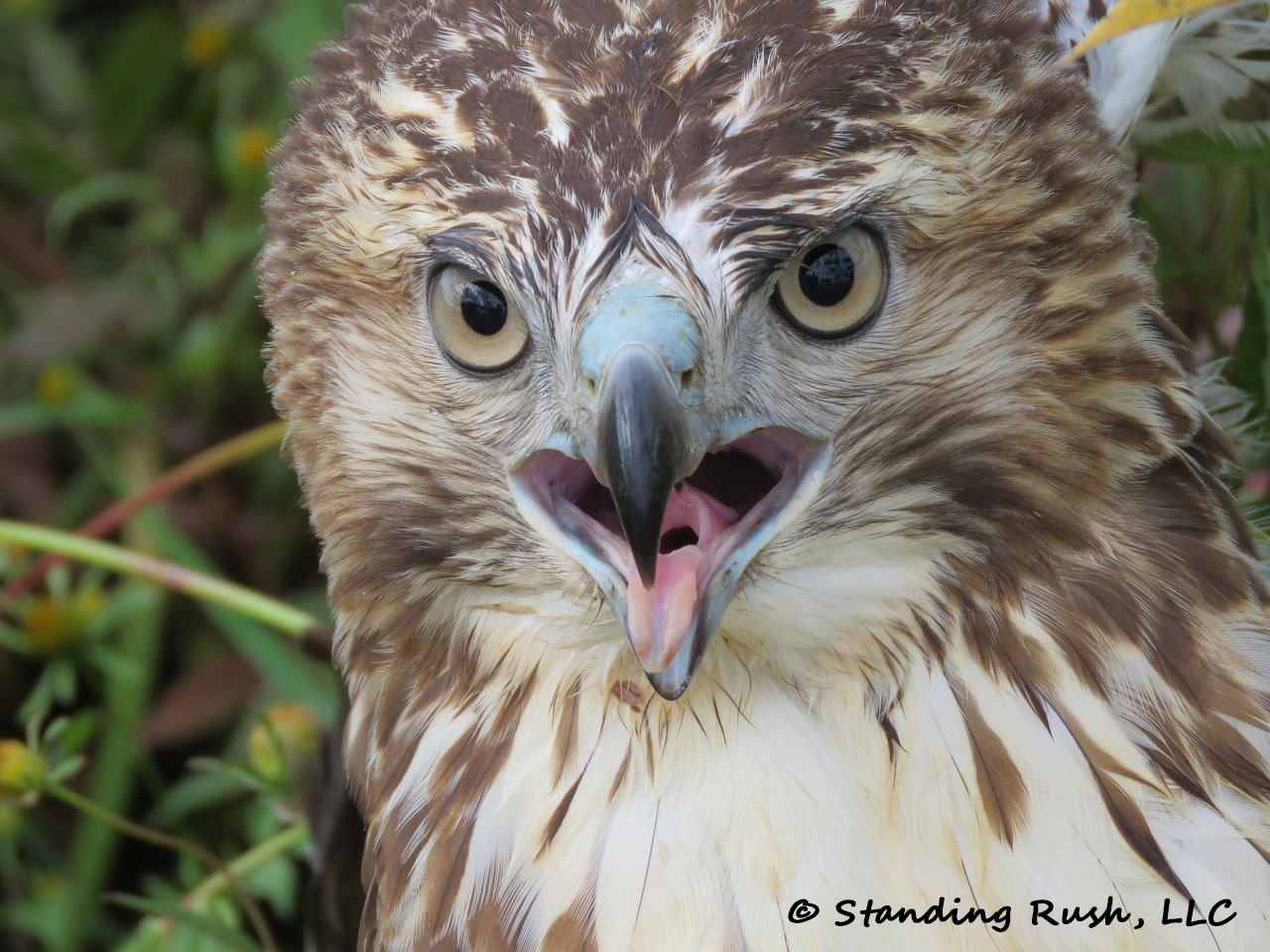
Close Encounter (Good Karma)

Another reminder of what a good purchase our Canon has proven to be
(click to enlarge to check out the detail; tongue is particularly striking)

Roy got up close and personal with a juvenile Red-tailed Hawk during a recent drive around the marsh. When I saw the photos that showed just how close, I thought it definitely warranted a share. 

The story started while Roy was checking on a pump. As he dropped a foot out of the truck, he noticed the nearby raptor struggling to gather a recent kill -- some type of a decent-sized snake. As the bird awkwardly lifted off the dike, prize "in hand," the snake slipped from its talons and fell into the nearby vegetation. Several quick attempts to right the ship (while simultaneously trying to rebound the juggled prize) resulted in the hawk on its back in a few feet of dense plant material . . . and in a few inches of water.

The thick mass of hibiscus, smartweed, and beggars tick may have provided a soft landing, but the young hawk
almost looked sheepish trying to regain its balance, its composure, and its meal

The plant growth was so dense that the bird literally couldn't get air under its wings; its posture suggests it was
feeling pretty threatened as Roy approached to try to help

Roy gave the hawk a couple minutes to find its footing. But with the snake now abandoned, the bird became more preoccupied with its own safety than its meal. Feeling bad that he disturbed an afternoon snack and that the hawk couldn't seem to get back on the wing, Roy gently extended the tines of a garden rake (protected by some rubber that he had just modified to slip over the end of the tool). The bird readily accepted the helping hand, and Roy was able to easily transfer the bird from the end of the rake to the end of a nearby cottonwood limb.

After another minute of sizing each other up at close range, Roy went back to his work. When he came back to check on his new friend a few minutes later, the hawk was gone. The bird may have lost some dignity, but the good news was (1) it seemed no worse for the wear, and (2) there are plenty more snakes in the marsh where that one came from!


Hunting in the Context of Conservation

This "punt gun" (photographed in July 1923), used in the United States to harvest ducks and geese into the 1920s, demonstrates how far conservation has come in the U.S. in 100 years
Photo courtesy of the Library of Congress

As we close out the first chapter of this year's waterfowl season on the marsh (teal season expired in Ohio tonight), I think it's worth dedicating a post to the general topic of hunting . . . and more pointedly, the topic of waterfowl hunting within the context of wetland conservation. [I'm taking a chance doing this late on a Sunday evening, as this is a topic that can quickly get controversial. Stick with me. I promise to add more of my personal commentary as the season progresses.]

At first blush, these two subjects -- hunting and conservation -- might seem diametrically opposed. Hunting undoubtedly serves as a flash point, conjuring debate relating to the ethical treatment of animals. "Why would you kill what you are trying to protect?" And while I would readily admit that there are those who pursue game merely as a sport with little regard for one's surroundings, there is a big distinction (in my mind, at least) between hunting and mere killing.

What began as a commercial pursuit to harvest food for the table
has evolved dramatically in the ~150 years since settlement in Ohio
Photo courtesy of York Museums Trust
In my mind, we owe the very existence to much of the wetland that remains on Lake Erie, the Great Lakes, and beyond to waterfowl hunting and waterfowl hunters. Like the native people before us, ducks and geese were first harvested on the Lake Erie shores (and elsewhere) based on a caloric need. That pursuit of course evolved with time, and in certain instances was reserved for those with a certain level of wealth and/or prestige.

Books can be and have been written about the history of waterfowling. But to me, at least as it relates to this specific project, the Bay View marshes would simply not exist if it were for the passion and dedication of specific individuals through the generations. And it is no coincidence that these individuals happen to all be duck hunting enthusiasts.

It all ties back to one of my favorite quotes of the modern environmental movement:

In the end we will conserve only what we love; we will love only what we understand; 
and we will understand only what we are taught. 
(Baba Dioum, 1968)

As I hope to portray in my writings here, duck hunting is much more than totting a shotgun into the cattails. It -- like most hunting pursuits -- is wrought with learning opportunities. It is experiential and often multi-generational. And when done with awareness and appreciation for all that surrounds the hunter, it can be conservation in the purest sense of the term.

One of last week's harvests
SIDE NOTE: Whether you choose to count yourself among the ranks as a waterfowler, you can support ducks, geese, and all related wetland conservation in Ohio by purchasing an Ohio Wetland Habitat Stamp each year. The $15 investment is a requirement for all duck hunters in the State, and coupled with the Federal Duck Stamp, helps duck hunters put some of their money where their mouth is.

POSTSCRIPT: Some of the punt guns like the ones shown here were known to harvest 75-100 birds in a single shot. Thankfully, techniques have become significantly more precise. We set property-specific rules for our hunters that are even more stringent than those established by our Federal and State governments. More on that later . . .

ONE FINAL POSTSCRIPT: Last Tuesday night, Roy and I enjoyed an impromptu teal hunt unlike any I've ever experienced. While humbled by dozens of passes at close range (for the first time in my life I went through an entire box of shells during one hunt!), I did manage to bag a handful of blue-wings.


Rest Pond Doing Its Job

Self-seeded millet in the foreground with desirable
perennials (dark green) dominating in the deeper water
I received one of those memorable messages on my phone on Friday. Roy let me know that he had just been out in the Rest Pond assessing how much flowering rush (a nasty invasive plant) we may have deal with out there. Back in June and July, we took several boat rides out for that same purpose, and the initial signs were ominous.

However, Roy's discovery late last week: what we thought were flowering rush starts a couple/few months ago (when only 4-10" long and largely submerged in a couple feet of water) proved to be almost all cattail. "I don't know what else to say other than this is as good as it gets.  I only found one plant of flowering rush . . . the amount of cattail & bulrush coming up through the millet and smartweed is outstanding. The millet is also putting out a second seed crop as the terminal heads get stripped."

The restoration of these 40 acres couldn't be coming much better. It comes down to a combination of planning, vision, existing site conditions, good fortune, favorable weather, and some dumb luck. We know a lot of it is out of our control, but especially when it progresses like it has here, we'll take it!


A 10 x 10' island of Walter's millet pioneering in the Rest Pond
It's extremely gratifying to see some predictability in nature's response. What is unfolding is really what we had hoped to see -- the residual seed from last year's millet crop has resulted in new plants this year that may dominate as much as 20 of the 40 acres; smartweed, another highly prized, seed-rich waterfowl forage, dominates maybe another 10 acres; and then the final 10 acres or so is transitioning to desirable perennial plants, most notably cattail and soft-stemmed bulrush. We are also starting to signs of other attractive plants like Walter's millet (right) and arrowhead interspersed within the annuals.


A punt boat "path" through smartweed on the west side of the Rest Pond; the transition to fall red means
flowers are evolving to edible seed -- this crop is every bit of 6' tall and should be a magnet for passing ducks and geese

While I didn't take any photos, I spent Sunday evening in the blind (#15) with my brother and nephew. It was another memorable night. The teal didn't cooperate, but I can honestly say I've never seen more wood ducks and mallards fly over my blind. We witnessed literally thousands of big ducks cascade into the evolving buffet between 5:00-8:00 PM and watched just as many pull out and fly south for the night -- with guts full of seed. The Rest Pond is doing its job.

I took this blurry image on my phone; click to enlarge to see what several hundred mallards look like
-- these were pushed out of the Rest Pond to the Tower Marsh late last week as we finished up seeding the dike
(it was the largest congregation I had seen on property this year; we saw multiple times more this past Sunday night) 


Keep the Teal Coming!

I'd estimate this flock at ~150 bluewings; it was part of a larger assemblage of maybe ~300 that have been
congregating this week in the millet that we seeded on the East Marsh 

If you've never seen teal fly, put it on your list. To me, it is a spiritual experience. All birds are fun to watch in flight if you really watch them, but these fast fliers take it to another level. Numbers have been building modestly over the last few days. But reports from the blinds this past weekend suggest we had enough to keep hunters alert and happy . . .

"I don't know if I can remember the last time we shot 14 teal in one morning from one blind."

"The teal were tons of fun, but I don't know if I've ever seen that many big ducks getting up from the Rest Pond at the same time." (A quote from a long-time lease holder just after opening morning)

We're a little anxious of cool-cold overnight lows forecast for the end of the week. While the Gulf Coast endorses a steady press from historic hurricanes, we have had incredible weather. Roy calls 75 degrees for a high and 55 for a low ideal -- especially if it is sustained. We have been hitting that about perfectly, but they are hinting at upper 40s for the weekend. Call them fare-weather, but historically, if the mercury dips below 50 degrees Fahrenheit, teal head south. We'll see . . .

These birds didn't know if they wanted to stay or go; fortunately for them, Roy was holding an I-phone and not a 12-gauge

I liked this crop because it literally gets my adrenaline pumping; so much fun to see them flying low over the marsh


Good Timing

Re-seeding of the main West Dike is complete; just in time for the rain

I wanted to post the image above just because it's a great testament to the importance of timing in this work (plus, I love the colors and the depth of the clouds in the sky). Roy convinced the Buehlers that they should come out this morning and seed the dike that they just stoned ahead of what forecasters are saying will be a steady and sustained rain that should last for the next day or so.

Until we heard from them this morning, they were planning to come out tomorrow (challenging the meteorologists' forecast). At the last minute, they called an audible in favor of today. Just as they pulled their dusty tractor back onto their trailer and got ready to head for home, the first rain drops hit my windshield. Ground is broken. Seed is in place. Fertilizer is in place. Hay is down. The forecast suggests good grass growing weather. Fingers crossed.

Wilson's Phalarope
I also just got word as to how the recent shorebird walk lead by the Black Swamp Bird Observatory went back on August 26th. About 15 birders from the Toledo Naturalists' Association spotted 59 species of birds (2,418 individuals) in just about 2.5 hours of walking around our East Marsh.

They recorded everything from American Bittern to Wilson's Phalarope (right), and just shared all the specific data with me. Again, timing was right. The mud was exposed and "fresh" from some recent light rains. So while diversity wasn't immense, they did record about 16 shorebird species. It seems fun was had by all.


Teal Opener with the Kids

Three people I always enjoy sharing company with;
we all laughed often and with plenty of birds in the air,
it didn't take a camera to make us smile
While last week ended just as it began from a work perspective, fast and furious, it seems only appropriate that I start this morning's entry with a quick recap of a quiet evening in the marsh -- our first duck hunt of the 2017 season. Opening day of the 15-day teal season was yesterday, and while I opted to defer to the lease holders for the morning hunt, one of my best buddies and I took my two oldest kids out for an evening in #15 (the name for a blind on the West Marsh; an artifact of a numbering system I'm honestly still trying to figure out).

Our son enjoyed time in the blind (and John's company) last season, but this was a first for our daughter. We had plenty of food, drinks, and bug spray packed just in case things went quiet after what was reported to be a pretty active morning of shooting. But as it turned out, we had plenty to watch in the sky and on the water.

Teal season is unique for a lot of reasons. The weather is often warm -- if not downright hot, especially when in waders. Sunrises and sunsets are still pushed relatively early and late. The marsh is still green, and the bugs are still active. And by law, hunters can effectively only shoot two species of ducks in Ohio -- the blue-winged teal and the even more pint-sized green-winged teal. (As an aside, Canada geese are also open for an early season.)

Teal are among my favorite birds. Not only do they fly like fighter jets -- often screaming through the sky in tight, fast formations -- but they are absolutely beautiful both on the wing and on the water. They are extremely tasty, too! Whether I have a shotgun in-hand or not though, they are an adrenaline rush in feathered form. I just love seeing them.

A photo is one of the only ways
to slow down a blue-wing
As it played out, John and I (the only hunters shouldering guns) only had three chances at teal, and one was a solo blue-wing that buzzed the decoys about three feet above the water. I only had time for one trailing shot and John didn't even see the bugger! We ended up empty handed in terms of a harvest, humbled by rusty shooting. But we must have seen several hundred "big ducks" (e.g. mallards, wood ducks, pintails, widgeon, gadwall, etc.) in addition to a few flocks of geese fly directly or nearly directly overhead.

The kids were all smiles. In addition to the ducks and geese, they enjoyed watching thousands of swallows feeding on the bug bonanza, chattering kingfishers and Caspian terns, and maybe a dozen trumpeter swans, as they all flew and fed unknowingly past the blind.

The morning hunters had fair to good success throughout the holiday weekend. My phone was filled with excited texts and photos from the field by noon each day. The recurring themes: a few teal around, lots of big ducks (by some accounts, more than have been seen in this marsh in a long time at this point in the year), and genuine excitement for how the marsh is looking. "The table is set."

Teal season is seen as a bonus or warm-up to the "real" duck hunting season for many. To me, it is an experience all its own. But I have to say, it gets the juices flowing for all that a full transition from summer to fall to winter can bring. Few things are better than autumn in the marsh!


Continued Busy

While this may seem like an unassuming image, it is significant; the stone protection of the newly rehabbed dike
on the West Marsh is now complete

I've hit a window of time when we have more projects going on, more stories to tell, than I have hours in the day to communicate them. Keeping up with a journal has always been tough for me when the summer days stretch late into the evening. But now, even with shorter day lengths, I just feel like I have too much to tell. It continues to be busy on the marsh.

Yesterday marked the official finish to the stone hauling project. We now have all 3,000 linear feet of the south-facing West Dike protected by newly placed limestone and another 500+ feet (probably more like 750') protected on the north side. This was another example of lots of work to get ready for a project, lots of anticipation and planning, and then boom -- the work is complete. We didn't see any way that the Buehler boys were going to knock this out (especially with just one or two trucks working) in under a week and finish before teal season -- which opens this Saturday! But finish they did . . . with room to spare. Over 100 truckloads of stone delivered and carefully placed in a matter of a few days.

Note marsh water (below pipe) is a good 30" below
the resting elevation of the bay level (foreground)
Beyond the relief of a newly protected asset, one of the most exciting aspects of the completed stone work is that we can start putting water back onto the West Marsh without concern of damage to the underlying clay dike. Today was the day.

Strategically, it made sense to keep water levels low to make placement of the limestone on the dike slopes easier and more accurate. With low water, we also benefited from a bit more time to germinate new plants.


But it is time to add some new life to the marsh once again. Roy and I pulled four stop logs from the West sluiceway yesterday afternoon, and the elevated bay water -- complete with fish and all the associated aquatic life -- started rushing in. The cool water will not only introduce new inhabitants, it will also make navigation by boat easier and further set the stage for the waterfowl that are making their way toward us as the fall migration gets underway.

Two side notes: (1) I took some fun photos and videos of the bay water as it began spilling into the Rest Pond yesterday. I just haven't had a chance to upload them. I'll try to soon. (2) Before releasing the water into the West Marsh, we made an attempt to re-flood the 100-acre Dinky Track on our east side. Things didn't go too well. An old screw gate not only wouldn't open, but it actually broke off the 24" supply pipe that we thought would be our conduit to the bay. We've done some head scratching, and we think we have a solution. We weren't looking for another project -- especially a few days before teal opener -- but such is life. Time to improvise. I'll do my best to explain that story as it unfolds . . .


Quite a Week

One of my favorite vantage points on the West Marsh; photo courtesy of Ellen Dziubek

It's been a bit of a whirlwind over the last week or so. In addition to some individual tours, we started the West Marsh dike stoning project, had our dinner with the West Marsh lease holders, hosted a shorebird walk in conjunction with the Toledo Naturalists Association and the Black Swamp Bird Observatory, removed a colossal duck blind that has been in the marsh for more than half a century, mowed accesses and stabilized boardwalks in preparation for the impending teal season, and closed on the sale of ~38-acres of our east marsh to the neighboring landowners . . . whew, what a week!

With the exception of this last one, I think I've spoken to most all of these endeavors, to some extent at least. But our selling our halves of the "North" and "Center" units of the East Marsh  -- a little over 38 acres in total -- was something we've kept pretty well quiet on until it was complete. We closed last Friday, and I think all involved are quite pleased with the outcome.

While I didn't know it at the time the photo was taken, I'm basically pointing to the area that we just sold to the neighbor;
photo courtesy of Ellen Dziubek

Green heron in the shallows
watching over dike project

The premise of selling this acreage back to the previous owners was first discussed months ago. Because an artificial property line cut two management units in half, north to south, our primary goal was to reunite the two areas. Because they weren't interested in selling, we approached them about buying.

The transaction was complicated by the need for a legal parcel split and some dedicated surveying. But in the end, the property lines make much more logical sense, and both parties seem to be very happy. I know for our part it's a relief to have this situation rectified.

Nate (our intern from this past summer who is just recently back to school) is among a small group of family members who just made the purchase. So I should take this opportunity to thank him for his efforts with Standing Rush, wish him good luck in the coming academic year, and voice my excitement for what has become a really positive relationship as neighbors. Thank you for all the effort these last few months, and here's to more great things moving forward together!

Another great photo courtesy of Ellen Dziubek -- this one from the dike that as of this afternoon is almost completely
protected from southerly winds and wave action; we hope to have the dike stone project completed in the next day or two


The End of an Era: Removing Old #16

Photos don't do this project justice; these two boatloads were supposed to be the "easy part" of removing this blind --
turns out you can get a fair amount of accumulation over 50 years+, even if you bring the lumber out "a couple 2x4's at a time"

I love days like yesterday. Action packed. It was the first day of school for our kids, so we were up and at 'em early. After an initial explosion of activity, the house was unusually quiet by 7:20, so I was able to gather my things and get out the door myself. Thanks to the luxury of a smart phone, I got a lot accomplished in the first half of the morning by phone and my email while checking things off my list around the bunkhouse. But with refreshing winds out of the north and afternoon temps projected to struggle to hit the 70s again, it was an ideal day for some heavy lifting. So during the late morning and afternoon, Roy and I finished up what has been a 3-day project that we spaced over maybe three weeks. And truth be told, it probably should have been done three years ago: we removed "Old #16."

Time took its toll
Scale is tough in photos like these, but this duck "blind" had grown to the point that it was hardly blinding -- or if it was, it was blinding in the wrong sense of the word. By the time we took a destructive hammer to it, the accumulation looked more like an air craft carrier. Lots of history and lots of stories reside in these hallowed grounds though. I've heard various reports about when hunting got started in this island of what is now cattails. One account puts it back 75 years or more. Another suggests that "major construction" on the "grass blind" didn't happen until the 60s sometime.

But suffice it to say, a lot of sunrises have been witnessed, a lot of coffee (etc.) has been consumed, a lot of ducks have been harvested (or at least scared), a lot of unique and memorable conversations have taken place, and a lot of laughter has been shared from this vantage point. I don't take that casually. In fact, I love the history.

Just like the removal of the blind -- and somehow, appropriately -- yesterday also marked another event probably long-overdue: Roy and I got to meet the entire group of ten lease holders who have been "renting" the West Marsh from us since the '15 waterfowl season. We obviously met a few of the guys early on, and they have been great ambassadors, but it was really great for us to put faces with all the names.

While there is one newcomer, all of these guys have a few critical things in common: (1) a common conservation ethic and respect for the environment where they pursue their passions, (2) a shared love for duck hunting, (3) direct or indirect ties to hunting in Bay View [some of these guys have hunted with their grandfathers, fathers, sons, and grandsons on this property], and (4) roots that tie them to Cleveland and for most, Beaver Creek Hunt Club (a private sportsman's playground between Vermilion and Lorain, OH).

The motley crew; the only two missing were a couple of the punters (one of whom had to split just before we took this photo); Roy and I really enjoyed the conversation, the meal, the hospitality, and the genuine interest in helping to make the marsh better
Beaver Creek was the site of last evening's dinner gathering. After informal introductions and a 3,000 calorie steak dinner, we enjoyed swapping stories, shared updates regarding progress on the marsh, and got the juices flowing in anticipation for a waterfowl season that starts in just eight short days. There are a handful of "post-worthy" topics from last evening alone, but they will come out in time -- especially as the duck season gets underway. I rolled into my driveway about 11:30 last night, admittedly tired from a full day. But I can honestly say it was one of my highlights of this adventure thus far. We gotta good thing going; we just gotta keep the momentum rolling in the right direction.

Believe it or not, there is a jon boat under this pile -- one of five loads of lumber that we removed from Old #16;
we did salvage a handful of side boards from the blind itself, the unbelievably weathered oak benches, and a few other odds and ends;
some will be distributed to the guys who show interest, and others will be kept as part of a growing time capsule for the property


Protecting an Asset -- Bringing Stone to the New Dike

Buehler Excavating (Oak Harbor, OH) getting underway on our newest project; they are a preferred contractor for us --
not only are they a pleasure to work with, they are masters of all things marsh management-related

After a year of planning, another important project got underway yesterday. Phase II of the West Dike rehabilitation/reconstruction project comes down to protecting the asset that was rebuilt last summer. Essentially, we are laying down an 8'-wide, 1'-thick band of crushed limestone along the entire 3,000 linear foot south-facing slope of the new dike to protect the underlying clay from the erosional forces of wind and waves.

If everything goes just right and we can stay on budget, we will also protect 500 linear feet of the most vulnerable north-facing slope. We are less concerned about this side of the dike though because there is a much lower probability of water being held high on the dike from this side, particularly without a good amount of vegetation to break up the momentum of wind/waves (as compared to what can become large expanses of open water to the south).

Always dangerous to use a size 15 work boot for scale;
this stone is classified as D-rock by ODOT and ranges from
grapefruits to footballs in size
While this project isn't glamorous, it is crucial to extending both our near-term and long-term water management capabilities. It will allow us to maintain higher water levels over the southern ~145-acres of marsh, particularly at strategic times of the year. This has a direct impact on our ability to hamper the spread of invasive species like Phramites and purple loosestrife. It also allows us to promote habitats that enhance the attractiveness of the unit for targeted wildlife (could be fish, could be birds, etc.).

We now anticipate this project investment to be at or very close to $50,000 -- a bit more than we anticipated when we were budgeting last winter, but a fair price considering the current cost of locally quarried stone. We took a hard look at recycled materials (clean, crushed concrete), but in the end, local supply was limited (to meet the required spec), cost savings weren't a certainty, and the finished product with virgin rock is easier to control. At this total project price, we wouldn't have been able to do this work without an infusion of outside funds. For the second year in a row, the Ohio Department of Natural Resources, Division of Wildlife's Private Lands Management program stepped up in a major way. They will end up covering somewhere around 60% of the overall project cost in exchange for our guarantee that the habitat will remain marsh for at least 15 years. Good news for everyone is: we plan to keep it that way a heck of a lot longer!

While Roy keeps this plate spinning, I am working on some other important strategic steps, most notably (1) the pending sale of ~38 acres on our east side to a neighbor (more on this soon, I hope) and, (2) a conservation easement application that we have been working on with the USDA for almost two years (again, I hope to have more detail to share on this in the weeks to come). On top of these major areas of focus, we have a duck season opening a week from Saturday. I'll start to give that topic some attention starting tomorrow.

Progress -- we figure they got close to 1,100 linear feet of the south slope protected in about a 1.5 days on the job;
if all goes well with equipment, weather, etc., they will be finished and on their way by mid-next week
(in time to give the marsh a couple days rest ahead of the teal opener)

Speaking of Visitors . . . More Tours, More Fun

Independent of weather, I literally always enjoy driving the dikes in the Mule; but when it's 74º F with low humidity and a breeze off the Bay . . . well in my world, it's hard to get much better

An unusually moderate August with afternoon highs in the 80s (or even 70s) rather than 90s with lower than typical humidity have lead to some good touring conditions. A handful of my older nieces were nice enough to make the trek out almost two weeks ago. Where does the time go? . . .  I'm just catching up with the photos.

The weather was ideal, and we had a really nice morning together. True to form, my niece Ellen is always behind the camera, so she isn't pictured. But I'm planning to share some of her really solid photos from our outing in a subsequent post. I've watermarked the photos above and below as ours, but truth be told, she should be credited. Thanks, El! And thanks again to all of you guys for spending a morning on the marsh!

Four of my oldest nieces taking in some of the finer points of marsh management; they really asked some good questions over the few hours we spent together -- raised right! (not that I'm biased)

We took advantage of more perfect late summer weather this past weekend, and finally checked off a "bucket list" bullet of our own (see previous post). Jenny and I were excited to host our neighbors and great friends for a driving/walking tour and maybe more importantly (for our respective 9-year olds) frog hunt. Our Anderson has been wanting to get his best friend out to the property for . . . well, since we took possession of it. With ten kids between the two families, timing has been a challenge to say the least. But we finally made it . . . with seven of the ten kids, at least!

The 4-wheeler got a workout at times, but the kids ended up really having fun chasing leopard frogs in the tall grass of the dike fringes. Sometimes the little guys marched ahead and other times they lagged behind, but either way, their hand nets were busy chasing leapers and fliers.

I always wish we could find a way to bug these conversations; it would be so fun to know what is being said between the distraction of a jumping frog, slithering snake, or buzzing dragonfly
Success can come in small packages

Eagles and waders were characteristically plentiful during our drive. Blackbird numbers continue to build. We got good looks at a handful of trumpeter swans and probably flushed 100-150 ducks (by far the most I've seen since spring). Most were in last year's millet to begin with, but we had fun watching them bounce back and forth between the Rest Pond and the main West Marsh. I would say 75% were wood ducks and most of the rest were mallards. I did see a few small groups (6-10) of green-winged teal. The fall migration is coming! More on that soon.

Sunday's stop at the marsh was bookended by a dip in Lake Erie (at the beach at East Harbor State Park) and dinner on Cold Creek. The kids slept well that night. The adults are still recovering. Fun stuff.


Not Just Mentors, Salt of the Earth Good Folks

Ready for a tour with my aunt and uncle; call it a "bucket list" day for all of us!

A week ago this morning, I had the unique privilege to spend the better part of an entire day with a couple that I've admired all my life. My Uncle Dick and Aunt Fran raised their six children on the east side of a shared side yard. Their home is just down the bank of "Cat's Ass Lake" -- on the family farm where my parents built a home and raised the eight of us. This is the setting where my awareness of and passion for the outdoors first germinated. Deep roots were set there to support a lifetime of love for the natural world.

Adjectives like hardworking, passionate, focused, dedicated, tireless, philanthropic, and community-minded are all part of Dick and Fran's public identities . . . as individuals, as a couple, as parents, and as leaders in northwest Ohio and beyond. I can certainly vouch for all of these descriptors as accurate. But I might also add words like: humble, earthy, humorous, genuine, loving, and authentic. Bottom line: these are solid folks, and I've always felt honored to be in their presence.

I worked for and more importantly with my Uncle Dick through high school and into the first couple years of college, when I transitioned into seasonal work for the family business that he was leading as CEO. We poured building foundations, fenced pasture, shingled roofs, installed irrigation lines, rebuilt docks, stoned patios, planted countless trees and plants . . . the list goes on and on -- and this was all on their property and/or the family farm. It was all designed and orchestrated by my uncle. He showed me how. And we did it shoulder to shoulder, whenever he could be available.

Here I am on our beach at about age 7 with my brother;
I'm holding a bass that Uncle Dick stocked into our lake
(and that I probably caught a dozen times)
I obviously have learned a tremendous amount from Uncle Dick. And as I've gotten older, I've come to realize that while our interactions were of course different, I've learned plenty from my aunt as well. (She did introduce me to my wife, after all!) It's for this reason that I will truly cherish the opportunity I had last week. At no other time in my life have I had such dedicated time (without a nail apron at least). I picked them up at their home at 8:00AM, sharp (punctuality was a lesson), enjoyed an hour of drive time introducing our project, toured them around both the East and West marshes -- dodging lingering raindrops on the east side in my truck only to have the temperature moderate and the day evolve into a pleasant driving tour on the Mule on the West. They then treated me to lunch (of course) before we headed for home. The simple and easy conversation of the drive back (while Aunt Fran snuck in a few short naps in the back seat) was another highlight.

In the end, Uncle Dick and Aunt Fran were characteristically engaged and enthusiastic. On top of all Dick's lifetime of accomplishments, he and his brothers spent more than their fair share of time in a duck blind. He appreciated the tour with that context, but I think both of them enjoyed it for the wildlife, beauty, peacefulness, and overall breadth of our mission. Now flirting with his late 80s, Uncle Dick joked with me that visiting Standing Rush "someday" had become something that he put on his "bucket list." For me, having the two of them to myself for the day -- to show some of the results of their lessons being lived out through my work -- was just as satisfying.

P.S. I hope to add additional images from our tour at some point. They took some additional photos with their camera, but I was apparently too busy tour guiding! Appropriately, I think they marked the 299th and 300th visitor (family, friend, restoration partner, hunter, interested party) whom we've toured over the last 2.5 years. These numbers may be off by a few. I wasn't keeping good records early on. I have to commit to keeping a guest book. As with visits like the one above, it will be fun to look back.


What a Difference a Rain Makes: The Dinky Track

The view looking south from the center of the 100-acre Dinky Track earlier this week

Barring a catastrophic dike failure (which we thankfully did not and should not experience), the thought that a single rain could cause flood damage to a wetland might sound strange. But the last line of my July 16, 2017 post (the day we flew seed over 50 acres of the Dinky Track) was pretty prophetic . . . to continue the biblical theme . . . "P.S. Thunderstorms are in the forecast again for this afternoon."

Just a few short hours after the seed rained down out of that plane, the actual rain came down. And it came down in big drops, close together. The thunderstorm was sustained and within a few short hours more than 2" of water fell. Usually, this wouldn't cause major problems with a millet seeding when water can be taken off a unit. But because we were just on the jagged edge of "dry" enough and because we couldn't get it dry quickly enough (in part due to extremely soft sediment holding moisture), we've now come to discover that much of the seed rotted. The landing strip of relatively bare mud above is a testament to too much water at just the wrong time.

Per usual in marsh management, one has to take some
bad (e.g. Swamp Loosestrife, above) with the good;
such is life in a world riddled by invasive species
But as is so often the case in nature, there is a silver lining. We had a hunch that the Dinky would respond differently to a late drawdown as compared to the adjacent Tower Marsh. That's why we flew millet onto 50% of the Dinky versus more like 15% of the Tower. What we didn't anticipate is that both units would show positive responses from the seedbed (the seeds naturally residing in the shallow soil).

Based on our hike earlier this week, the Dinky has much of the same nut sedge that we are observing next door (a good thing). Where the millet is lacking, we are also seeing other good pushes of smartweed and beggerstick (more good news). There are also some hints at some desirable perennials -- most notably soft-stem bulrush (again, a good thing).

We knew we were going to be dealing with some invasive loosestrife, both purple (below) and swamp (left, and in isolated stalks to the right above). As we discussed from early on, the purple is largely being held in check by a friendly beetle. There are a couple initially daunting stands in the Dinky now, but as the photo below illustrates well, the beetles are doing their jobs. And as for the swamp loosestrife, they are really only prevalent on the very tops of old, rotting root clumps (on "high ground" islands no more than 18"x 18"). We are scratching our heads a bit as to the best management approach with these buggers (no, the beetles have no appetite for swamp loosestrife), but the good news is, they don't tend to spread overly quickly, and they are really only sporadically present in most of the unit.

A fairly sizable (~1 acre) stand of purple loosestrife trying to establish within Phragmites that was sprayed in 2015;
note browning and highly stressed plants in middle of frame (being attacked by the Galerucella beetle) and the
bright-colored plants behind -- in the cue to be consumed/killed

Bidens, or beggersticks, can be a bit of a nuisance when wearing fleece or neoprene (seeds stick to everything) --
but the ducks happily feed on them come fall, so we welcome their presence in the natural succession plan

Roy estimates he saw as many as 1,000 shorebirds (big numbers but not huge diversity) earlier this week;
rain in today's forecast might make Friday's viewing worth breaking out the field guide and camera -- to be continued
I could go on and on cataloging the plants we are seeing now and the various outcomes that could evolve. But as Roy keeps saying, "This is a one week at a time proposition." We watch the weather, watch the response, and adapt accordingly.