Showing posts sorted by relevance for query tower woods. Sort by date Show all posts

Monday, April 10, 2017

Step 1 of a Woodland Restoration, continued . . .

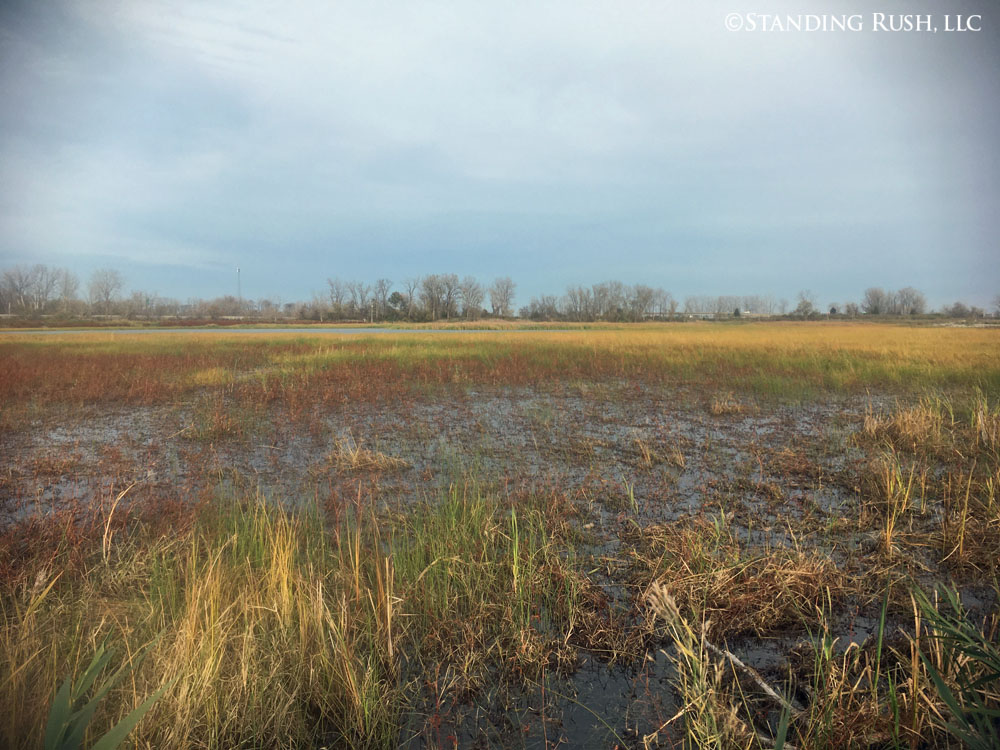
Dead ash trees dominate what is left of the canopy of our 5.7-acre "Tower Woods" -- June 2015.
The Tower Woods following bush honey suckle and dead ash removal, prepped for reforestation -- April 2017.


It is already painfully obvious that it will be challenging to stay disciplined about posting regularly (much less daily) as the days get longer and the temperatures rise. The last few days brought 60s and 70s -- with today flirting with 80 degrees for the first time this year . . . a far cry from the upper 30s and snow of late last week. Good weather will tempt me away from the keyboard, but I'll do my best to keep journaling . . . 

Today was a noteworthy day in that we were visited by the Ohio DNR, Division of Forestry. The state forester came this morning to inspect the "site prep" portion of our the reforestation contract that we have entered into with the USDA. (More detail: 3/21/17) As you can see from the side-by-side from the sky, the "before" and "after" comparison is visually pretty striking.

The bottom photo depicts what remains of the woodlot after nearly two weeks of careful site preparation. An excavator with a surprisingly dexterous grabber attachment worked in conjunction with a dozer and track skidloader to minimize impacts on the surface soil while uprooting and removing invasive bush honeysuckle, dead ash trees (by far the dominant canopy tree), and any other less desirable woody species. What remains are just 50-60 solitary trees, mostly locusts and hackberries (with a few cottonwoods, oak, maples, and elms mixed in for good measure).

The state forester said he really could not have asked for a better job, so we got the green light to move to Phase II -- which will essentially be babysitting the understory to selectively remove any remnants of the invasive honeysuckle that try to rebound from this initial effort. Roy will serve as our regular watchdog. We have been given various suggestions for next steps based on how the weather plays out this spring/summer and how the site responds. It should be very interesting.

If all goes as planned, we will be ordering 1,100 trees from a Michigan grower in August or September. Each seedling will be a native hardwood (oak, black walnut, cherry, and sycamore), and each will be 2-4' tall when it is planted next spring (likely April 2018). 

While the local rumor mill in and around Bay View has many people convinced that we're prepping the site for houses our condos, those who hear we are planting more trees are all smiles. So are we.


Saturday, October 21, 2017

Treework, Field Mowing & Indian Summer

At about the size of a dime, this Eastern Tailed Blue is the smallest
and most common blue butterfly found in Ohio -- it had me on the move trying
to capture its exquisite detail on another Indian Summer afternoon

The days are definitely getting shorter -- and fast -- but with nearly an entire week with afternoon highs in the seventies, it's truly hard to believe that November is right around the corner. I spent most of my last day at the marsh (last Thursday) sweating through a couple t-shirts. It hardly felt like the second half of October . . .

Roy and I spent the majority of that day clearing "debris" in preparation for a "field mow." I put both terms in quotations because the "field" is actually the ~six-acre former woodlot that we concentrated on back in the spring. [You can read about our initial efforts through some of my earlier posts: Step 1 of a Woodlot Restoration and Step 1 of a Woodland Restoration, continued . . .]

And the "debris" is a broad term -- it consisted mostly of smaller chunks of wood (mainly pieces of trunks, stumps, and roots). But it also included (1) a few newly fallen trees (four of the ~65 large specimens that we salvaged that didn't quite make it through the season's winds) and (2) dozens of thick necks of wine bottles cast into the thick understory years ago. This jagged green glassware has a story worth retelling (probably best for its own post), but suffice it to say the sharpened ends would make fast work of an unsuspecting tractor tire sidewall. So they had to be picked up before Roy could get going on the mower.

BEFORE: The "Tower Woods" restoration site just after noon on Thursday -- a complete hodgepodge of annuals
(mostly ag weeds) has taken over much of the understory since the removal of invasive bush honeysuckle and dead ash
trees last March; after a few hours on foot, things were picked up just enough that Roy could get underway with the mower

AFTER: The Tower Woods from a similar vantage point just before 5:00 Thursday afternoon;
what a difference a few hours makes with a brush hog mower and chainsaw!

Between bouncing around on the tractor (Roy) and lugging a chainsaw and downed limbs (me), both of us were pretty well ready to tag out by late in the afternoon. We probably have another 6-8 hours of tag-teaming left to ready the site for the transition to winter -- and eventually spring . . . when we will be planting 1,100 new tree seedlings on the site. Now that we know we can handle it with a tractor/mower, our management options expand for weed management after tree planting. It's going to be a lot of work, and (unlike marsh management) a lot of time. But eventually, we look forward to a new crop of woody habitat to infill among the towering canopy of hackberry, locust, maple, and other tree survivors.

I'll end this post the way I started: with a cool insect -- this Autumn Meadowhawk (see p. 61) is a classic
holdout for the late season bliss of Indian Summer
Sunny sumac leaves were lousy with these little predators (I watched them zero in on a handful of mosquitoes and midges
while I changed out of my work boots); but just because there were lots of them, it doesn't mean they were easy to
capture in a clear frame!

This particular male was the most cooperative, but I still wish I could have better captured the brilliance of his
red coloration -- autumn just seems to know how to bring out the reds!


Monday, November 30, 2020

November 2020: Not Time for the Parka Just Yet

 Here's a taste of late autumn from Standing Rush:

Rest Pond progression, continued . . .
It is truly amazing to compare this image to those taken in spring & summer, just a few, short months ago -- a naturally-occurring waterfowl buffet, but also refuge to countless species of insects, amphibians, fish, reptiles, and birds (of the non-fowl persuasion) . . . just to name a few.


While much of our attention on this website focuses on happenings "inside" the marsh, it is worth noting that water levels have been trending downward on the broader lake and bay over recent months (hard not to, considering the levels we reached over the last couple/few years). Projections -- shaky as they always are -- tentatively show this trend continuing. 

This image shows a particularly low snapshot during a significant SW blow (remember: lots of water can temporarily blow out of Sandusky Bay based on wind direction). It is striking to see the dead and tattered remnants of what was essentially a wooded barrier island just off-shore when we took possession of the property in 2015.What a difference 24-36" of water makes.


Roy was eager to show me progress in the Tower Woods at the backend of a full day at the marsh. I hadn't personally been hands-on with this tree planting in over a year, and it was amazing to see (1) the high percentage of trees of all species that are surviving, and (2) how much they have grown since they were put in the ground as 10-20" seedlings three growing seasons ago. 

Roy proudly attending to a thriving oak (above)
and sycamore (below).


Also worth showing growth of the "Bunkhouse Trees"
-- all are looking good!

NEWS FLASH: The USACE permit application that we worked so hard on over the summer was issued this month -- a big victory; we hope it can pave the way to lots of great things on Standing Rush's East Marsh.

"Ruger" (one of our punter's labs) wanted to point out that duck hunting continued and based on birds in the air, it remained worth keeping poised and ready to shoot -- and retrieve!


Tuesday, June 27, 2017

Formal Photodocumentation

What's cooler than capturing this level of detail of a white water lily in bloom from 25 yards?
Realizing after the fact that a fly had a much closer view!
I spent much of the day today tackling a task that I've said I would do for over two years now: I established "permanent" photo locations via 4' oak stakes strategically placed in nineteen locations around the East Marsh. I then labeled each according to a newly created reference map and took a series of photos from each location. The ~55 photos will be printed and assembled in a 3-ring binder for reference so that photos from the exact same location and vantage point can be collected on a regular (e.g. monthly basis). Tomorrow, I will turn my attention to the West Marsh.

We have been informally following this procedure since day one. But the advantage of a more rigid system like this is that we really can visually depict landscape-scale changes through time -- both in the short-term (month-to-month) and over multiple years.

A neighboring lily from a different perspective;
note the detail in the reflection that somehow can't even
be seen in the bloom itself
The photos I took today can largely serve as the baseline for the "before" photos on the East Marsh. While there are certainly areas that have changed dramatically since we took possession of the property in early 2015 (e.g. the Tower Woods and the recently drawn-down Central Unit), much of the east side of the property has been comparably hands-off until now. Our efforts during the 2016 field season were focused largely on the West Marsh. But with Pumpzilla (our recently acquired diesel pump) tagteaming with our stationary pump for more than a week now, water levels are hitting critical new lows, and we should hopefully be able to start a new chapter of active management by the end of this week.

If everything keeps pumping for another 24-36 hours and the weather cooperates (two big "ifs"), we should achieve our primary objective of introducing Japanese millet to as much as 80 acres of newly exposed mudflat. We have 30 complete (Central Unit) and if all the stars stay aligned, we'll have 50 more flown in on Thursday morning.

While Nate and Roy continued to tend to the pumps, I not only established our photodocumentation methodology, I also took the liberty to take in the wildlife. Here's a sampling of what I saw -- through the camera, at least.

Ducklings, like these 2-3 week-old wood ducks, are a fairly common site, but they are skittish and quick,
typically making them difficult to photograph

This critter -- the double-crested cormorant -- probably deserves its own post. But for now, I'll just include it visually. While extremely common in the region and around the marsh, these water birds have also proven to be pretty camera shy. I was pleased to be able to capture this adult (left) and juvenile (right) preening on two clumps of dead loosestrife.

By contrast, this muskrat was uncharacteristically happy to pose for me in the afternoon sunshine;
he almost looked sheepish though, like he knew I didn't approve of him eating so close to the dike
This mature baldy was keeping a pretty watchful eye on me from a dead willow that almost always seems to serve as a perch for eagles;
he did let me get surprisingly close and even capture some cool video of his feathers dancing in the breeze


Wednesday, May 9, 2018

A Month of Milestones

When one wooden stake represents one new hardwood seedling, one starts to appreciate what 1,100 new seedlings
looks like -- that's a lot of trees! Here is the Tower woods, about half planted (4/25/18)

The last four weeks represent the most physically demanding month in my history with this property. I have not completed a publishable entry here since April 12th. Coincidentally, it was two days earlier (on April 10) that the first shipment of bareroot tree seedlings arrived (unexpectedly early) at our doorstep. It has been a full-court press ever since to work around heavy rains and periods of above-average temperatures to effectively get them in the ground.

So technically, I don't have any one excuse for not keeping current with blog entries -- I have 1,100 of them! But I am happy to report that as of about 4:30 pm yesterday, the entire 5.7-acre site is planted. Now the focus will shift to protecting the vulnerable seedlings (from animal browse, drought, competition/smothering by surrounding weeds, etc.). But more on all that in a pending entry.

While we won't have much time to revel in our success, we did recognize the accomplishment last evening around the dinner table. Jenny, the kids, and I celebrated the milestone as any family of little ones would -- with dessert. I didn't have the energy to make a run out for ice cream, so a raid of the Girl Scout cookie cabinet had to suffice. Once again, I slept hard last night.
_______________
Much has happened in and around these tree getting in the ground. So at the risk of giving away punch lines, I've decided that I'm going to try to circle back and write entries for some key happenings over the last four weeks. I can't promise I'll have them online immediately, but my goal is to write a handful of posts to continue to recognize milestones and progress.

Progress on a project like this is kind of like tree planting: one at a time.

More to come soon . . .

Tuesday, March 31, 2020

March 2020: Life Marches On

Management and wildlife highlights this month included the following:


Due to the solitary nature of the research, Bowling Green State University was able to continue its multi-year investigation into northern pike reproduction and the top predator's dependency on coastal wetlands as critical spawning habitat.

The 40-acre Rest Pond was intentionally drawn down over several pumping events to move relatively warm marsh water from within the wetland into the (comparably cold) adjacent bay to coincide with ice-out. Bay water was then allowed to flow freely back into the marsh, inundating desirable spawning habitat (note deep water canal above and emergent vegetation below). This carefully timed water movement through Standing Rush's "fish-friendly" Structure 1 was intended to encourage pike passage into the marsh just as they and their future offspring would benefit from its refuge.

A Fyke net (aka fish trap) set by BGSU researcher Nate Stott just inside Standing Rush's West Marsh (see black framed structure highlighted by the red arrow in the left channel of the Rest Pond).

Two male northern pike trapped in the estuary off of Sandusky Bay immediately adjacent to Standing Rush's Structure 1.

A major goal of this year's research is to fit individual adult northern pike with small radio transmitters that can be harmlessly inserted into the abdomen to track future movements in and around the wetland, the bay, and broader Lake Erie over the next 2-3 years.


A true sign of spring -- one of three nesting pairs of "our eagles" -- birds that have set up residence on or immediately adjacent to Standing Rush.

How many bald eagles can you count in one willow tree? Many of these birds are juveniles, likely offspring of "our eagles."


Trail camera images retrieved late this month demonstrate why I may not have seen many deer the couple times I got in the stand this past season.

Our inability to secure a trapper this spring (due to the pandemic) has direct consequences in the marsh. The badly injured muskrat immediately above -- aside a healthy specimen for comparison -- shows the outcome of finite food and space availability, especially during the spring breeding season. It is not unusual for muskrats to battle to the death as populations grow and competition for mates escalates.

Beaver activity just north of our Tower Woods -- while SO COOL to see on one hand, a bit ominous on the other; these water-loving structural engineers are persistent and can be very destructive!


Thursday, April 27, 2017

Tails & Scales

What I believe to be a Butler's gartersnake
Yet another sign of spring . . . At about 15" long and perfectly camouflaged to blend with the newly exposed ground in our "Tower Woods," this little relative of Ohio's most common snake (the Eastern gartersnake) was taking advantage of plenty of sunshine and temperatures in the low 80s, earlier this week.

Now that the dead canopy is totally removed (see April 10th post), we were literally on our hands and knees trying to identify the first starts of new, green growth when this bugger slithered into view. Roy had to point him out, and he was literally right under my nose! It's the first snake I've seen at (very) close range this spring, but there is no doubt that these legless reptiles have been waking up more and more over the last several weeks.

Watersnakes are becoming a common sight, particularly on sun-heated rocks along shorelines or in low-hanging limbs over or near water. It's not unusual this time of year to see literally dozens of the Common watersnake sharing a sun-bleached willow. They are often Medusa-like in their propensity to get intertwined. I need to do some homework, but I speculate that this behavior is tied not only to elevating body temperature, but also to breeding.

Midland painted turtle
Painted turtles are also getting to be a common sight on downed logs and on small, remnant wooden duck hunting paraphernalia from years gone by. Unfortunately, I'm also seeing fair numbers on roadways that surround the marsh. I actually plucked the young adult to the right from the center line of SR 269 while driving in our UTV. I'm always struck with their beauty -- particularly at close range -- and by the fact that because they are likely the most common turtle in the state, they are so often under-appreciated. While we certainly will be on the lookout for some of their less common relatives, a paint's colors and patterns really are striking.

Mystery serpent
Keeping on the topic of reptiles, I really liked the almost abstract still-life that Roy captured on a wave-weathered piece of driftwood. Can you identify him (or her) without seeing a head or a tail? I'll let this image serve as a teaser to another snake post I plan to include very soon. For now, I'll just say we have gotten a positive ID on a species we've been keeping a keen eye out for . . .