West Marsh Water Conveyance: Project Update #1 (Site Prep)

The first sign of activity: the first dump truck arrives at the project site

About a year ago, I introduced a project that would evolve to become our top priority for the 2018 construction season. All of our other management priorities had to be maintained, but this project quickly became our fundamental goal for this year's management season.

At long last, the replacement of our aging infrastructure that connects the marsh to Sandusky Bay is finally underway! It's been a very busy couple weeks -- and I've spared readers of a lot of the months-long backstory in navigating the administrative and contractual hurdles that got us to "Mobilization Day" -- but we're finally making progress on the ground.

[IMPORTANT NOTE: Our plan all along was to target July/August for the heavy lifting on this project -- namely, the removal of the old concrete structure and the installation of a new "hybrid" structure, which is designed to integrate a much more versatile precast concrete pump/gate station with a wider, much more fish-friendly sheet pile steel water conveyance to the Bay. Unfortunately, bidding and contracting delays have put us where we are: starting the project just as early waterfowl seasons (teal and early goose) got underway. Fortunately, we have (1) duck hunting lease holders who appreciate our restoration efforts and the immense improvement this new "plumbing" will offer to the site, and (2) a contractor who will do everything in their power to minimize their disturbance during the most important times in the hunting season. If we can get the major commotion (and noise) behind us prior to "big duck" season in October, we should be able to be more discrete to complete the project either in the last quarter of 2018, or -- worst case, Q1 of 2019.]

I will do my best to provide regular updates along the way, but I can already see that it is going to be challenging. We have been and will be very busy. Here's a quick overview of the first week or so of work on the ground:

Amazing what an excavator and dozer can do in two short (and extremely HOT) days -- mobilization has included
not just this "yellow metal" but also dump trucks, a smaller skidsteerer, a work trailer, and even a porta-potty
-- it's a lot of stuff to fit in pretty tight quarters

"Old Reliable" (our old pump) being lifted from the pump pit for the last time -- after more than 50 years of service;
note temporary sheet pile bulkhead being driven into the bay side of the project site (background) in preparation
for the removal of the old, all-concrete water conveyance structure

The old pump being "laid to rest," quite literally, on a trailer; the future of this hulking contraption is uncertain --
its modest 10HP motor may be laughably large and heavy by today's standards, but it ran reliably and pumped
unbelievably efficiently . . . we may need to find a way to resurrect it for additional use somewhere else on the marsh 

A closer look at the protective temporary bulkhead being installed
on the bay-side of the project area
(in preparation for its first test -- a forecast that included 4-6"
of rain and E/NE winds in excess of 30 knots)

Soil boring is a geotechnical engineering step
(completed last Friday)
that will help confirm final designs

Early excavation in preparation for demolition of the existing concrete structure (slated for next week)

In summary, the first six days at the project site were highlighted by: vegetation clearing and site prep (including installation of erosion control); temporary bulkhead construction (on both the bay-side and marsh-side); exploratory excavating; soil boring; and elevation survey confirmation. Conditions ranged from blazing sun with tropical humidity, 90+ degree temps, and heat indexes over 100-degrees to cloudy, cool, and comfortable. We had to brace for the remnants of a tropical storm that had weatherpeople warning of the potential for 7-10' waves on the lake and  5-7" of rain in 48 hours in the marsh (over this past weekend). Fortunately, while we are sitting today out to let the system clear, we were largely spared: the wind most certainly blew and the rain most certainly came and outstayed its welcome. But we didn't get stuck under the heavy cells, and it looks like we managed to escape with more like 1.5" of new water from Saturday morning through early this morning. We're all breathing a lot easier with a dry forecast ahead. Now, if we could just get a few more teal flying . . . 


Pre-Construction Fish Sampling

Terrain alone makes fish sampling in these environments complicated

Fish collecting in wetland environments is notoriously difficult. Gathering representative data on the species diversity and relative abundance of each type of fish present at any given time presents major challenges. Water levels vary (and are often too shallow for sampling using traditional boat-mounted methods). Obstacles are abundant (whether in the form of diverse islands of vegetation, submerged woody debris, and/or soft sediments). Generally, sampler access is rarely easy and opportunities for refuge and sampling evasion are immense.

Fyke net setup just inside the marsh at the
soon-to-be-replaced pump structure
But on the eve of equipment mobilization for our much anticipated "Water Conveyance Replacement Project" in our West Marsh (our biggest restoration activity of the 2018 field season), we had to give it "the old college try" -- quite literally. Yesterday, one day before the start of their fall semester, three graduate students from the Bowling Green State University's Aquatic Ecology & Fisheries Laboratory volunteered to join us for a long, sweaty, and -- for a self-proclaimed "fish freak" like myself -- very FUN day in the marsh.

The goal: Utilize multiple sampling techniques to gather a pre-construction "snapshot in time" as to what fish are currently utilizing the West Marsh and the bayside communities immediately adjacent to the structure that will soon be replaced.

So, it made sense to start at what will become the construction zone. The first Fyke nets were set on either side of the soon-to-be demolished concrete structure -- one on the marsh side and one on the bay side. We then spent the balance of our first hour setting three more trap nets at other strategic locations within the West "Rest Pond" and the "Main Marsh," immediately adjacent to the south.

Fyke net setup just outside the marsh and soon-to-be-replaced
structure, extending into the estuary to Sandusky Bay
Because we were trying to accomplish our sampling blitz all within one field day (and because we also wanted to reduce the probability of turtle mortality in the hoop nets), we opted to shoot to soak the stationary traps for approximately four hours each. While there is always eager anticipation built into this waiting period, we didn't have time to dwell on the waiting game. We spent any "down time" actively sampling a handful of interior locations by pulling a 3-meter seine with an oversized collection bag. This method most certainly has its limitations (we could literally see certain species like carp and largemouth bass swimming out in front of us), but it definitely produced some unique findings.

In my experience, I've found it is a lot more gratifying to frame fish sampling in terms of what you capture (and learn) rather than what you don't. Every sampling event is another learning experience. Time of year, time of day, weather conditions, sampling methods, access capabilities -- they all play major roles. Of course, we would have loved to see more yesterday. But we caught fish!

A pile of young of year sunfish -- predominantly bluegill, pumpkinseeds, orangspotted sunfish, green sunfish,
black crappies and white crappies collected in one Fyke net haul --
nearly every one of these fish was born either this year or last

We have been waiting for a day like yesterday for a long time (for me personally, since day one). So it is normal to wish you could record every last species -- heck, every last fish -- swimming in the marsh! But yesterday was just our first effort. It was the proverbial "snapshot in time." Our human resources were limited (though highly motivated); our methods were limited (we didn't even get to backpack or boat-mounted electrofishing); and, our time was finite (although we busted a lot out between 9AM and 6PM on one humid, 90-degree late summer day).

Identifying and counting sunfish
as they are removed from the net
and released
In the end, our sampling yielded 14 species, most certainly dominated by the Centrarchid Family (the "Sunfishes"):

Bluegill (Lepomis macrochirus)
Pumpkinseed (Lepomis gibbosus)*
Black Crappie (Pomoxis nigromaculatus)
White Crappie (Pomoxis annularis)
Green Sunfish (Lepomis cyanellus)*
Orangespotted Sunfish (Lepomis humilis)
Largemouth Bass (Micropterus salmoides)

Others included:

Gizzard Shad (Dorosoma cepedianum)
Brook Silverside (Labidesthes sicculus)*
Western Mosquitofish (Gambusia affinis)
Common Carp (Cyprinus carpio)
Goldfish (Carassius auratus)
Golden Shiner (Notemigonus crysoleucas)
White Bass (Morone chrysops) -- estuary only


I maintain a master list of species that we have observed since we first started work on the property. My list of fish species is now up to 26 after yesterday's efforts. Those starred above were new finds yesterday. Those that we did not see yesterday that we have seen before on the property include: Channel Catfish, Black Bullhead, Brown Bullhead, Yellow Bullhead, Bowfin, Freshwater Drum, Emerald Shiner, Yellow Perch, White Perch, Smallmouth Bass, Northern Pike, and Steelhead (Rainbow Trout).

It would have been super cool to recapture one or more of the northerns that we stocked in conjunction with TPS this past spring. Nate, one of the BGSU masters students, is actually working on his doctoral degree on how northern pike utilize coastal habitats on Lake Erie. Sounds to me like a reason to keep sampling at Standing Rush!

Here are a few more of my favorite photos from yesterday's efforts. I'll try to post some of the individual fish species that we collected soon.

Deploying, retrieving, processing, and recovering Fyke nets -- like all fish sampling -- is best accomplished as a team
This little guy stuck with us and was completely hands-on for a full twelve hours; I woke him just before 7 AM
and we got home just before 7 PM -- we might possibly have a scientist in the making; he was in hog heaven
Our dedicated crew from BGSU -- they definitely reinforced a common student mantra: "We'll work for food!"
And they did it with smiles and enthusiasm -- appreciate it, guys; hope it can be the start of a continuing collaboration


That Time of Year Again (Somehow)

Jim navigating our new brush mower over the aftermath of a 4" rain from a week ago;
this season has definitely been loyal to the old adage, "when it rains, it pours"

Somehow, we're in the midst of the annual scramble to ready the marsh for another year of duck hunting. Leases are squared away, and the heavy lifting (the actual habitat management) is an ongoing effort that continues to "trend in the right direction" (as Roy likes to say), but the latter half of August has customarily brought a flurry of hunting-specific activity. Teal season (one of my favorites) opens September 1 -- that's a week from tomorrow!

Jim mowing down a heavily overgrown
spur dike looks more like a game
of Where's Waldo
The punters (remember, those are duck hunting guides) and, to a lesser extent, the hunters have done most of the heavy lifting (literally) over the last few years in this capacity. Prepping blinds is one major project. Structural repairs must inevitably be done. (It's a tough environment for wood construction.) Grasses and cover vegetation ("grassing") needs to be shored up. Some creature-comfort accessories are often added. And typically, some unwanted guests -- e.g., muskrats, hornets, etc. -- must be "discouraged" from continuing to set up shop. Nothing beats sharing a blind with good friends, but long-toothed rodents and paper wasps don't qualify.

Often, there is a desire to improve "shooting holes" (open water expanses intended to draw ducks). Sometimes, these efforts involve manual cutting and clearing of small areas of emergent plants -- in our case, typically cattails. But because we have been holding water high (historically high, actually), that won't be necessary this year.

There is also the matter of prepping punt boats and decoy skiffs . . . varnishing punt poles . . . organizing and tending to decoys. These are fun things that add to the custom, ritual, and the anticipation. But make no mistake: they are work.

Yesterday, we had the opportunity to get after another annual right of passage -- "mowing" (trailblazing) paths to each of the blind access locations. As you can see in the photos above/right, we now have an incredible tool for the job -- thanks to the initiative and generosity of one of our faithful lease holders (THANKS, JOE!). This brush mower is an absolute beast! And while it's hard not to work up a sweat any time this project is on the docket, the right tool makes it so much simpler, safer, and effective.

There are -- and have been -- a ton of projects picking up momentum in the marsh. I'll be elaborating on each of them (e.g., a pending conservation easement, a pending real estate sale, a pending water conveyance improvement project) individually over weeks and months ahead. But yesterday afternoon, it was fun to get a good sweat going and just think about the ducks that should soon be overhead.

One of my projects yesterday was adding the 10" board on the far left (above) to one of our existing hunter boardwalks;
it's only about 30' long, but until the end of the day yesterday, it was only about 26" wide -- the increased
width makes taking the new mower across much less stressful


A Different Type of "Quad" (This Ain't No MULE!)


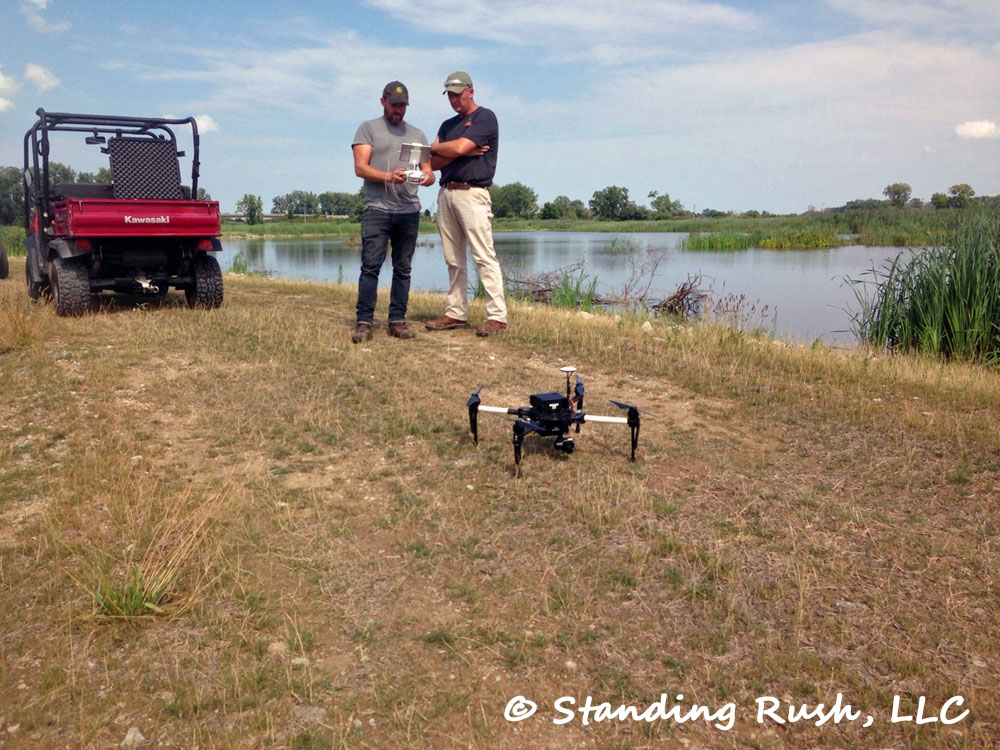
Pause the video above a few times as the drone gains elevation (particularly between 0:07 and 0:37). The color contrast in the vegetation below is not only neat to see, it's valuable from a management perspective.


Since very early on in this restoration project, I saw the value of a bird's eye perspective on the marsh. All the way back in July 2015 -- just after taking possession of the property -- a friend and neighbor of one of my brothers (who happens to be a professional videographer and drone enthusiast) offered to come "fly the property." The fifty or so photos and couple dozen short videos that we captured that calm Saturday morning were eye-popping then . . . and have been unbelievably useful ever since.

The raw footage above is one of my favorites. I particularly love the ~30 seconds of footage that starts at or about 0:07. Not only is the marsh incredibly beautiful when looking straight down starting from about 25-feet, the story that unfolds is extremely useful from a technical perspective. If you pause the video at 0:10, you start to see why I get so excited.

Bryan Ellis of TPS getting acclimated on our main West dike
(pun very much intended) with the school's drone --
equipped with a thermal imaging camera
The individual sprig of mint green among the sea of dark green is a hint. (Sorry, I'm a guy, so my color palette is a bit more limited than an Eddie Bauer catalog. I digress . . .)

As the drone gains elevation and the color contrast becomes more apparent, a trained eye can not only easily differentiate the color, it can also identify the plants! In this simplified case: dark green = broadleaf cattail (a desirable cornerstone plant in our region) and mint green = Phragmites (a monstrous invasive we are tirelessly trying to fight back). So in one ~1:30 video, we confirmed an initial hunch: drones can help confirm what we are seeing on the ground and offer a unique perspective to provide valuable management direction.

All of this makes a lot more sense when you realize that one of our primary tasks each summer is to "map" vegetative cover -- essentially, determine what's growing, where. This is important for a whole host of reasons. It can be done (and very effectively, I might add) the old fashion ways -- in the brain (through on-the-ground, in the wader, or in the punt boat) observation . . . that can then be transcribed to crude pencil sketches and field notes. And it can also be done in much more technical ways.

Yesterday, I hosted an instructor and friend from Toledo Public School's Natural Science Technology Center -- an established component of the new Aerospace & Natural Science Academy of Toledo (ANSAT). First and foremost, Bryan is an extremely passionate and enthusiastic person (which I love). He is also extremely talented and knowledgeable in a wide array of subjects that are very relevant to what we do at the marsh. One of his many talents: a drone pilot. So yesterday, we set two goals. First, we wanted to give Bryan a basic tour (somehow, this was the first time we were able to lure him out!), and secondly, we wanted to get the bugs worked out so that we could try using their program's extremely hi-tech "quad" to prepare a thermal fingerprint of the entire property. Each color will theoretically help us map individual plant species.

Vegetative polygons overlayed atop an aerial of the marsh;
in this case, red would mean spray and green would mean don't spray
I am running low on steam myself right now, so I'll have to elaborate on this on a future post. But the punchline is we need to prepare a visual similar to the one above within the next few weeks. Each shaded "polygon" will correlate to a unique string of coordinates that can then be uploaded into an on-board computer to guide a helicopter as it systematically sprays only the areas we shade and tell the computer (and linked sprayer) to mist with herbicide. The areas could be a couple hundred square feet up to several acres in size over the 500+ acre site.

We did this back in 2015 (combining my brother's friend's traditional drone images and the old fashion ground-truthing techniques) and it worked pretty darn well. We're going to see if we can improve on things with this fall's spraying campaign via our collaboration with TPS. Thank you, Bryan! Should be fun!!


Back to Business

Other than lots of leaves, an electrical mess, an empty gas tank, and a bunch of bird poop, the MULE
wasn't too much worse for the wear -- it's now back in business

Miraculously, our Kawasaki MULE has been recovered . . . and only ~1,000' from where it was brazenly hot-wired and stolen from our shop a month or so ago! "Good neighbor" vigilance lead to an early morning text to Roy -- the UTV had been spotted in a neighboring woodlot, driven (or perhaps pushed) into a thick tangle of dogwood and wild grape less than a quarter mile from our shop. After a call to the sheriff, it was ours to tow home.

I'll spare you all the gory details, but suffice it to say we weren't expecting this. I had already settled with the insurance company, and was resigned to eating a few extra thousand dollars of losses, even after the "replacement" check had cleared. I spent the better part of three weeks scanning Craiglist, Ebay, and other online forums for resale -- both shopping for a replacement and holding out (fading) hope that I might stumble upon our beloved ride.

Even after the recovery (which happened a week ago now already), my communications with the sheriff's office continue -- as they press on to pursue other items that were stolen. Amazingly, the neighboring marsh was broken into just last week. A day or two later, nearly a half million dollars worth of similar equipment was just recovered in Wood County (none of it seems to be ours).

It's a sad state of affairs when you need to convert a conservation project into Fort Knox. But we've definitely had to change our tact. Motion lights are installed. Cameras are now in place. Alarm systems are poised, and locks are now fortified. Anyone highly motivated enough can get into about anything, but we now have a much tighter line of defense.

I feel like the UTV recovery has allowed me to turn the page a bit. It's been a rough month. But now, the insurance check has been returned. The minor damage to the vehicle has been repaired. We are back to management and back to tours. Thankfully, I'm feeling more ready to get back behind the camera . . . back to writing . . . back to business.


Tough Week

Dad surprised me the spring of my freshman year in college when he arrived to pick me up with his boat and motor in toe. We spent a week together fishing our way home, through Minnesota and Wisconsin. We caught a ton a fish, had a TON of laughs, and ate a ton of burgers and coleslaw. It will be a memory that I will hold with me forever.

Last week will be a memorable one: it started with the peaceful passing of my 85 year-old father -- a tremendously consistent and positive influence in my life -- and evolved into a blur of family gatherings, community outreach, laughter, and of course, tears. Many of my siblings, in-laws, and nieces and nephews were privileged to be with him or very nearby as he took his last breath.

A newly acquired Hospice bed allowed him to pass where and how he always wanted -- in his home, surrounded by family, overlooking his beloved backyard. Mom was at his side. Fittingly -- considering Dad was my introduction to my passion for fishing and my mentor in loving all things outdoors -- I was getting some fresh air and was taking a few quiet casts on the dock just below his window as he died.

It has been a roller coaster of emotion.

Two days later, as I was driving to the marsh for a couple important meetings with potential contractors for our collaboration with Coastal Management, I got more tough news. Our field office and adjacent shop were burglarized on Monday night (June 25) or early Tuesday morning (June 26). 

The loss of this vehicle goes beyond its monetary value;
if you know of anything that might be able to lead to its
recovery, please contact the Erie County Sheriff's Office
(all tips can be made anonymously)
The perpetrators did their dirty work sometime between 6PM and 8AM -- likely in the cover of darkness. They knew what they were after . . . not only did they hot-wire and steal our Kawasaki MULE (our four-wheeler), they took a smattering of power tools, hunting gear (decoys/waders), and other miscellaneous equipment. Tracks through our adjacent field showed that they drove the UTV south from the property, but where they ended up is anyone's guess.

It was a shot in the gut -- especially considering the timing. Of our tangible losses, losing the vehicle will be the hardest pill to swallow. Despite insurance, we will be out thousands of dollars . . . and the time and inconvenience to rebuild and refortify. Maybe the biggest bummer though is that our trust and security has been compromised. We will do all that we can to make sure this doesn't happen again.

[NOTE: The Erie County Sheriff's Office asked that we post about this break-in. If you are local and can pass along any tips -- either regarding this burglary or any other local criminal activity -- they will take your information seriously and pursue it to the fullest extent that they can.]

This morning, I have to admit, I am still feeling pretty numb. I feel like a dish rag that has been repeatedly dunked and squeezed almost to dry. It is tough to refocus, especially with a mid-week holiday, but I think I'm ready for something closer to routine. Life marches on.


FOR SALE: Alweld Jon Boat/23 HP Mud Motor/Trailer - $6,000

This set up would be ideal for excursions on rivers, lakes, and backwaters. It has an open hull design
(bench in the front and one in the back), so it can be easily customized

Attention Hunters, Fishermen, & Marsh Enthusiasts: We have decided to sell our larger Jon boat, motor, and trailer!

The package includes the following:

  • 2015 Alweld Jon Boat (Model #1542SS: ~15'L x 42" W)
  • 2015 Backwater 23SS SWOMP Classic long tail mud motor (23 HP: Made in USA)
  • 2015 Yacht Club Trailer (Model 1612)
  • Accessories: 2 safety keys, factory external fuel tank, grab bar (never installed) 


These motors are not only versatile -- they are tons of fun! This rig can fly over water just a few inches deep, and the
guarded prop is designed to bounce harmlessly over logs and rocks as you go
All items purchased new in July 2015 from dealer in Fenton, MI. List price of entire package exceeds $7,000. Fewer than 20 hours on water. Winter stored indoors.

Exceptional setup, just too large for our needs (needed to down-size to better accommodate some of our marsh management tools). Too nice to use as a straight work boat.

Want to get excited about these motors? Check out:


A Classic Mantra of the Modern Environmental Movement: Think Globally, Act Locally

Inside the Old Woman Creek State Nature Preserve and National Estuarine Research Reserve Visitors Center
-- Huron, Ohio; less than 20 miles east of Standing Rush
Photo courtesy Deb Platt & TrekOhio.com

Recently, I’ve been spending a lot of time – often time when truthfully, I should be asleep –brainstorming on how to make our efforts on Sandusky Bay more relevant to a larger/broader audience. Since this project’s conception, I have dreamed of ways to ignite grassroots passion by building local buy-in to ultimately magnify it locally, regionally, and even globally.

When I allow myself to “think big” this way, I envision a multi-use facility on or near our project site that could potentially serve multiple complementary purposes:
(1) offer interpretive learning to make wetland preservation tangible and relevant;
(2) host target audiences – in my current thinking, particularly 10 to 20 year-olds – who, independent of their backgrounds or future professions, will have a significant and lasting impact on the future of wetlands and other natural areas, as the future stewards of our communities and our planet;
(3) serve as a hub for hands-on learning and field research;
(4) provide fitting refuge for a broad smattering of outdoor enthusiasts – birders, photographers, fishermen, hunters, and trappers (to name a few); and,
(5) house the managers who will continue to steward this specific land well beyond my time on this unbelievable blue marble.

Note signage for "Ecological Wetland,"
just down river of the Ipo-ri damn on the Han River,
Ipo-ri, Geumsa-myeon, Yeoju-gun, Gyeonggi-do, South Korea
Photo courtesy of C. Dziubek
I don’t know if this facility will ever come to fruition – or even if it needs to. As I lay awake at night, I recognize that there are plenty of worthy organizations pursuing similar ends just on the drive from Toledo to Cleveland. All are a little different, but all are important. And all are part of a much broader network of entities around the country and around the globe that are working to emphasize the importance of wetland habitats.

I have really found myself thinking globally recently. I have fallen asleep the last few nights reading a Handbook on Best Practices for the Planning, Design and Operation of Wetland Education Centres. (Who knew such a publication would exist much less be accessible from my couch?) The handbook is “organized by” the Ramsar Convention Secretariat – as in Ramsar, Iran. It is “prepared in collaboration with” the Environmental Ecosystem Research Foundation (ERF), Republic of Korea, with financial support from the Ministry of Environment of the Republic of Korea.

"Visitor Village" at Brockholes Nature Reserve -- Preston, England
This is truly a global endeavor . . . it is written by team of professionals from around the planet who have real-world, practical experience. The various sections of the handbook all strike a chord with me for various reasons. But what really has stuck with me over the last day or two is how similar we all really are: it doesn’t matter if we are in NW Ohio or Sub-Saharan Africa, the depths of a South American rain forest or the peaks of western Europe – we all need clean water, and a subset of every population is trying to figure out how to make (or keep) clean and reliable water – and all life that relies on it – a priority.

Two quick global anecdotes that may help tie the importance of wetlands back to current events:

First, my brother-in-law has loyally served our country both in active military and civilian (reserve) capacities for his entire career. Over three decades, he has made marked professional advancements in large part because of his hard work, dedication, and unwavering critical thinking (among a much longer list of positive attributes). Earlier this spring, he was in South Korea. I don’t know – or need to know – the particulars of why he was there. But as with all of his foreign tours, I slept well knowing that he was working to be a voice of reason and peace in our world. It only seemed fitting that he texted my wife and me the photo enclosed here (click to enlarge the image above to read the road signs). As foreign and complex as the issues surrounding the Korean Peninsula might feel – we are united in a common recognition of the importance of wetland habitats. I found hope in that reality.

A satellite perspective of Kaliningrad Stadium (Kaliningrad, Russia),
constructed to host the 2018 FIFA World Cup, was built atop October Island,
the last natural wetland in the region
CNES 2018, Distribution Airbus DS via AP, File
My second anecdote is less uplifting, but just as relevant. It is “torn from the headlines” of the World Cup, which is currently being hosted in Russia. My boys in particular are riveted to the TV whenever we let them watch, but as with any major sporting event (e.g., pick most any Olympics), there is so often an environmental cost. I was pretty disheartened to read this article from Weather.com -- World Cup Stadium Built Over Russian City’s Last Rare Wildlife Habitat.

We have made great strides, just in the last several decades, to put priority on our finite environmental resources. Clearly, we have a long way to go.


[ASIDE: I have adopted a common refrain voiced from agencies and advocates in and around Ohio who reference “more than 90% loss” of wetland habitat along Lake Erie’s western shoreline since European settlement. (Truth be told, the same statistic unfortunately holds true statewide.) Usually, when I explain that the habitat 150 years ago was larger than the Everglades, it gets people’s attention. But yesterday, I heard it perhaps explained even more powerfully. If the Great Lakes experienced “more than 90% loss” of the lakes’ water itself, everything except Lake Ontario would be bone dry. Think about it: Lake Superior AVERAGES nearly 500’ deep! If we lost 90%+ of our fresh water, do you think we’d be calling it a catastrophe? In my mind, losing 90%+ of the kidneys that protect our Great Lake is not much less alarming.]


13 Special Trees/Happy Father's Day

I noticed last week that the new Tulip Tree just to the left of our entrance
door has already stretched just past the peak of our roof 
Last fall, I wrote a post that alluded to a pretty special addition to our property -- 13 special additions, more accurately. The thirteen large trees planted last November at the entrance to our field office -- or "bunkhouse," as we often affectionately refer to it -- provided some welcomed and tangible benefits right out of the gate: improved privacy from the sometimes loud and surprisingly busy rural highway nearby, a visual softening of the landscape immediately surrounding the building, and a promise of much-needed and much- appreciated future shade . . . at least once the leaves emerge again in the spring (in the case of the hardwoods).

Well, emerge they have . . . And so now it's time to tell the rest of the story. These beautiful trees are not just another tree planting project. They were made possible by a handful of generous donors (who have asked to remain anonymous).

Yesterday, Roy and I -- with the unexpected help of last year's intern, Nate -- placed posts and placards at the base of the first ten trees. My goal was to start to recognize some of the many people who either (1) have loved this marsh over the years, (2) have helped protect this special place, or both. Thirteen trees is hardly enough, so my apologies to anyone who has yet to be formally recognized. Trust that I have plans for more trees -- and more placards!

But I thought it important to start to identify some of the individuals and families who have been stewards of this land . . . and to recognize those who have served as models of stewardship as significant positive influences in my life. Thanks to all who have contributed to this collective effort. As I say nearly every day and have said since the beginning of this project, I feel blessed to be able to see and experience this story as it continues to unfold, one chapter at a time. Again, we look forward to enjoying the solitude and the protection that these trees can provide for years and years to come!


This species holds a special meaning for me personally -- there is a uncharacteristically broad specimen just outside
the kitchen window of the first house my wife and I bought just before we were married; I also planted two on 
the hill beneath  my parents' home when I was just out of college . . . they are growing happily alongside 
many others in the nearby woods and both are now 50'+ tall
Mom & Dad:
heartfelt thanks for all that you have done for me, and now my family, along the way --
Happy Father's Day, Dad!


R.I.P. "Beast"


This 60-second video clip demonstrates not only how hardwired northern pike are to be voracious predators, it also shows how one 8" fish can quickly capture the imagination -- not only of a high school student, but really . . . of anyone who is willing to marvel at this amazing creature's innate ability to hunt and grow.

The fish recorded here was affectionately called "Beast" in the TPS lab. At the time of this filming, it was just 10 weeks old. Isolated for its proclivity to eat its neighbor (even if it was the same species), Beast's aggression and appetite ultimately became its downfall. Record-setting heat late last week coupled with too many emerald shiners in the tank (going belly-up before they were all eaten) led the water to sour. It was a loss for the lab, but taught yet another lesson.

A handful of fingerlings were held back from the release earlier this week. As surrogate "parents" for the summer months, my kids and I will house them in our basement. The tank was set up last evening. The goal will be to keep at least a couple pike alive and grow them as much as possible until they can be returned to the TPS students next fall. The biggest challenge will be keeping them well-fed enough that they don't eat each other! Something tells me my 10-year-old son is up to the challenge.


TPS Proud -- Northern Pike Release: The Final 65 Miles!

A successful aquaculture project can be measured in healthy fish, but in our case, it can also be measured
in broad smiles and a hands-on introduction to the marsh . . . for all those involved

Back on February 28th, several dozen mature northern pike -- both females and males -- were collected on an unseasonably mild, early spring afternoon from Budd Lake in northern New Jersey. Housed in holding troughs, they made what must have seemed to be a lengthy (and bumpy) ~6.5-mile commute to a state hatchery and rearing facility in nearby Hackettstown.

These early spawners would serve as the broodstock for tens of thousands of fry that began hatching on March 8th at the NJ Division of Fish and Wildlife's Hackettstown State Fish Hatchery. While our planning started well before, this is where a unique collaboration was born -- quite literally. Within this multitude of growing fish was a very small subset of young fingerlings that would soon be making a much more lengthy over-the-road journey -- another 521 miles to Toledo Public School's Natural Science Technology Center.

Some might consider these guys the stars of the show . . .
they were obviously important, but the true stars
are pictured below
Earlier posts document how this diverse partnership grew and evolved, but yesterday, as we successfully released 150 healthy, happy 5-6" northern pike fingerlings into the marsh at Standing Rush, I couldn't help but think of those first 6.5 miles. Because between 2/28/18 and 5/29/18, our little northerns traveled no fewer than 592.5 miles by road -- with the final 65 miles being via escorted caravan to their new home along Sandusky Bay.

Some might think that's a lot of fuss for a few bags of fish. But for those involved, I think yesterday brought consensus that there was a "greater good" at play. The students not only handled the media and agency representatives with grace, they got to get their hands dirty -- again, quite literally -- in the marsh. To me, that's what this is all about.
____________________________________

Some of my favorite "moments" from yesterday, in pictures:

Three dozen northerns (and one student) -- all eagerly awaiting an introduction to a new home

Release #1 (first of four locations where fingerlings were released over ~185 acres of Standing Rush's West Marsh)

Always cool how every release brings anticipation and excitement

Special thanks to (left to right): Laura Kubiak (TPS Wildlife & Sustainability Instructor) and ODNR, Divisional of Wildlife representatives Travis Hartman, (Lake Erie Program Administrator) & Kevin Kayle (Fish Hatchery Program Administrator); not only was ODNR administratively supportive, they also took the time to be with us in person to support the kids’ effort

Ms. Laura Kubiak (back, left in sunglasses) with six of her proud students
just prior to the final release

NOTE: These students were so invested in this project, that they came to Standing Rush on one of their first full days of summer vacation. Quite a group.

P.S. Thanks to WTOL (11)/WUPW (36) for their coverage of our efforts yesterday on their evening news. Keep an eye out for additional coverage via other local media outlets. We appreciate good news being made newsworthy!


Circling Back: Tree Planting -- Kinda Like Eating an Elephant

Shelters are finally getting added to the hundreds of trees we just finished planting -- this photo captures about 75 tubes,
or roughly 7% of the new seedlings to be protected

Recently, a lot of people have been asking, "How do you hand plant over 1,000 trees?" My answer: One tree at a time. In my experience, it's not a project where you can look too far forward or too far back. You are best to get as efficient as you can be, and just keep planting.

My oldest two spent a Sunday afternoon/evening planting
with me -- another 75 trees in the ground . . . 
Two poorly timed rain events -- both big ones -- derailed plans to have school groups come out to assist with the manual labor. If that could have happened, we would have likely been finished in mid-April, likely in 7-10 days. But this is a busy time of year for everyone. So ultimately, it just became most logical for us to hand-plant them ourselves. There is a lot of bending and kneeling involved, two verbs Roy's body doesn't like too much -- especially by the hundreds/thousands, so he contributed immensely toward the site prep, and I focused on the actual planting.

My wife came out twice and helped to the tune of 100+ trees;
it looks like she is in the witness protection program,
but she'll still kill me when she sees this
(she never likes photos of herself)
We also had a few locals pitch in for single days of planting -- which helped a ton. It actually became a bit of a family affair, too, with my wife and kids happy to lend a hand.

I have written plenty to provide the broader context for this project, but here are some specifics that I (and hopefully others) can learn from the next time a similar project is contemplated. (ASIDE: We are slated to plant another 2,800 trees next spring. The stock will be smaller though, and the site conditions are much more favorable, so it should theoretically be a simpler job.)

Species Planted: Pin Oak (200), Swamp White Oak (200), Burr Oak (300), Red Maple (100), Shellbark Hickory (100), Sycamore (100), and Ohio Buckeye (100).

Trees were planted ~12' on center in a random fashion (relative to species), but they were planted in rows (to simplify mowing, spraying, and general maintenance). We did pick a line that was not easily visible from any common vantage point. So from the road, for example, they do not appear to be in rows, but instead completely haphazardly planted. The goal was to plant larger stock, so most were 2-4' tall. The hickories and the sycamores were on the smaller side (some more like 18"), but all looked really healthy.

24" Sycamore, in the ground
<2 weeks and already
leafing out nicely
Because many of the trees had larger, more developed root systems, the nursery (Porcupine Hollow Farm - Central Lake, MI) suggested that we plant into a 6" hole. There is much more to this story, but we ended up drilling about 800 of these holes (~15 deep, on average) using a walk behind Dingo (power auger). Nate -- our intern from last year -- did the first 150-200 and Roy did the rest. We rented the equipment for two full days, and the auger ran more or less continuously for at least 8 hours each day. Some of the holes had to be drilled twice because the heavy rains came before we could get the trees planted in all of them, and the surrounding soil swelled and seeped back into the hole.

Low-lying areas were like working in peanut butter -- at least after the rains -- but the soil itself is surprisingly dark, organic, and workable at this particular site when it's not too wet. We did import 8 cubic yards of very sandy top soil from a local yard to supplement each planting. There was a lot of labor involved (hand-delivering ~1/3 of a 5-gal bucket of topsoil to each hole), but in the end, I think we had a much better finished product. Especially when the imported topsoil could be kept dry, it was great for backfilling around the vulnerable roots such that air pockets could be eliminated, or at least significantly reduced. Void spaces are a main culprit for seedling mortality soon after transplanting, so we got in the practice of (1) pinning each seedling against the outside of the hole -- at the right elevation relative to where it was growing at the nursery; (2) backfilling and compacting loose topsoil under and around the newly placed roots; and, (3) straightening the seedling as we gently but firmly compacted more soil into and over the auger hole using our boots.

Matt, my student shadow from
last week, adding a protective
tree tube
On a good day, with holes drilled and topsoil placed around each opening, I could hand-plant 175 trees in a 10 hour day by myself. I did have an hour or so of prep (e.g., getting organized and wrapping bundles of seedlings in wet burlap to protect them from drying from sunlight and wind). I also had to allow some time for clean-up each day. If in a rhythm, I could plant about 20-25 trees per hour, once I was set up and ready to go.

When I look back on my notes, I spent three full days (8-10 hours) and five half days (4-5 hours) planting from 4/12 - 5/8/18. When the site was just too wet or the temperatures got too high (didn't like planting when it was above 65 degrees), we just kept the seedlings wrapped in moist burlap, loosely contained inside plastic within large cardboard boxes and housed them either in our field office (if the temps stayed below 55 degrees) or in a neighbor's storage room. The neighbor's was preferred as it got warmer outside because it was dark, cool (50ish), stable, and humid (because it was adjacent to a large minnow tank). Ideal storage is 40 degrees and dark, but even though our temps crept up a bit, we didn't have any issues with mold, and nothing started to leaf until it was in the ground. Keeping dormancy is important because it really helps minimize shock to the newly transplanted seedling.

Protection is the next step in this process, and it is no small task. While we are not obligated by our funding partner (NRCS - EQIP) to do so, we are going to place 4' tree tubes over as many of the newly planted seedlings as possible. Despite the high cost (tubes and accessories cost more than the trees themselves), we have purchased enough to shelter all 1,100. These biodegradable plastic structures serve several important functions: (1) they reduce browse from mice, voles, and rabbits from below and deer from above; (2) they conserve moisture and create a greenhouse-like environment to accelerate vertical growth; (3) they hold back competitive weeds from smothering the seedling; (4) they protect the young seedlings from harsh winds; and, (5) they help keep the seedlings growing straight.

Each tube is fastened to a 48" x 1" x 1" pine post that is hammered within 3" of the seedling's trunk (but not through the roots!). The tube is connected to the post using pre-installed zip ties and is capped with a mesh net to prevent song birds from getting trapped inside the plastic (tubes/stakes are common perches and smaller birds think they might make a good place for a nest, but they often can't get back out once they get in). We are also adding a 2' x 2' plastic square (stapled on each of the four corners) to provide extra protection from competing weed growth. Studies have shown that these investments can more than double survival to a mature canopy. Even if 25-50% of our trees survive long-term, we will consider the planting to be a tremendous success.

A young (30") red maple seedling in a newly installed 48" tall "tree tube" by Tree Pro
All this seedling needs is the bird net
on top and it is ready to grow --
1 down, 1,099 to go!

P.S. If you ever want to read more on a particular subject, don't forget about the "Search This Blog" feature on the right sidebar. For example, if you enter "tree planting" into the search box, you can catch up on all posts related to this particular subject.


BSBO and the Biggest Week in American Birding

Special thanks to BSBO staff, leaders, volunteers, and guests for two enjoyable mornings
afield this past week at Standing Rush

With 1,100 trees now planted, 200+ pike to attend to, 140 tree tubes installed, nearly 100 bird species identified, 2 guided birding walks completed in collaboration with the Black Swamp Bird Observatory (BSBO), and 1 student from St. John's Jesuit HS shadowing me, (in addition to the routine happenings of a typical week at work,) this truly was a "Biggest Week."

One of literally dozens of species of warblers, small 
migratory songbirds that draw birdwatchers to our area 
by the tens of thousands each year
(Yellow-rumped Warbler)
This weekend marks the official end to BSBO's Biggest Week in American Birding festival -- an annual ten day celebration highlighting NW Ohio's significance in a transcontinental migration that pulls hundreds of bird species . . . and now 100,000+ birdwatchers . . . to and through our area. Lake Erie (and all the Great Lakes, for that matter) present quite an impediment for our winged guests, who -- in springtime -- are flying back north from the southern U.S. and even Central and South America to find suitable nesting and summering habitat further north. So our south shore becomes a magnet for large concentrations of all things birding -- birds and people. And as an oasis of food and shelter, the marshes of the Western Basin of Lake Erie become the epicenter.

As readers of this blog may recall, last fall we were the lone recipient of BSBO's conservation fund, an inspiring reinvestment in local, grassroots efforts to protect and improve local habitats that benefit resident and migrant bird populations -- along with the broader ecosystem. These funds come $5 at a time from "Biggest Week" registrations. So again, we say thank you.

Lighting was poor, but it was still exciting to
see this Sandhill Crane -- only the second
we've seen on the ground since we took
possession of the property
This was our first spring as an official participant in a logistical marvel. Dozens and dozens of guided trips are offered to dozens and dozens of diverse locations from Oak Openings to Erie County. Federal and State properties absorb tremendous numbers of birders, but this is also an opportunity for enthusiasts to tour private properties, like ours, that have limited or no access any other time of year.

Photos probably summarize our two morning walks better than my words can. But essentially, the goal was to open the floor to the main attraction -- the birds -- while sprinkling in some of the history and promise that makes our property unique. There was definitely a genuine interest in our restoration activities, and I have to admit, it was a shot in the arm to hear people from all over the country enthusiastically endorse what we are undertaking.

Birders are a rare breed, from my experience. Most revel in the detail and the diversity of their most highly prized subjects, but most also appreciate that they are part of a broader ecosystem. It's pretty tough to have one without the other, so our growing collaboration with BSBO makes a lot of sense. Sure, our guests loved compiling their "list" of nearly 100 bird species seen on the property (not bad for ~10 hours of walking and observing over two spring mornings), but they also appreciated hearing where the land has been and where we hope to take it into the future.

Thursday's group in action -- participants came from as far afield as Texas and North Carolina; in fact, I would say
we had as many guests from out of state (and considerably so) than we did from Ohio
I lucked into some pretty cool composition with this photo; I love the unique bend of the log beneath the on-legged perch
of a bird that is typically most at home standing in mud
(I'm not confident with my shorebirds, but I'm pretty confident that this is a Solitary Sandpiper)
We pulled water off our 40-acre Rest Pond over the last week in the hopes of drawing some shorebird diversity;
these Short-Billed Dowitchers (along with a dozen-plus other species of long-legged guests) didn't disappoint
This Palm Warber winters in Central America or the Caribbean, but it contributes not only to Northwest Ohio's
designation as the "Warbler Capital of the World" but also to stiff necks (see below)
A familiar scene -- not only at our property, but all over the region as spring migrants push north

For those interested in a comprehensive list, here are the 80 species of birds we collectively observed and recorded on one of the two (~5 hour) walks at Standing Rush this past week. I haven't seen the list for the other outing yet, but it was amazing to me how certain species made their presence known one day but not the other. I guess it's a testament to the logic of a biggest week. Truth is, there have been migrants flying through our region for months now, and their will be for another couple months. And just as one thinks migrations north are all wrapped up, birds begin passing back through on their way back to wintering grounds. Upshot is: keep the binoculars and handy.

P.S. Parts of our property were part of what was referred to historically as "Medusa Marsh" (because of the influence of the Medusa Portland Cement Company's plant physically located just to our north at the unincorporated community of Bay Bridge -- just east of Bay View). We aren't even sure what marked the boundaries associated with this name, but for most birders, Medusa Marsh is anything loosely located around our highway exit. People are almost apologetic to use this name for the property; I like it -- it's part of the heritage and history of the land.


A Month of Milestones

When one wooden stake represents one new hardwood seedling, one starts to appreciate what 1,100 new seedlings
looks like -- that's a lot of trees! Here is the Tower woods, about half planted (4/25/18)

The last four weeks represent the most physically demanding month in my history with this property. I have not completed a publishable entry here since April 12th. Coincidentally, it was two days earlier (on April 10) that the first shipment of bareroot tree seedlings arrived (unexpectedly early) at our doorstep. It has been a full-court press ever since to work around heavy rains and periods of above-average temperatures to effectively get them in the ground.

So technically, I don't have any one excuse for not keeping current with blog entries -- I have 1,100 of them! But I am happy to report that as of about 4:30 pm yesterday, the entire 5.7-acre site is planted. Now the focus will shift to protecting the vulnerable seedlings (from animal browse, drought, competition/smothering by surrounding weeds, etc.). But more on all that in a pending entry.

While we won't have much time to revel in our success, we did recognize the accomplishment last evening around the dinner table. Jenny, the kids, and I celebrated the milestone as any family of little ones would -- with dessert. I didn't have the energy to make a run out for ice cream, so a raid of the Girl Scout cookie cabinet had to suffice. Once again, I slept hard last night.
_______________
Much has happened in and around these tree getting in the ground. So at the risk of giving away punch lines, I've decided that I'm going to try to circle back and write entries for some key happenings over the last four weeks. I can't promise I'll have them online immediately, but my goal is to write a handful of posts to continue to recognize milestones and progress.

Progress on a project like this is kind of like tree planting: one at a time.

More to come soon . . .