Showing posts with label Bowling Green State University. Show all posts

No Replacement for Hands-On Learning: #TPSProud

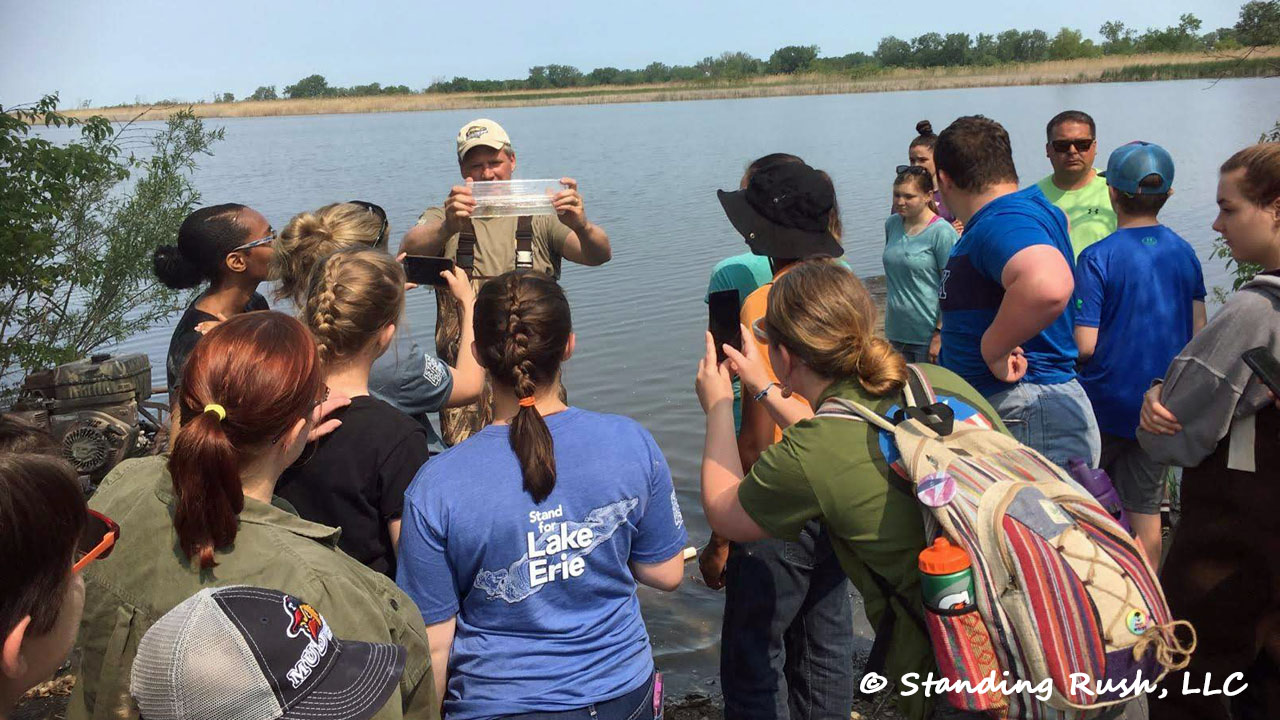
Students from Toledo Public School's Natural Science Technology Center (TPS-NSTC) help process the catch from a Fyke net
set at Standing Rush last Friday morning; a voluntary field trip to release fish provided the perfect opportunity to catch fish
(not to mention identify them, hold them, and marvel at their unique physical features and incredible diversity that can
best be appreciated through hands-on learning)

If the first half of May was dominated by birds at Standing Rush (and with the awesome diversity, it sure felt like it was), our migratory visitors on the wing were forced to share the stage with fish during the latter half of last month. Considering that the U.S. Army Corps of Engineers just recorded water levels on Lake Erie to be the highest ever recorded in the month of May, I guess it's fitting. Whether we like it or not, water, water (truly is) everywhere . . .

This year's northern pike release featured fingerlings
that started off smaller and ended up bigger
(on average) as compared to last year
But lucky for us, so are fish. And thanks to TPS's Natural Science Technology Center -- through an ongoing collaboration with Standing Rush and now Bowling Green State University -- we've just added more than 100 more healthy, happy northern pike fingerlings to the watery fray.

The release took place on a picture-perfect late spring morning late last week. But for the dozen or so students (and dozen or so parents, families, teachers, and adoring fans), it was actually one of the first days of summer vacation. That made the turn-out to Standing Rush even more impressive.

It was truly gratifying and awe-inspiring to witness the enthusiasm. And after another semester of working together, it was wholly satisfying to witness the attentiveness, genuine interest, and passion with which these kids experienced the marsh. Volunteers were eager to pull on hot neoprene waders to lend a hand, to get mud boots muddy, and to zip on life jackets to accompany there carefully nurtured foster fish to their new homes.

Roy returning with a couple happy students and an empty plastic bag, having released a couple dozen more
northern pike fingerlings into the West Marsh
Students were as eager to learn fish identification (as with
this black crappie) as they were to man the 15' seine net
used to catch 
And while releasing fish was the primary focus of the day, we wanted to make sure that we gave these students the hands-on opportunity to do some "sampling" as well. Fish sampling or monitoring goes way beyond capture by hook and line. It is important not only because it provides a glimpse into the diversity of fish species using a specific water resource, it also offers hints on population trends as well as how the environment can be augmented to support either higher numbers, use of the habitat by specific targeted species, or in some cases, both.

Sampling is also very important to this collaboration because (a) follow-up monitoring by BGSU with the hope of recapture of a subset of the released individuals will hopefully shed more light on the reproduction and early development of northern pike that is central to their specific research, (b) because fish monitoring in general can help us better understand how our newly improved connection to Sandusky Bay is improving fish stocks within our specific marsh [and shed light on how similar structures can help fish stocks in similar habitats on Lake Erie and beyond], and (c) because Standing Rush is assisting TPS in building a reference and teaching collection of the fish of Ohio -- I'll write more on this exciting project very soon.

A forth reason fish sampling is important is it's just plain fun. It gives people a unique glimpse into an underwater world that can be difficult to see and appreciate otherwise. And especially for young people, seeing and handling all the different shapes, sizes, and colors can ignite a spark of interest. In my particular case, that spark was fortunate enough to be nurtured into a lifetime flame -- a lasting passion for all things fish.

Here are some more photos from a great day in the field (and in the water) and from the final day in the lab leading up to the release.

Three students made hauling in the Fyke net a lot easier on Roy (foreground, left)
and me (center, top near float)
A captive audience taking in the details about another (temporarily) captive fish

Me with a couple of TPS's most devout fish enthusiasts (both holding nets) with their equally enthusiastic and devoted
instructor, Laura Schetter Kubiak [note all four of us are donning our Standing Rush graphic T's!]

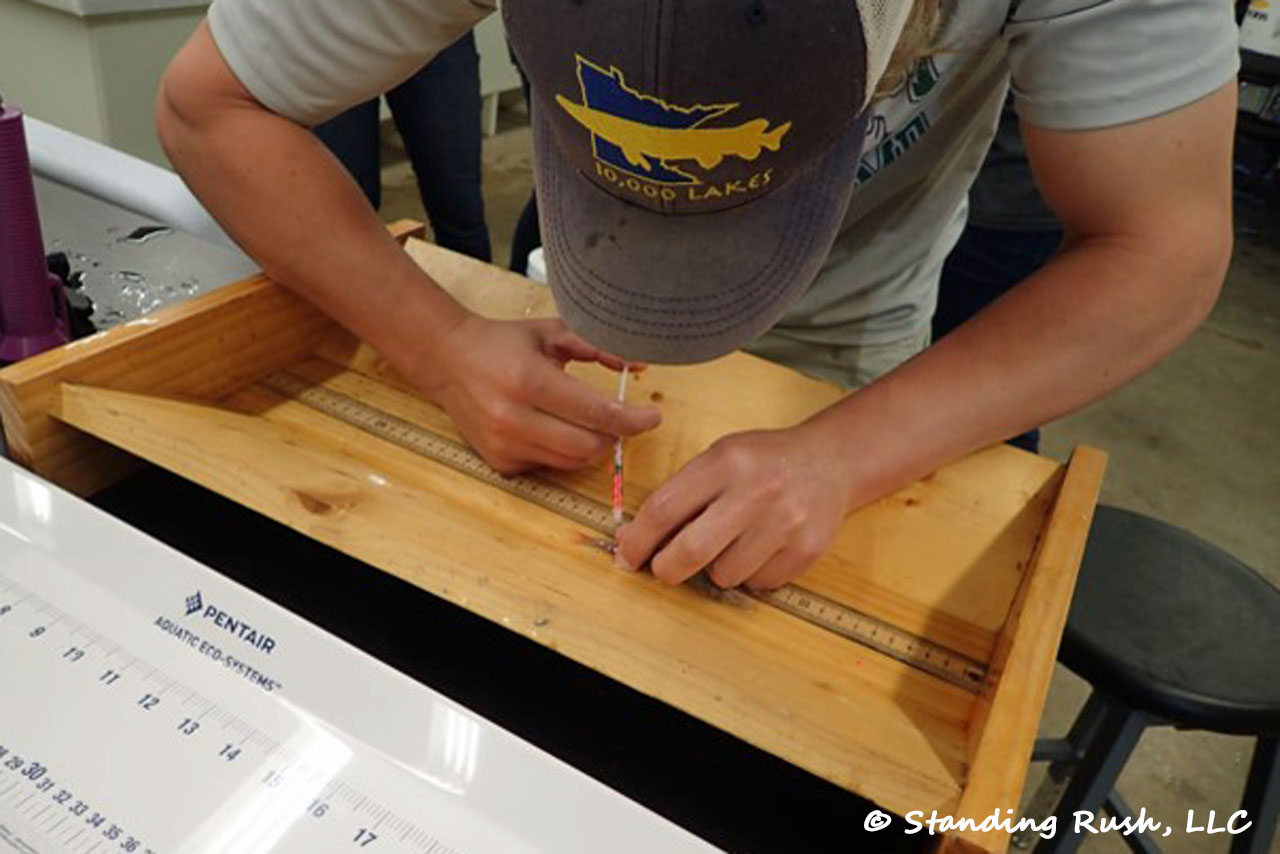
Nate Stott, lead researcher from BGSU, tagging a fingerling northern pike in the TPS lab the day before release

An incoming TPS sophomore helping with fish "tattooing"in the TPS lab last Thursday morning

A newly "tattooed" northern pike at TPS (note florescent dye at base of anal fin)


One enthusiastic bunch -- smiles were broad and fresh stories were already being retold as the students loaded into their vehicles 
and caravaned the 50 or so miles back to their school . . . so close, but in some ways a world away from the marsh

1,200 More Reasons to be Excited About Restoration & Scientific Research

Nate Stott of BGSU and Laura Kubiak of TPS prep to release bags of ~300 early fingerling northern pike into a 1,200-gal
aquaculture tank that was generously donated to Toledo Public Schools and Laura's lab by Castalia Trout Club;
Standing Rush facilitated a site visit to tour the Club's hatchery and rearing house last fall so students could better
appreciate the operation and where their new aquaculture system was coming from

Call it foreshadowing, but the cover article of the most recent Ohio Outdoor News that Standing Rush was featured in (see below) was entitled "Spring Prime Time for Pike" -- we couldn't agree more. That's why we are once again teaming with Toledo Public Schools NSTC (Natural Science Technology Center), the ODNR Division of Wildlife, and the NJDEP Division of Fish & Wildlife to raise fingerling northern pike for release into the marsh.

One of ~1,200 four-week-old northern pike hatched in
Hackettstown, NJ and delivered to TPS'
Natural Science Technology Center last Thursday
You can read all about last year's inaugural efforts by visiting historical posts. While last spring was a resounding success in its own right, we felt compelled to make a few noteworthy modifications to this year's methodology. The first, and the most significant, is the addition of another foundational partner: Bowling Green State University's Department of Biological Sciences.

As it so happens, BGSU's fisheries lab (which I was a participant in 20 years ago) has a graduate student by the name of Nate Stott who happens to be concentrating his research on the reproduction and early stage development of northern pike in the Western Basin of Lake Erie. He is through his Master's but as we've gotten to know each other more, we've mutually determined that it makes sense to utilize Standing Rush for his doctoral research over the next two to three years.

A related modification from last year is that Nate plans to tag each individual pike (a process that does not harm the fish in any way) in the hope that a subset can be recaptured in the marsh after they are released into the wild. This will both further Nate's research and give us a better understanding of broader fish usage (beyond this single species) on the property. All involved are excited about what can be learned from these future field efforts. (I plan to elaborate on Nate's research in a future post.)

A final key modification from last year is the quantity of fish we plan to raise for release. In 2018, we started with ~225 individuals with a goal of releasing at least 100 advanced fingerlings (5-6" in length). In 2019, we are starting with more like 1,200 individuals with a lofty goal of releasing as close to 1,000 fish as possible. Not only are we starting with significantly MORE fish as compared to last year, we are also starting with significantly SMALLER fish . . . ~2" on average as opposed to ~4" on average. (Much of this size disparity has to do with a delayed spring in New Jersey this past February/March.) The goal will again be to "grow" these tiny predatory fish as much as possible between now and late May/early June -- getting them to eat as much as possible without eating each other! This year, both Nate and I will be interacting closely with the high school students. The idea is to have them take ownership in the project so that it really means something to them when they see the fish released into the wild.

An overview of the young northern pikes' new home -- at least for the next month or so -- at TPS' NSTC lab/classroom

Approximately 300 fingerling northern pike being moved from their transport cooler
(where they spent about 10 hours in the bed of a truck); aeration kept the small fish
healthy until they could be acclimated and released into their new home in TPS' lab


Completion of a critical first step -- the last of the newly arrived northern pike are added to their new surroundings at TPS


Pre-Construction Fish Sampling

Terrain alone makes fish sampling in these environments complicated

Fish collecting in wetland environments is notoriously difficult. Gathering representative data on the species diversity and relative abundance of each type of fish present at any given time presents major challenges. Water levels vary (and are often too shallow for sampling using traditional boat-mounted methods). Obstacles are abundant (whether in the form of diverse islands of vegetation, submerged woody debris, and/or soft sediments). Generally, sampler access is rarely easy and opportunities for refuge and sampling evasion are immense.

Fyke net setup just inside the marsh at the
soon-to-be-replaced pump structure
But on the eve of equipment mobilization for our much anticipated "Water Conveyance Replacement Project" in our West Marsh (our biggest restoration activity of the 2018 field season), we had to give it "the old college try" -- quite literally. Yesterday, one day before the start of their fall semester, three graduate students from the Bowling Green State University's Aquatic Ecology & Fisheries Laboratory volunteered to join us for a long, sweaty, and -- for a self-proclaimed "fish freak" like myself -- very FUN day in the marsh.

The goal: Utilize multiple sampling techniques to gather a pre-construction "snapshot in time" as to what fish are currently utilizing the West Marsh and the bayside communities immediately adjacent to the structure that will soon be replaced.

So, it made sense to start at what will become the construction zone. The first Fyke nets were set on either side of the soon-to-be demolished concrete structure -- one on the marsh side and one on the bay side. We then spent the balance of our first hour setting three more trap nets at other strategic locations within the West "Rest Pond" and the "Main Marsh," immediately adjacent to the south.

Fyke net setup just outside the marsh and soon-to-be-replaced
structure, extending into the estuary to Sandusky Bay
Because we were trying to accomplish our sampling blitz all within one field day (and because we also wanted to reduce the probability of turtle mortality in the hoop nets), we opted to shoot to soak the stationary traps for approximately four hours each. While there is always eager anticipation built into this waiting period, we didn't have time to dwell on the waiting game. We spent any "down time" actively sampling a handful of interior locations by pulling a 3-meter seine with an oversized collection bag. This method most certainly has its limitations (we could literally see certain species like carp and largemouth bass swimming out in front of us), but it definitely produced some unique findings.

In my experience, I've found it is a lot more gratifying to frame fish sampling in terms of what you capture (and learn) rather than what you don't. Every sampling event is another learning experience. Time of year, time of day, weather conditions, sampling methods, access capabilities -- they all play major roles. Of course, we would have loved to see more yesterday. But we caught fish!

A pile of young of year sunfish -- predominantly bluegill, pumpkinseeds, orangspotted sunfish, green sunfish,
black crappies and white crappies collected in one Fyke net haul --
nearly every one of these fish was born either this year or last

We have been waiting for a day like yesterday for a long time (for me personally, since day one). So it is normal to wish you could record every last species -- heck, every last fish -- swimming in the marsh! But yesterday was just our first effort. It was the proverbial "snapshot in time." Our human resources were limited (though highly motivated); our methods were limited (we didn't even get to backpack or boat-mounted electrofishing); and, our time was finite (although we busted a lot out between 9AM and 6PM on one humid, 90-degree late summer day).

Identifying and counting sunfish
as they are removed from the net
and released
In the end, our sampling yielded 14 species, most certainly dominated by the Centrarchid Family (the "Sunfishes"):

Bluegill (Lepomis macrochirus)
Pumpkinseed (Lepomis gibbosus)*
Black Crappie (Pomoxis nigromaculatus)
White Crappie (Pomoxis annularis)
Green Sunfish (Lepomis cyanellus)*
Orangespotted Sunfish (Lepomis humilis)
Largemouth Bass (Micropterus salmoides)

Others included:

Gizzard Shad (Dorosoma cepedianum)
Brook Silverside (Labidesthes sicculus)*
Western Mosquitofish (Gambusia affinis)
Common Carp (Cyprinus carpio)
Goldfish (Carassius auratus)
Golden Shiner (Notemigonus crysoleucas)
White Bass (Morone chrysops) -- estuary only


I maintain a master list of species that we have observed since we first started work on the property. My list of fish species is now up to 26 after yesterday's efforts. Those starred above were new finds yesterday. Those that we did not see yesterday that we have seen before on the property include: Channel Catfish, Black Bullhead, Brown Bullhead, Yellow Bullhead, Bowfin, Freshwater Drum, Emerald Shiner, Yellow Perch, White Perch, Smallmouth Bass, Northern Pike, and Steelhead (Rainbow Trout).

It would have been super cool to recapture one or more of the northerns that we stocked in conjunction with TPS this past spring. Nate, one of the BGSU masters students, is actually working on his doctoral degree on how northern pike utilize coastal habitats on Lake Erie. Sounds to me like a reason to keep sampling at Standing Rush!

Here are a few more of my favorite photos from yesterday's efforts. I'll try to post some of the individual fish species that we collected soon.

Deploying, retrieving, processing, and recovering Fyke nets -- like all fish sampling -- is best accomplished as a team
This little guy stuck with us and was completely hands-on for a full twelve hours; I woke him just before 7 AM
and we got home just before 7 PM -- we might possibly have a scientist in the making; he was in hog heaven
Our dedicated crew from BGSU -- they definitely reinforced a common student mantra: "We'll work for food!"
And they did it with smiles and enthusiasm -- appreciate it, guys; hope it can be the start of a continuing collaboration