Beyond the characteristic influx of spring migrants passing through on the wing (see previous post), May was defined by an emphasis on water quality.
Spring may be historically stubborn to yield new green growth in the marsh, but May's warm temps certainly got the bulrushes going (as evidenced by this dense stand of soft-stem emerging from the Rest Pond -- photo taken 5/50/21.
One evolving project that we are extremely excited about brings many of our favorite things together: marsh restoration & management, water quality, interactive education, emerging technologies, and functional data collection & analysis. At the invitation of our friends from Toledo Public Schools, we have been asked to host a water quality data collecting buoy that is being developed by an incredibly gifted collection of scientific minds. This unique collaboration was conceived and is being spear-headed by a robotics and software engineer from the NASA Langley Research Center. You can read more about the early development of the project here. We are thrilled to be one of two locations in the country (the second being Yorktown, VA on the Chesapeake Bay) where prototypical equipment has been deployed.
Preliminary testing not only yielded real-time data collection on useful water quality parameters including temperature, pH, dissolved oxygen, and nitrates, it also provided high school students a glimpse into a wetland world that is often as foreign as outer space. We are flattered to be a part of this team and this worthwhile project, and we are excited that the first iteration prototype yielded enough positive feedback to prompt the development of a second generation. Wetland Buoy 2.0 is currently under development and should be ready to be deployed in the fall. Updates will follow.
Roy delivering real-time water quality data from Standing Rush to the classroom at Toledo Public School's Natural Science Technology Center (NSTC).
New signage marks the newly completed Structure 2 connection between the Main West Marsh (behind the camera) and the Rest Pond (pictured), the management unit where water quality data is being collected.
This open canopy of free-flowing water between the Main West Marsh (behind the camera) and the Rest Pond (top of image) was the primary impetus behind the construction of Structure 2. This dramatically increased exchange of water benefits not just water quality, but also all of the biodiversity (both plants and wildlife) that thrive in these recently restored habitats.
This Eastern Foxsnake (or Fox Snake) neonate (or hatchling) -- a Species of Concern only found in marsh habitats of the Western Basin of Lake Erie in Ohio -- fittingly made its presence known while we were deploying the water quality buoy.
This nearly 5' Eastern Foxsnake specimen (which greeted Roy at the container door to the shop) did a little growing up -- and demonstrates that the species is thriving at Standing Rush.
Another shot of the emerging sea of green, taken in the Rest Pond toward the end of this month.
Mom and I -- surrounded by a few dozen of my immediate family -- all of whom are joining me and Standing for Something Great
(photo taken in early August back at the family farm at our 19th annual Kraus Camp Out reunion weekend)
We are now inside ten days before our kids are back in school (which will be a full week, if not two, later than most have returned). Per usual, summer has absolutely flown by. Long days and late sunsets, lots of activity and some extended travel, and lots of writing -- for various grants and permits -- have largely put me on an unofficial . . . and unintended . . . summer "vacation" from both the blog and social media. It's high time I provide some updates because there has been PLENTY going on . . .
One of a variety of wetland habitats sprinkled
into the often arid Colorado Rockies
in summer (photo taken just outside
Silverton, CO in July)
Since day one of this project, I've said we are never going to be satisfied with treading water; we are always going to strive to be moving ahead, making improvements to the property and, where possible, the surrounding community. In 2015, we set a goal of accomplishing 1-2 "major projects" each calendar year. Over the last several years, this has translated to an average of two larger-scale initiatives each field season. Typically, at least one of these projects has required permitting through the US Army Corps of Engineers and other affiliated agencies. And whenever and wherever possible, we seek funding assistance to get the job done efficiently and done right.
With just over four months remaining in 2019, we are on-track to complete as many as SEVEN major projects at Standing Rush this calendar year: (1) completion of what we call "Structure 1" -- the primary water conveyance structure to the West Marsh; (2) re-armoring of over 1,000 linear feet of our bayfront ("exterior") dike; (3) rehabilitation of 3,000 linear feet of earthen berm that makes up our southern boundary on the West Marsh;
(4) rehabilitation of more than 1,000 linear feet of interior berm to augment #2 above (awaiting final permitting approval -- haven't written about this one yet);
(5) rehabilitation of 2,000 linear feet of interior berm to augment restoration activities begun in 2016 (awaiting final permitting approval -- again, haven't written about this one yet);
(6) completion of what we call "Structure 2" -- the second phase of #1 above that will further enhance connections between the West Marsh & Sandusky Bay (slated for construction Sept-Nov); and,
(7) permanent legal protection of an additional ~200 acres of coastal marsh habitat through the USDA's Wetland Reserve Easement (WRE) program.
News just came yesterday that ~200 acres of our West Marsh have been officially selected for funding through the USDA's Wetland Reserve Easement (WRE) Program
Clearly, there has been a lot going on. And clearly, there is plenty still to do on this list. The complexity of all these moving parts has been amplified by the fact that Roy was away for the last couple weeks of June and I was away for the first couple weeks of July (on a family road trip to Colorado). When you are a staff of two, this has a profound impact. But both of us needed to get away.
As with so much of the work that we do, success is predicated on persistence, collaboration, patience, talented subcontractors, good communication, and good fortune . . . or some would say, dumb luck. Weather is a constant wild card -- as is persistent high water (a reality that is apt to last well into 2020). Permitting is often largely out of our control -- at least after the application is submitted. And there is a chronology that often creates a chain reaction of cascading consequences -- intended or unintended -- as each project evolves.
But we feel generally fortunate as to where things currently stand. We continue to feel very much supported by federal, state and local partners. People are paying attention to our efforts (which isn't critical, but it's certainly helpful if they can help in the collaboration). [In fact, at one point last month, I was compelled to book a flight home from Colorado because Governor DeWine was planning to pay us a visit. That outing had to be postponed because of a stubborn budget process, but we did get the opportunity to show a US EPA representative around the property.)
TPS instructor Laura Kubiak took Standing Rush's message with her all the way to Alaska this summer
And yet with all the progress taking place on the ground, what I'm perhaps most excited about is what's currently happening from our collective desktops.
Just yesterday, we received official acceptance into another round of WRE funding (see #7 above). This means we were one of perhaps a dozen properties from the entire state of Ohio that was selected for enrollment in the USDA's perpetual easement program. While we haven't yet "closed" on the easement (think real estate transaction), things seem to be aligning favorably such that we could in a matter of months. To see how important this is in the fulfillment of our broader mission, see the announcement of our first easement, which closed this past May. There is a ton of paperwork involved in this process, but the long-term benefit to the property far outweighs the headache, at least from our perspective.
Speaking of paperwork, much of my time recently has been spent developing a comprehensive plan that is intended to both guide and prioritize future management improvement projects and attract additional funding and technical partnership opportunities. This will remain a primary focus for me for the better part of the next couple months. It will mean a lot less time in the field, but I promise I'll keep on Roy to take lots of pictures. And as the sun sets earlier and we get back into an autumn routine, I promise to be posting more!
Two breeding male sunfish, both less than 4" long, collected right off our main dock -- the smaller is definitely an Orangespotted Sunfish; the second, is perhaps less clear (*see bottom photo; be sure to click to enlarge)
Earlier in the week, I started contemplating what I thought would be a straight-forward information share to explain another neat collaboration between Standing Rush, Toledo Public Schools, and Bowling Green State University. Essentially, I'm replicating an effort that I executed in the summer of 1997 with my undergraduate institution (St. John's, MN), the University of Minnesota, and the MN DNR -- embarking on what I called a "scavenger hunt" of freshwater fish biodiversity.
Twenty years ago, my target was fish of the "Land of 10,000 Lakes." Today, through the cooperation and permitting oversight of the Ohio DNR Division of Wildlife, we are building a collection of the fish of Ohio. With all the rain we continue to get, people might start calling me Noah . . . but in our particular case, we're not looking to collect mating pairs -- we are actually shooting to gather between one and ten individuals of as many different species of fish as possible. Each "specimen" (individual of a given species) needs to be in good condition, show characteristic physical attributes of the species, be of a target size, and be from Ohio waters.
Once collected (by net, trap, electrofishing, or even hook and line) and deemed appropriate, the particulars of the sampling location and sampling method are carefully recorded, and then the individual fish are euthanized and placed in a bath of diluted formaldehyde for 10-14 days. Each will then go through a series of water rinses over another 7-10 days before they are placed in lab-grade ethanol (rubbing alcohol) and stored in either glassware or plastic jars.
Brook Silverside (an elegant insectivore with an up-turned "beak" perfectly evolved to target larval, terrestrial, and flying insects) are another relatively common species in Standing Rush waters
According to A Naturalist's Guide to the Fishes of Ohio, a timely field guide packed with incredible reference photos and meticulously researched and well-organized species detail, Ohio boasts of some 187 species of freshwater fish (17 of which are either hybrids or invasive species). Our goal is not to collect them all, but instead to build a physical "library" of the most common 40-60 species that are encountered in the state.
These types of collections serve two primary functions: (1) They provide another form of hands-on learning so that students can physically touch and see the dizzying array of species that live and fight for survival in the waters we see around us; and, (2) because these collections can last literally decades, they can provide valuable insights to both students and researchers years and years down the road.
Either Black Bullhead or Brown Bullhead (very difficult to distinguish & commonly hybridize) photographed along our new water control structure, using a GoPro
As I've mentioned several times before, I am a self-proclaimed "fish freak" -- I can (and do) sit with child-like curiosity every time I get to intimately observe another species. From colors to textures, fin structures to body adaptations, I always marvel at how evolution and ecology intertwine.
Sure, it's my hope that several dozen specimen jars -- and the process by which the collection is assembled -- will spark more fish enthusiasts. But I am perhaps even more hopeful that it will get the gears turning for even more people about how our actions impact our landscapes and how our landscapes impact the life that can be supported.
Unless you are living under a rock, you've likely heard that a recent UN report suggests over 1-million (that's 1,000,000!) species of plants and animals are at risk of extinction -- that's permanent elimination from the planet Earth. Just today, I read of how this loss of biodiversity draws sobering parallels to the 'Great Dying' -- the global extinction of life of some 250 million years ago. (Please consider taking the time to read the two articles linked above for broader context.)
A recent article published in the journal Science also shines light on another sobering (and related) trend, the national and global reduction of protected lands, particularly since the year 2000. These forces are big, they're complex, and frankly, they're scary. At times, they can feel insurmountable. They also strike right at the core of Standing Rush's primary mission. So, in my mind, I have two choices: (1) stick my head in the sand and act like there is nothing wrong, or (2) fight for the mission of Standing Rush while helping to shine light on the broader challenges facing our world. To us, there really is only once choice.
A large Bowfin, or "dogfish" patrolling the waters off our old pump station
Golden Shiner, a relatively "common" member of the family Cyprinidae (the largest group of Ohio fishes) and an important food source for many larger, predatory game fish
Pumpkinseed Sunfish can easily be mistaken for Orangespotted Sunfish (see top image) and identification is further complicated by the newly recognized Northern Sunfish (Lepomis peltastes) that just achieved species status in 2013; all three appear to be present at Standing Rush
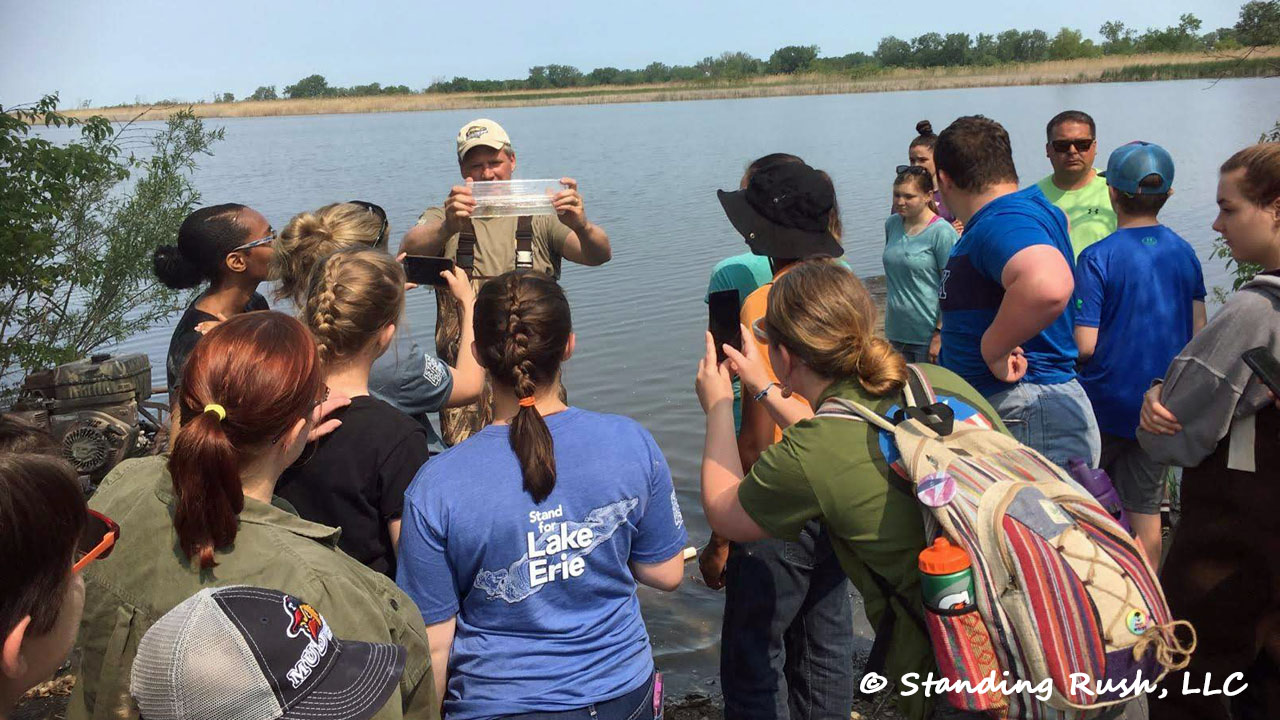
Students from Toledo Public School's Natural Science Technology Center (TPS-NSTC) help process the catch from a Fyke net
set at Standing Rush last Friday morning; a voluntary field trip to release fish provided the perfect opportunity to catch fish
(not to mention identify them, hold them, and marvel at their unique physical features and incredible diversity that can
best be appreciated through hands-on learning)
If the first half of May was dominated by birds at Standing Rush (and with the awesome diversity, it sure felt like it was), our migratory visitors on the wing were forced to share the stage with fish during the latter half of last month. Considering that the U.S. Army Corps of Engineers just recorded water levels on Lake Erie to be the highest ever recorded in the month of May, I guess it's fitting. Whether we like it or not, water, water (truly is) everywhere . . .
This year's northern pike release featured fingerlings
that started off smaller and ended up bigger
(on average) as compared to last year
But lucky for us, so are fish. And thanks to TPS's Natural Science Technology Center -- through an ongoing collaboration with Standing Rush and now Bowling Green State University -- we've just added more than 100 more healthy, happy northern pike fingerlings to the watery fray.
The release took place on a picture-perfect late spring morning late last week. But for the dozen or so students (and dozen or so parents, families, teachers, and adoring fans), it was actually one of the first days of summer vacation. That made the turn-out to Standing Rush even more impressive.
It was truly gratifying and awe-inspiring to witness the enthusiasm. And after another semester of working together, it was wholly satisfying to witness the attentiveness, genuine interest, and passion with which these kids experienced the marsh. Volunteers were eager to pull on hot neoprene waders to lend a hand, to get mud boots muddy, and to zip on life jackets to accompany there carefully nurtured foster fish to their new homes.
Roy returning with a couple happy students and an empty plastic bag, having released a couple dozen more
northern pike fingerlings into the West Marsh
Students were as eager to learn fish identification (as with
this black crappie) as they were to man the 15' seine net
used to catch
And while releasing fish was the primary focus of the day, we wanted to make sure that we gave these students the hands-on opportunity to do some "sampling" as well. Fish sampling or monitoring goes way beyond capture by hook and line. It is important not only because it provides a glimpse into the diversity of fish species using a specific water resource, it also offers hints on population trends as well as how the environment can be augmented to support either higher numbers, use of the habitat by specific targeted species, or in some cases, both.
Sampling is also very important to this collaboration because (a) follow-up monitoring by BGSU with the hope of recapture of a subset of the released individuals will hopefully shed more light on the reproduction and early development of northern pike that is central to their specific research, (b) because fish monitoring in general can help us better understand how our newly improved connection to Sandusky Bay is improving fish stocks within our specific marsh [and shed light on how similar structures can help fish stocks in similar habitats on Lake Erie and beyond], and (c) because Standing Rush is assisting TPS in building a reference and teaching collection of the fish of Ohio -- I'll write more on this exciting project very soon.
A forth reason fish sampling is important is it's just plain fun. It gives people a unique glimpse into an underwater world that can be difficult to see and appreciate otherwise. And especially for young people, seeing and handling all the different shapes, sizes, and colors can ignite a spark of interest. In my particular case, that spark was fortunate enough to be nurtured into a lifetime flame -- a lasting passion for all things fish.
Here are some more photos from a great day in the field (and in the water) and from the final day in the lab leading up to the release.
Three students made hauling in the Fyke net a lot easier on Roy (foreground, left)
and me (center, top near float)
A captive audience taking in the details about another (temporarily) captive fish
Me with a couple of TPS's most devout fish enthusiasts (both holding nets) with their equally enthusiastic and devoted
instructor, Laura Schetter Kubiak [note all four of us are donning our Standing Rush graphic T's!]
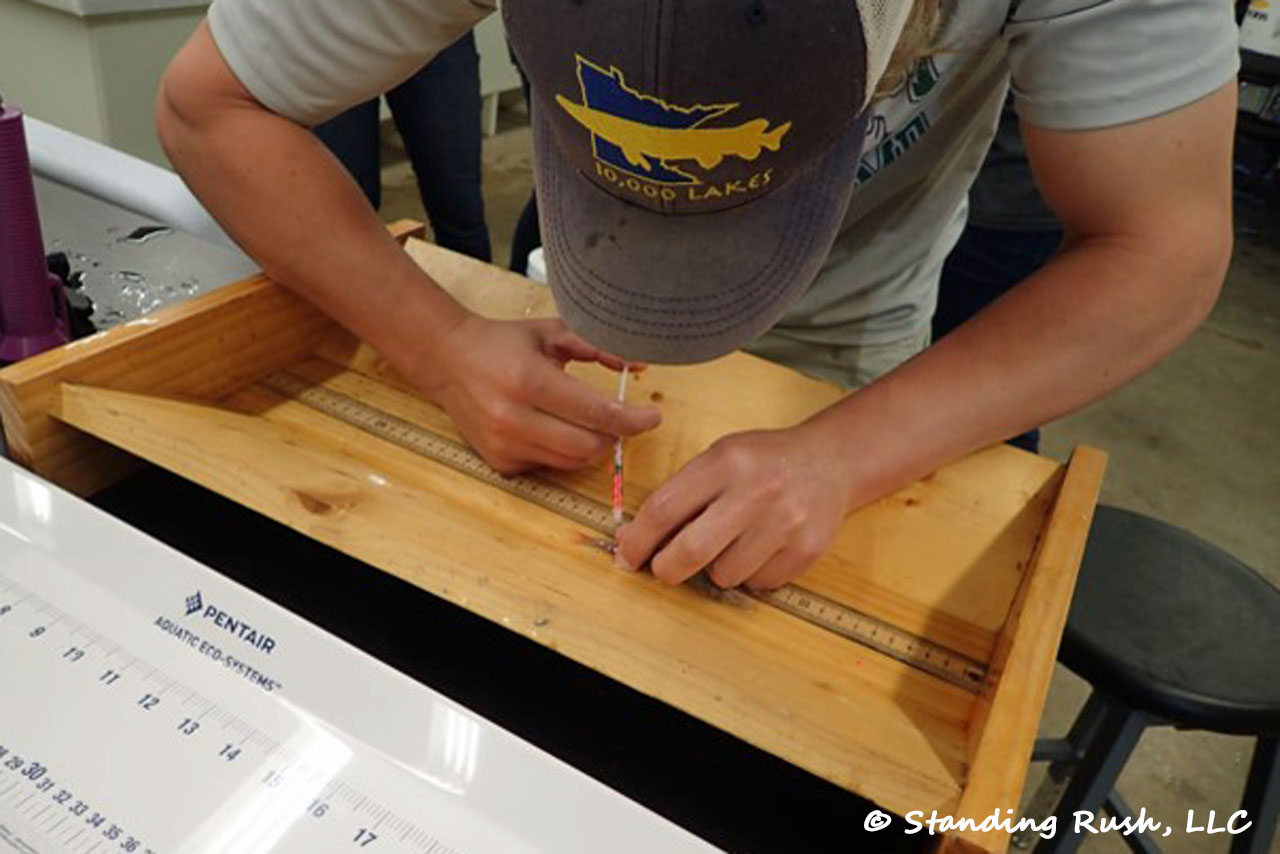
Nate Stott, lead researcher from BGSU, tagging a fingerling northern pike in the TPS lab the day before release
An incoming TPS sophomore helping with fish "tattooing"in the TPS lab last Thursday morning
A newly "tattooed" northern pike at TPS (note florescent dye at base of anal fin)
One enthusiastic bunch -- smiles were broad and fresh stories were already being retold as the students loaded into their vehicles and caravaned the 50 or so miles back to their school . . . so close, but in some ways a world away from the marsh
Nate Stott of BGSU and Laura Kubiak of TPS prep to release bags of ~300 early fingerling northern pike into a 1,200-gal
aquaculture tank that was generously donated to Toledo Public Schools and Laura's lab by Castalia Trout Club;
Standing Rush facilitated a site visit to tour the Club's hatchery and rearing house last fall so students could better
appreciate the operation and where their new aquaculture system was coming from
Call it foreshadowing, but the cover article of the most recent Ohio Outdoor News that Standing Rush was featured in (see below) was entitled "Spring Prime Time for Pike" -- we couldn't agree more. That's why we are once again teaming with Toledo Public Schools NSTC (Natural Science Technology Center), the ODNR Division of Wildlife, and the NJDEP Division of Fish & Wildlife to raise fingerling northern pike for release into the marsh.
One of ~1,200 four-week-old northern pike hatched in
Hackettstown, NJ and delivered to TPS'
Natural Science Technology Center last Thursday
You can read all about last year's inaugural efforts by visiting historical posts. While last spring was a resounding success in its own right, we felt compelled to make a few noteworthy modifications to this year's methodology. The first, and the most significant, is the addition of another foundational partner: Bowling Green State University's Department of Biological Sciences.
As it so happens, BGSU's fisheries lab (which I was a participant in 20 years ago) has a graduate student by the name of Nate Stott who happens to be concentrating his research on the reproduction and early stage development of northern pike in the Western Basin of Lake Erie. He is through his Master's but as we've gotten to know each other more, we've mutually determined that it makes sense to utilize Standing Rush for his doctoral research over the next two to three years.
A related modification from last year is that Nate plans to tag each individual pike (a process that does not harm the fish in any way) in the hope that a subset can be recaptured in the marsh after they are released into the wild. This will both further Nate's research and give us a better understanding of broader fish usage (beyond this single species) on the property. All involved are excited about what can be learned from these future field efforts. (I plan to elaborate on Nate's research in a future post.)
A final key modification from last year is the quantity of fish we plan to raise for release. In 2018, we started with ~225 individuals with a goal of releasing at least 100 advanced fingerlings (5-6" in length). In 2019, we are starting with more like 1,200 individuals with a lofty goal of releasing as close to 1,000 fish as possible. Not only are we starting with significantly MORE fish as compared to last year, we are also starting with significantly SMALLER fish . . . ~2" on average as opposed to ~4" on average. (Much of this size disparity has to do with a delayed spring in New Jersey this past February/March.) The goal will again be to "grow" these tiny predatory fish as much as possible between now and late May/early June -- getting them to eat as much as possible without eating each other! This year, both Nate and I will be interacting closely with the high school students. The idea is to have them take ownership in the project so that it really means something to them when they see the fish released into the wild.
An overview of the young northern pikes' new home -- at least for the next month or so -- at TPS' NSTC lab/classroom
Approximately 300 fingerling northern pike being moved from their transport cooler
(where they spent about 10 hours in the bed of a truck); aeration kept the small fish
healthy until they could be acclimated and released into their new home in TPS' lab
Completion of a critical first step -- the last of the newly arrived northern pike are added to their new surroundings at TPS
Pause the video above a few times as the drone gains elevation (particularly between 0:07 and 0:37). The color contrast in the vegetation below is not only neat to see, it's valuable from a management perspective.
Since very early on in this restoration project, I saw the value of a bird's eye perspective on the marsh. All the way back in July 2015 -- just after taking possession of the property -- a friend and neighbor of one of my brothers (who happens to be a professional videographer and drone enthusiast) offered to come "fly the property." The fifty or so photos and couple dozen short videos that we captured that calm Saturday morning were eye-popping then . . . and have been unbelievably useful ever since.
The raw footage above is one of my favorites. I particularly love the ~30 seconds of footage that starts at or about 0:07. Not only is the marsh incredibly beautiful when looking straight down starting from about 25-feet, the story that unfolds is extremely useful from a technical perspective. If you pause the video at 0:10, you start to see why I get so excited.
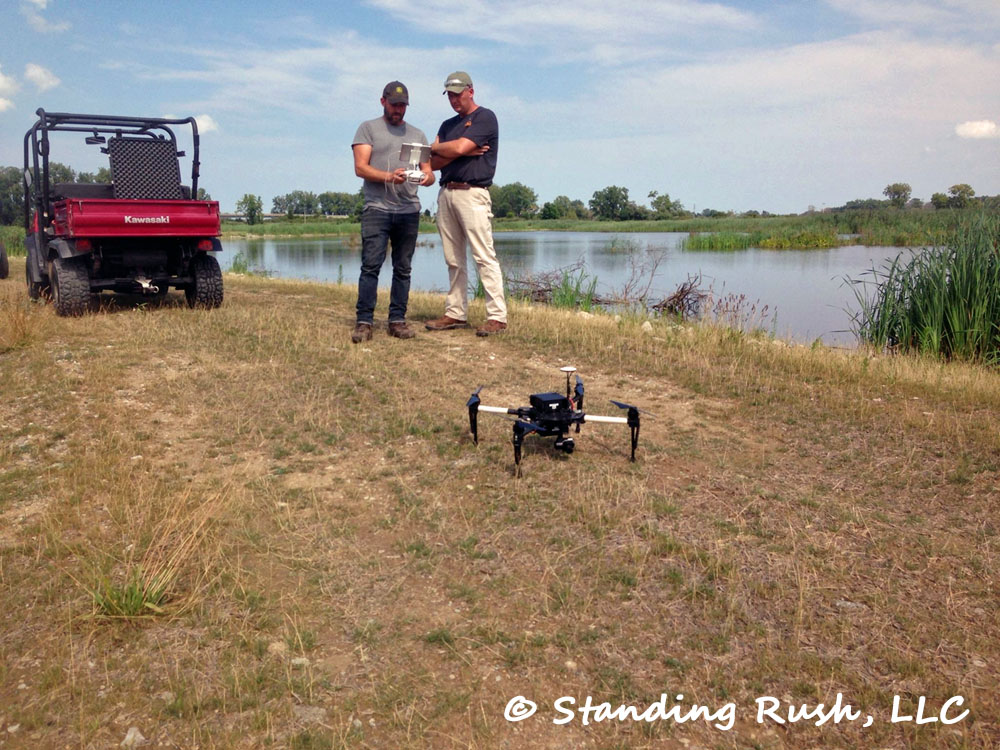
Bryan Ellis of TPS getting acclimated on our main West dike
(pun very much intended) with the school's drone --
equipped with a thermal imaging camera
The individual sprig of mint green among the sea of dark green is a hint. (Sorry, I'm a guy, so my color palette is a bit more limited than an Eddie Bauer catalog. I digress . . .)
As the drone gains elevation and the color contrast becomes more apparent, a trained eye can not only easily differentiate the color, it can also identify the plants! In this simplified case: dark green = broadleaf cattail (a desirable cornerstone plant in our region) and mint green = Phragmites (a monstrous invasive we are tirelessly trying to fight back). So in one ~1:30 video, we confirmed an initial hunch: drones can help confirm what we are seeing on the ground and offer a unique perspective to provide valuable management direction.
All of this makes a lot more sense when you realize that one of our primary tasks each summer is to "map" vegetative cover -- essentially, determine what's growing, where. This is important for a whole host of reasons. It can be done (and very effectively, I might add) the old fashion ways -- in the brain (through on-the-ground, in the wader, or in the punt boat) observation . . . that can then be transcribed to crude pencil sketches and field notes. And it can also be done in much more technical ways.
Yesterday, I hosted an instructor and friend from Toledo Public School's Natural Science Technology Center -- an established component of the new Aerospace & Natural Science Academy of Toledo (ANSAT). First and foremost, Bryan is an extremely passionate and enthusiastic person (which I love). He is also extremely talented and knowledgeable in a wide array of subjects that are very relevant to what we do at the marsh. One of his many talents: a drone pilot. So yesterday, we set two goals. First, we wanted to give Bryan a basic tour (somehow, this was the first time we were able to lure him out!), and secondly, we wanted to get the bugs worked out so that we could try using their program's extremely hi-tech "quad" to prepare a thermal fingerprint of the entire property. Each color will theoretically help us map individual plant species.
Vegetative polygons overlayed atop an aerial of the marsh;
in this case, red would mean spray and green would mean don't spray
I am running low on steam myself right now, so I'll have to elaborate on this on a future post. But the punchline is we need to prepare a visual similar to the one above within the next few weeks. Each shaded "polygon" will correlate to a unique string of coordinates that can then be uploaded into an on-board computer to guide a helicopter as it systematically sprays only the areas we shade and tell the computer (and linked sprayer) to mist with herbicide. The areas could be a couple hundred square feet up to several acres in size over the 500+ acre site.
We did this back in 2015 (combining my brother's friend's traditional drone images and the old fashion ground-truthing techniques) and it worked pretty darn well. We're going to see if we can improve on things with this fall's spraying campaign via our collaboration with TPS. Thank you, Bryan! Should be fun!!
This 60-second video clip demonstrates not only how hardwired northern pike are to be voracious predators, it also shows how one 8" fish can quickly capture the imagination -- not only of a high school student, but really . . . of anyone who is willing to marvel at this amazing creature's innate ability to hunt and grow.
The fish recorded here was affectionately called "Beast" in the TPS lab. At the time of this filming, it was just 10 weeks old. Isolated for its proclivity to eat its neighbor (even if it was the same species), Beast's aggression and appetite ultimately became its downfall. Record-setting heat late last week coupled with too many emerald shiners in the tank (going belly-up before they were all eaten) led the water to sour. It was a loss for the lab, but taught yet another lesson.
A handful of fingerlings were held back from the release earlier this week. As surrogate "parents" for the summer months, my kids and I will house them in our basement. The tank was set up last evening. The goal will be to keep at least a couple pike alive and grow them as much as possible until they can be returned to the TPS students next fall. The biggest challenge will be keeping them well-fed enough that they don't eat each other! Something tells me my 10-year-old son is up to the challenge.
A successful aquaculture project can be measured in healthy fish, but in our case, it can also be measured
in broad smiles and a hands-on introduction to the marsh . . . for all those involved
Back on February 28th, several dozen mature northern pike -- both females and males -- were collected on an unseasonably mild, early spring afternoon from Budd Lake in northern New Jersey. Housed in holding troughs, they made what must have seemed to be a lengthy (and bumpy) ~6.5-mile commute to a state hatchery and rearing facility in nearby Hackettstown.
These early spawners would serve as the broodstock for tens of thousands of fry that began hatching on March 8th at the NJ Division of Fish and Wildlife's Hackettstown State Fish Hatchery. While our planning started well before, this is where a unique collaboration was born -- quite literally. Within this multitude of growing fish was a very small subset of young fingerlings that would soon be making a much more lengthy over-the-road journey -- another 521 miles to Toledo Public School's Natural Science Technology Center.
Some might consider these guys the stars of the show . . .
they were obviously important, but the true stars
are pictured below
Earlier posts document how this diverse partnership grew and evolved, but yesterday, as we successfully released 150 healthy, happy 5-6" northern pike fingerlings into the marsh at Standing Rush, I couldn't help but think of those first 6.5 miles. Because between 2/28/18 and 5/29/18, our little northerns traveled no fewer than 592.5 miles by road -- with the final 65 miles being via escorted caravan to their new home along Sandusky Bay.
Some might think that's a lot of fuss for a few bags of fish. But for those involved, I think yesterday brought consensus that there was a "greater good" at play. The students not only handled the media and agency representatives with grace, they got to get their hands dirty -- again, quite literally -- in the marsh. To me, that's what this is all about.
____________________________________
Some of my favorite "moments" from yesterday, in pictures:
Three dozen northerns (and one student) -- all eagerly awaiting an introduction to a new home
Release #1 (first of four locations where fingerlings were released over ~185 acres of Standing Rush's West Marsh)
Always cool how every release brings anticipation and excitement
Special thanks to (left to right): Laura Kubiak (TPS Wildlife & Sustainability Instructor) and ODNR, Divisional of Wildlife representatives Travis Hartman, (Lake Erie Program Administrator) & Kevin Kayle (Fish Hatchery Program Administrator); not only was ODNR administratively supportive, they also took the time to be with us in person to support the kids’ effort
Ms. Laura Kubiak (back, left in sunglasses) with six of her proud students
just prior to the final release
NOTE: These students were so invested in this project, that they came to Standing Rush on one of their first full days of summer vacation. Quite a group.
P.S. Thanks to WTOL (11)/WUPW (36) for their coverage of our efforts yesterday on their evening news. Keep an eye out for additional coverage via other local media outlets. We appreciate good news being made newsworthy!
An awesome GoPro perspective of TPS's fish, two weeks after their move to Toledo (5/4/18); they are about 10 weeks
old in this image and average about 5" in length (although they range from 4-7")
(Written 5/9/18: I have been getting a lot of inquiries as to the status of this project, so I am circling back to provide an update.)Back in early March, I explained how a budding collaboration with Toledo Public Schools Natural Science Technology Center had evolved into an aquaculture project involving the rearing and (hopefully) ultimate release of fingerling northern pike into the waters of the marsh. Here's a progress report.
The tank that I sourced for TPS is a 300-gal, self-contained
recirculating system with an additional 100-gal capacity
for course and enzymatic water treatment
(the two vertical drums to the right of the circular tank)
Step 1 was determining what infrastructure the lab needed to support such an undertaking. The image to the right depicts our ultimate set-up.
Step 2 involved finding a willing and able outside partner, not only to source the fish but to educate us on the finer points of raising pike that are just 3-6" long. Very few hatcheries "tank raise" northerns -- meaning grow the fish indoors. The ODNR has suspended northern pike production entirely (to focus on species that have a broader geographic impact). Private hatcheries and most regional state hatcheries that deal with northerns hatch the eggs and then release the tiny fry into "growing ponds" when they are half the size of a penny (i.e., about immediately). This simplifies the process on one hand in that the developing fingerlings can feed on zooplankton and size-appropriate food items. They are then re-harvested at a target size and stocked into other waterways -- typically in the fall. This method wasn't an option for us, so a fortuitous cold call to the New Jersey DEP, Division of Fish and Wildlife proved to be the break that I/we needed.
I am so glad that I got the opportunity to visit the hatchery in Hackettstown, NJ in person -- not only was the history of the 100+ year-old facility impressive, but so was the modern rearing room that I visited (above, right), where literally hundreds of thousands of northern pike fingerlings were growing before my very eyes
Step 3 proved to be more challenging than I expected -- namely getting the fish from western NJ the 521 miles to the lab in Toledo. It turns out next-day airing 200+ fish, albeit 3-4" fish, isn't as easy as one might think. And while we thought we had a taxi service setup (capitalizing on a cousin of mine driving through at what seemed to be just the right time), ultimately, I ended up taking a drive myself.
Tyler counting out ~75 fingerlings
into each ~10-gal aerated cooler
Heavy rains had put a hold on our tree planting efforts at the property, so I had to take advantage of my window of opportunity. I left late-afternoon on a Thursday (4/19), got to a hotel within 15 minutes of the hatchery before midnight, and was at the facility gate by 6:30 am to meet an unbelievably accommodating hatchery crew supervisor for a quick tour, orientation, and fish transfer.
My visit was way too short, but I learned a lot in a hurry. I was surprised at how similar their set-up is to what we have now established at TPS. They, too, utilized 300-gal poly tanks. The main differences are (1) their tanks utilize a flow-through system of local, spring-fed water, and (2) they are raising 3,000 fingerlings per tank (not 200 like we are). The good news is, we have room to grow!
We are trying to mimic what they do exactly -- down to the exact auto-feeder and dry feed that we are offering. Seeing this equipment in action not only built understanding but confidence.
I was really overwhelmed at how incredibly friendly, informative, and eager to collaborate my primary contact (Tyler Tressler) and his Hatchery Superintendent (Craig Lemon) were and continue to be. It gives me high hopes that this project will be successful this spring, and hopefully into subsequent springs.
Me with Tyler posing in front of three coolers and 227 fish,
just before departing for a 500+ mile return trip to Toledo
(amazingly, we didn't loose a single fish!)
So, Step 4 has been the really fun part -- transitioning the juvenile fish to their new (temporary) surroundings in the TPS lab. So far, so good. We anticipated up to 20% mortality due to adjustments to new water chemistry. We also have to expect some losses to escape (jumpers) and cannibalism.
The fact is, there is plenty of art to this science, so we have had to feel our way through a bit. But I am really pleased with where things stand as of today. We have lost fewer than a dozen fish to water quality-related issues. We have also eliminated the possibility of casualties due to jumping by making some modifications to the tank. Now, our challenge is to adjust the quantity and frequency of our feeding so that these little buggers will stop eating each other! Man, are they predators. [Aside: Dry feed is offered in very small quantities every 5 minutes, 24 hours/day in the hatchery to try to maximize growth while minimizing the pike's predatory instinct. We are now feeding every 15 minutes, but because we only have ~200 fish in our tank, I am constantly trying to feed enough without feeding too much -- too much leads to deteriorating water quality.]
Most importantly, the students, staff, and even the TPS administration have taken a real interest in the project. To date, the fish have received visits from the Toledo's mayor, local media, and many other visitors to the lab. I said from the onset, even if we end up with ~100 healthy fingerlings to release into the marsh, this first iteration will be a tremendous success. Beyond the numbers, we are connecting dots for people -- how do fish relate to wetlands, and how do wetlands relate to a better quality of life.
We're getting there. We hope to release (Step 5!) in the next three weeks. To be continued . . .
Fittingly, Roy captured this ~24" male northern this past week on the marsh side of our West Pump
(right where I staged the PhotoShop picture in my March 5 post);
this marks the first confirmed pike on the property since we started our work -- it likely came in back in April when
a strong NE storm temporarily pushed bay water over and around our aging pump structure;
it was at the pump because the water temps are probably telling it to head back to the Bay -- pretty exciting
P.S. Here's my first crack at some GoPro video. I plan to do some more to capture feeding behaviors. I'll shoot to post soon!
While I readily admit this image is "Photoshopped" (not me and the fish, but the two of us and the background),
it is my sincere hope that the project I am undertaking with Toledo Public Schools Natural Science Technology Center
may someday yield these results at the marsh
A Facebook post this evening prompted me to create the deliberately crude mashup shown above: me with a ~42" northern pike (caught and released in Canada a handful of years ago) and the West Marsh Rest Pond (captured on a bright afternoon last summer). While this combination may be far-fetched at present, it was very much feasible in years past . . . and thanks to an evolving collaboration with the TPS Natural Science Technology Center -- and our ongoing restoration efforts -- it may be once again . . . and sooner than some people may think.
While we certainly don't have a perfect understanding of the fish diversity currently utilizing the marsh, I do have some educated guesses based on both observation and training. For those who don't know, I am a self-proclaimed and hopefully never recovered fish fanatic. I love just about everything and anything that swims under the water. So even though we haven't done any quantitative monitoring, I have been paying attention -- since day one. And we do have a good sense for what historically roamed these waters and what currently utilizes other "high quality" marsh environments along the Lake Erie coast.
An early northern pike "fingerling" -- likely 2-3" in length;
even at this size these fish are both predator and prey
So, while I could literally write till I've bored every single one of you to submission about what we've seen to-date and what I anticipate we could see beneath our often murky waters, I'll concentrate this entry on the project at hand: an attempt to collaborate with 20-or-so high school students and their instructor to establish an in-lab aquaculture system to raise and eventually release 100+ northern pike into our marsh in Bay View. We have the support of the Division of Wildlife (ODNR/DOW), the project was just officially given the green light by the school district, the primary infrastructure is ordered and on its way, and we now have the necessary permits from the Department of Agriculture to import and raise the fish.
If all works out, our northerns-to-be are currently incubating in a state hatchery in New Jersey;
the facility is one of very few in the U.S. that tank raise northern pike after they hatch to fry
(which typically takes 8-12 days after fertilization)
So, what is the motivation and what is the process -- at least as we anticipate it? First off, we chose this aquaculture project in an effort to make a tangible link between the classroom and our broader efforts in the field. We could have chosen largemouth bass or yellow perch (or many other species), but these and others exist in fairly robust numbers in and around the marsh. "Northerns," by contrast, are not just one of Ohio's true "apex predators" (meaning they sit atop many fish food chains -- which makes them pretty exciting), but their numbers are also relatively low regionally compared to historical benchmarks.
Don't let their skinny stature fool you -- even at a couple
inches long (the size we hope our adopted fish will be
when we get them), northerns are built to eat
(if you're not really careful, they'll even eat each other!)
Northerns have traditionally played an important role in contributing to the balance of many aquatic ecosystems, particularly in water bodies like Lake Erie and those north of Ohio that historically would have had vast expanses of shallow, nutrient-rich "backwaters" (wetlands and vegetated shallow bays). "Water wolves" or "slimers" (a couple of my favorite nicknames for NP) are voracious predators, but they are also prone to sharp declines if they do not have proper habitat (a familiar refrain in wildlife management).
Coastal marshes serve as a critical lifeline -- providing both nutritious and dependable food and vital protection from the elements. As with many fish, wetlands are a protective "nursery" for northern pike.
In all likelihood, northerns have been seeking this refuge over the last several weeks across the Great Lakes. They are one of the earliest spawners of any of our native sport fish. It is not uncommon for spawning to occur beneath the ice, and it's likely that some are making their way from vast expanses of relative open water (in the main lake) to spawning grounds -- even as you read this.
Timing will dictate how large our
"advanced fingerlings" will be
prior to release -- we're shooting
for 6-inches+
The complexity of habitat they seek should offer vegetation upon which they can adhere their vulnerable eggs. But again, those plants also provide protection from unpredictable winds, habitat for a tremendous diversity of food items, and cover from which the northerns can ambush that same prey. Nature has a way of knowing what its inhabitants need, and for a young northern pike, needs are most certainly met in a fully functional wetland.
To me, that's what's so cool about this project. We are working hard in the field to improve ecological function, and the students (with my help) will hopefully be able to introduce a unique species that will be able to directly benefit from our actions.
Additionally, our primary infrastructure improvement for this field season (the water conveyance structure that connects our entire West Marsh directly to Sandusky Bay and all of Lake Erie) is being designed with "fish-friendly" amenities. We not only want TPS's new guests to be happy when they are introduced in late May or early June, we want to make sure that both they and natural populations will have easy access to and from our wetland for years to come. Fingers crossed that we can get the pieces to continue to fall in place to make that puzzle a reality.
P.S. All the photos beneath my creation at the top were sourced from various state agencies. Speaking of state agencies, if anyone is driving between New York City or eastern New Jersey and northwest Ohio in early to mid-April, and would be willing to be an Uber driver for 200 tiny northern pike fingerlings, please contact us -- I'm still trying to figure out the best way to get the vulnerable young fish from a state hatchery in Hackettstown, NJ to Toledo. We may even be able to pay a driver a nominal fee for helping out!