Showing posts with label herbicide recommendations. Show all posts

Tuesday, January 8, 2019

Never Judge a Book by Its Cover: Flowering Rush

Flowering Rush (Butomus umbellatus) -- just because it's pretty doesn't mean we have to like looking at it
(fortunately, the seen above is not on Standing Rush property; but it's close by,
and we're doing our best to avoid a full-fledged invasion)

One of my new year's resolutions is to take the time to circle back into last year's field season to tell stories that I couldn't find the time to tell when the sun rises early and sets late. On a cloudy, balmy January afternoon seated in my office chair, where the quiet is only interrupted at present by the nearly constant ping of incoming email and texts and the distant rumble of seasonally misplaced thunderstorms (currently rolling over the marsh), it seems appropriate to share some summer green.

Clusters of a dozen or more flowers -- each about an inch
across and suspended from an umbrella-like network
of stems -- introduce both vibrant color
and the risk of an unwanted invasion
And in this case, I can also share some pinks, yellows, and lavenders. Flowering Rush (FR) -- NOT to be confused with Standing Rush -- is another of our region's visually impressive but ecologically depressing invasive species. With origins in Africa, Asia, and Eurasia, its range is vast, and based on what we've observed in the last several years, we can see why.

When we began our field work in 2015, Flowering Rush (or "F-ing Rush," as some prefer to affectionately refer to it) seemed very limited, at least in our corner of Sandusky Bay. We can remember isolated plants in a ditch area that fluctuated from inundated to dry multiple times throughout that first season.

But as water levels have continued to rise and hold, not just locally but across the Bay, Lake Erie, and all of the Great Lakes, we've seen what seems to be a sustained proliferation of the glossy-leaved plant all around us -- and unfortunately, to some extent, within our marshes' boundaries.

While the surface area impacted remained relatively modest in 2018 (under a single percent of our overall area), Flower Rush eradication became Job #1 for Roy last June - August. Many a hot day was spent scouting and spraying. Unfortunately, mechanical control (e.g., cutting or pulling) only amplifies the problem thanks to scores of stubborn "bulbils," or bulb-like propagules that grow within the root structure. A backpack sprayer (equipped with a cocktail of glyphosate, imasapyr, and a surfactant ) did the job for individual plants and small, isolated pockets that typically hugged dikes and canals. But on a few occasions, we actually tag-teamed to carefully apply herbicide both by backpack and by boat (equipped with a battery-powered ATV sprayer tank).

Roy on Flowering Rush patrol; identification was relatively easy as our eyes got trained to the showy, pink inflorescence --
but the challenge is FR tends to come on strongest from mid-late summer and blooming is a staggered event;
plus, the invasive seems quite at home among our desirable cornerstone emergents: cattail and soft-stemmed bulrush
Isolated plants (especially with flowers) became easy to identify and spray, but it seemed to take two discrete spray
events, separated by at least a week or two, to achieve the desired result
An example of what a FR looked like when it was ready for its second spray; two weeks later very little vegetation
remained, at least above the water surface
At first blush, this stand of largely soft-stemmed bulrush (a desirable emergent species thanks to its food and shelter
contributions) does not look too bad; but click to enlarge to see all of the pink flowers of FR circled in red
An off-site location heavily infested with FR; the risk is that, much like Phragmites, Flowering Rush will become a complete monoculture -- monopolizing the unique setting without supporting much other plant or wildlife diversity to speak of

We have heard horror stories of Flowering Rush growing from depths of up to nine feet of water and in monocultures so thick and persistent that impacted areas -- sometimes hundreds of acres in size -- are virtually impenetrable. But we are seeing decent evidence that FR doesn't respond well to turbid water (a condition we can encourage, as needed) and that we have a herbicide technique that should be effective. So for now, we feel fairly optimistic that we are staying on top of the onslaught. It's another chapter in the invasive species saga.
Thursday, September 20, 2018

Aerial Spraying: A Critical Tool in Our Toolbox

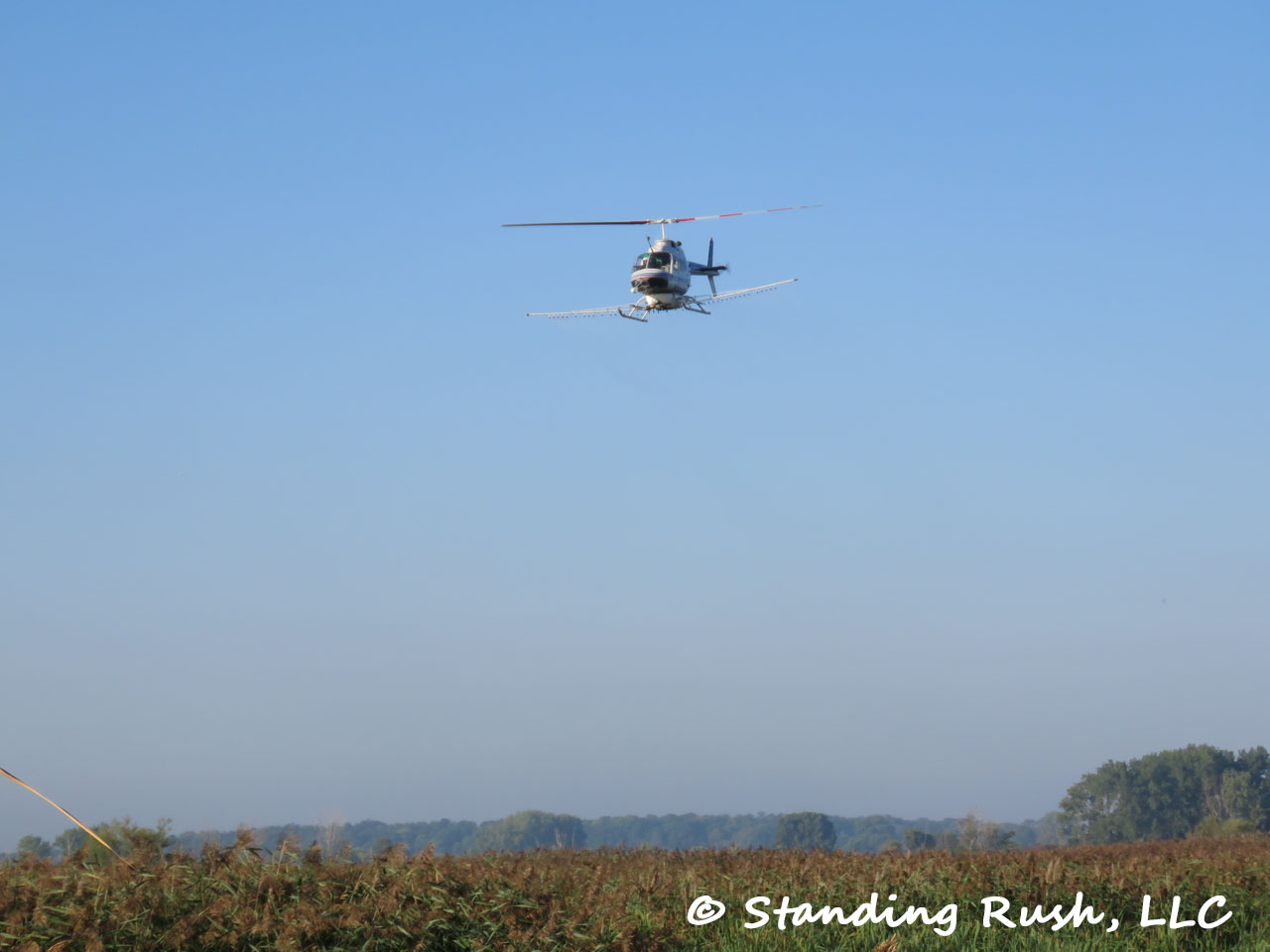
A "bluebird sky" and next to no wind made for pretty much ideal spraying conditions

Earlier this week Standing Rush was visited by the single most important tool in our fight against Phragmites australis: a specialized helicopter equipped to mist low concentrations of herbicide onto dense stands of the noxious, invasive plant. In less than an hour we were able to effectively treat more than 90 acres of Phragmites monoculture. Because the reed grows so aggressively ("mono" = one; "culture" = plant), we can efficiently target the "bad" (invasive species) with minimal collateral damage to the "good" (desirable native plants).

Unless framed by a dark background (e.g., trees above), it is often very hard to even see the herbicide as it is being applied

Lots of research has gone into what and when to spray for maximum efficacy. A generic cocktail of Rodeo® herbicide (a commonly utilized glyphosphate used in aquatic settings) and water is applied at a 5% solution. While this mix could be considered relatively "hot" (concentrated), the combination of the misting applicator and the circulation of the helicopter blades allows for effective treatment at surprisingly low total volumes. 

Late summer/early fall spraying has proven to be the most effective time of year when targeting Phragmites. There are a couple key benefits to this timing:
(1) the target plants are actively pulling moisture from their above-ground stems and leaves in preparation for winter dormancy (thereby effectively transporting the herbicide throughout the plant and roots), and
(2) if sprayed late enough in the season (as we hope to have this year) any desirable, native vegetation -- on the fringes of spray zones or when less frequently interspersed within the Phrag -- can either be given time to drop viable seed (for future colonization) or be spared completely (due to earlier dormancy).

Most of the work on our end ties back to preparation for spraying day. While we weren't able to fully implement our drone reconnaissance this year, we did manage to establish detailed maps for the pilot to direct both he and his aircraft to the specific areas we wanted sprayed. We ended up reviewing last year's aerial imagery and then ground-truthed and refined our guestimates to establish several dozen discrete "polygons" -- or shapes formed by actual GPS coordinates. By downloading the shape files, the pilot can then let his instrumentation dictate when and where to spray. And all we have to do is sit back and watch!


More Phragmites can get sprayed in this ~30 second video (and often with better accuracy) 
than we could possibly hope to accomplish in an entire day spraying from the ground

Special thanks to a collaboration between the USFWS, the Ohio Division of Wildlife, and Winous Point Marsh Conservancy for allowing this important work to get accomplished. Standing Rush was one of just a handful of properties selected for spraying through the program this year. Not only did we benefit from cost-sharing to defray management costs, the spraying also helped to set the stage for a healthier vegetative community next season and for years to come.


Thursday, June 22, 2017

Not Just Poisonous But Stubborn & Spreading

A closeup may be attractive, but this plant is trouble

Parsley, celery, carrots, anise, fennel, cilantro, and POISON hemlock – as they say, “One of these things is not like the other.” All are members of the carrot family (Apiaceae, formerly known as Umbelliferae), and all but one are – not only non-toxic –  but edible.

One significant challenge comes when poison hemlock, an arguably visually appealing plant, is misidentified. If ingested, as few as a handful of leaves – or any of the other anatomy, including the seeds and roots – can incapacitate an otherwise healthy adult in a matter of seconds. The potent toxin causes permanent paralysis of the muscles, including those used for breathing. Remarkably, this plant is truly lethal (ask Socrates), and there is no known antidote.

Another significant challenge is that beyond the extreme toxicity of this outwardly innocuous carrot-like impostor, poison hemlock joins a growing list of invasive plants as a true nuisance in the marsh community. Europe was home originally, but now the plant is increasingly common along roadways, railways, field edges, disturbed sites, wet areas, streambanks, pastures, and even ag land in much of the United States. According to the Ohio State University Extension program (2012), "The population of poison hemlock along field edges, in fence rows, around barn lots, and now even growing throughout hay fields seems to have reached new proportions," in the state, and its versatility is making it a rampant invader in Ohio (and beyond).

When I first sat down to write this post, I thought I’d have to commission Roy to procure some photos. There is no shortage of photo-documentation online, but I wanted images from our specific property. What I found in looking back at just about any landscape shot we’ve taken in the last three weeks is that poison hemlock is at least present just about everywhere there is relative high ground. It loves the dikes, particularly in areas where cool season grasses are thin and/or Phrag is or was recently prevalent.

Poison hemlock lining both sideslopes of the dike where the portable pump is now installed; these plants are a modest 3-6' tall, but prolific flowering means prolific seed production if we don't get ahead of them

We can attest that this plant readily grows in excess of 10 feet tall in moist, fertile conditions. A subtle side note from an Illinois source says it “likes calcium-rich substrates.” We fit that bill, too – our marl-rich soils certainly qualify.

By way of identification, the plant produces small white flowers that are typical of the carrot family, and has a smooth, hairless purple-spotted stem and dark, glossy-green, fern-like triangular leaves in addition to a fleshy, white taproot.

To confuse things further, poison hemlock is often mistaken for another noxious and toxic invasive plant called giant hogweed. It exhibits many crude similarities in form and is one that is also spreading rapidly across Ohio.

Although poison hemlock is more known for poisonings as a result of ingesting (particularly by an unsuspecting cow), I've found evidence that the plant’s natural oils may absorb through the skin. According to the University of Illinois Extension, simply handling the plant seldom causes a toxic reaction in humans, but “ingesting” it even through the eyes or open wounds can cause poisoning. For this reason, I’m now in the habit of wearing a mesh face shield and safety glasses when I’m encountering the plant with our bladed power trimmer.

Where's Waldo? Can you find the
swallowtail caterpillar happily
munching away on this hemlock?
(click to enlarge)

I just received the bill for our second mowing of the season, and couldn’t help but notice the note added IN BOLD to the invoice, “HEMLOCK BECOMING A PROBLEM” – Joe is being kind; that’s an understatement. We are trying to mow and trim more often so that grasses might outcompete. Mowing after the hemlock has bolted and before seed set will prevent seed production. But because this relative newcomer hasn't historically been prevalent enough to be problematic, we're still developing a more comprehensive management strategy.

While poison hemlock can be partially managed by mowing and tilling, it seems the most effective control approach involves properly timed applications of selective post-emergent herbicides. Flowering begins in early to mid-May and really seems to hit its stride in June on our property. It is a prolific seed producer, so applications of herbicides made now should reduce seed production.

Based on OSU Extension recommendations, there are several herbicide options. Crossbow, Banvel and 2,4-D are all thought to be fairly effective on small poison hemlock in the spring. Taller plants may can be controlled with glyphosate (Roundup) during the summer months, so we may start experimenting with selective spraying soon. Being a biennial, however, poison hemlock is perhaps most effectively controlled late in the fall. We'll be experimenting with a variety of tactics, and we're certainly open to suggestions! Eventually, I hope to be able to report back with some success stories.