The ever-striking Common Gallinule is becoming that much more common at Standing Rush thanks to expansion
of desirable vegetative habitat (and all the shelter and food options that come with a diversity of native plants)
Despite significantly shorter day length and considerably more hours of darkness in the evening, (candidly) it has still been a major challenge to regain the discipline of regular journal entries. Per usual, it's not for a lack of activity in and around the marsh. [More than at any time in this project's five years, I also continue to be very busy at my desk planning for future improvement opportunities.]
These types of distinctions, while always
appreciated, are a tangible reminder
of the importance of collaboration
-- no great work happens
in a vacuum
The images above and immediately below are in recognition and appreciation of an evening well-spent this past Saturday. I was invited as a guest of the Firelands Audubon Society to its Lake Erie Wing Watch banquet in Huron, Ohio to receive its conservation award on behalf of Standing Rush. A passionate ~125 attendees filled a room surrounded by exhibitors displaying all things birds. A very talented and articulate keynote gave an incredible talk about an entire year fully devoted to birding. But as I settled in to dig into my delicious meal (including homemade elderberry pie!), it became obvious that this group extends its enthusiasm not only to their ultimate pursuits -- the birds -- but to everything it takes to support their well-being.
It was an honor, of course, to be recognized for our efforts, but even more so, it was an honor to spend some time with this group. Our paths officially crossed when a couple of their active members -- Bill and Dorthy Baker -- took a tour of Standing Rush as part of the Biggest Week in American Birding this past spring. Their friendliness, enthusiasm, active curiosity, and professionalism all contributed to their instant appeal. And now we can hopefully add another talented group to a growing list of collaborators. We look forward to the opportunity to tour them on-site soon!
With so many projects going on simultaneously, we just haven't been as diligent about taking (and sharing) wildlife images;
that doesn't mean we haven't enjoyed watching broods like these gallinules grow up before our very eyes
Other highlights over the last few weeks include:
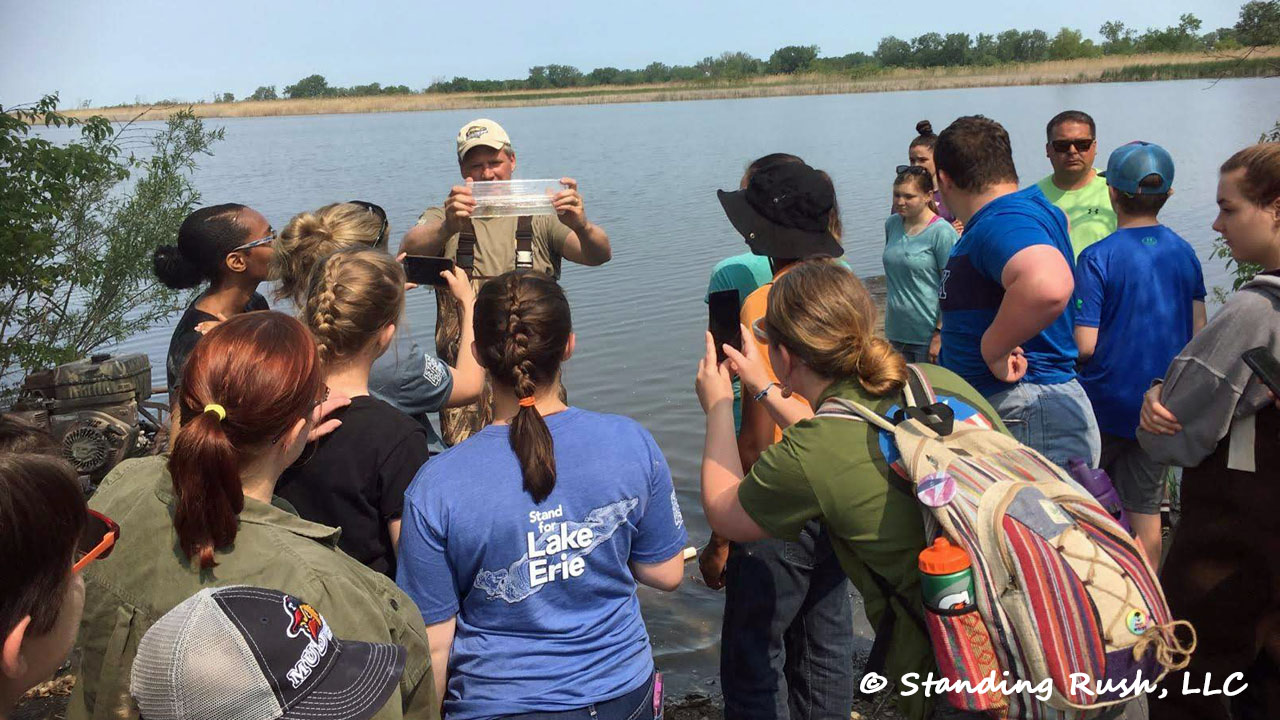
Annual fish sampling in and adjacent to Standing Rush's West Marsh (once again in conjunction with BGSU's Fisheries & Aquatic Ecology lab and some scientists in-training);
installation of an initial pipe and screw gate to provide targeted connectivity between Standing Rush and an adjacent agricultural drainage ditch (to intercept storm water runoff before it enters Sandusky Bay);
berm rehabilitation on the interior of our West Marsh's bayfront dikes (including earthwork and seeding);
the start of another waterfowl season: with persistent hot and humid weather, teal and early goose season opened somewhat unceremoniously the weekend before last -- there have been a few mornings of activity (coinciding with brief cool-downs) thus far; we're optimistic that the best is yet to come . . . there's a lot of duck season ahead of us.
The fish does not have to be big to capture one's attention; here we count rigid dorsal rays of a yearling crappie
to distinguish black from white
Fish sampling once again took the form of multiple, strategically placed Fyke nets and a good amount of seining;
plans to electrofish just outside our new water conveyance to the bay were scrapped due to high winds,
but the usual late-summer suspects were still identified, tallied, and released within the marsh
The nondescript pipe at the center of this image may look pretty uninspiring, but we hope it will be the start of some
really exciting water quality improvement opportunities at and around Standing Rush
This image was taken to document the amount of debris (mostly bladderwort and cattails) caught by the debris screen
in front of our new pump in just a few short hours, but the background is a good visual of the extra protection
provided by recent berm rehabilitation efforts (lower marsh water level to left; elevated bay water level to right)
Just like the early arrival of teal, seeding dikes is starting to feel like an annual right of passage;
like so many things that Roy does quietly and without fanfare around the marsh,
his careful attention now will bear dividends later
Q: How have three weeks gone by since my last post?!
A: Continued historic high water (leading to daily vigilance in observing water levels within the marsh to detect and repair inevitable leaks); pressing for clearance from the USACE for the green light to start another dike rehab project (see aforementioned leaks -- I'll write a dedicated post on this very soon); tying up the loose ends from our first GLRI-funded project; prepping for our second GLRI-funded project; tours; meetings; another cooperative management agreement with ODNR Private Lands; more work on our WRE easements (East and West); and, of course, more fish!
Yep, it's been a busy month of June.
It's always difficult to recap a day in the marsh -- much less a week . . . or multiple weeks. So I'll just try to hit some high points. And per usual, I'll try to share representative images to help tell some individual stories.
The first is one we're particularly excited about because it's yet another example of "if you build it, they will come."
A little over a week ago we were hosting a group of a dozen or so biologists, ecologists, and water chemistry experts. Our tour ended at our new pump and water conveyance structure. Just as we were talking about the attributes of the "fish-friendly" design, Roy looked over the guardrail and noticed something we've never seen before . . .
Tens of thousands of shiners along with a "slurry" of juvenile fish <1" long had congregated in the 50-foot flume of our new structure. Although the pump had been running for several days with nothing but the occasional and isolated school of juvenile mosquito fish visible, something cued this mass concentration.
The emerald shiner is a favored baitfish, not only by fishermen,
but more importantly by yellow perch, walleye, bass, crappies,
As soon as we concluded the tour, we were one the phone with our good friend Jim Johnson. As a Bay View native and lifelong outdoor enthusiast, Jim grew up hunting, trapping, and exploring the marsh. (I've written of Jim before because he is a true marsh lover and is our lead punter on the West Marsh.) Jim also happens to be a licensed commercial minnow fisherman and bait store owner who has seined and dipped for emerald shiners on Lake Erie for more than three decades.
Jim's truck arrived in a matter of minutes. Quite simply, he was awestruck. Jim confirmed what we suspected. The shiners were largely "emeralds" (with a few spottails mixed in for good measure) and they were there to spawn.
Moving water is a primary draw, but other factors like water temperature, photoperiod, water clarity, water chemistry, and even lunar cycle can all play a role in increasing numbers. It's always fun to see such a concentration of life. But it is particularly exciting with the context that emerald shiner populations have been on the sharp decline throughout Lake Erie for the better part of a decade.
These emerald shiners were dipped from within the structure just long enough to be positively identified and then were promptly released (unharmed)
Jim said he hasn't seen a congregation like we've witnessed (much less a spawning event) in years. He was so enthusiastic about seeing the phenomenon -- which lasted the better part of a week -- that he was more interested in sitting and watching than filling his nets, mobile tanks, or bait shop (even though he was running low). Reality is, we were all just content to sit and watch the shimmering ebb and flow of life . . . with smiles on our faces.
SIDE NOTES:
(1) To read more about the decline in the emerald shiner population on Lake Erie, check out this article from my friend, John Hageman. Contributing factors may be high predation from historically large populations of walleye and yellow perch; high susceptibility to a viral disease called VHS (Viral Hemorrhagic Septicemia); increasingly volatile spring wind events (notably Superstorm Sandy in 2012); and potentially even mortality related to harmful algae blooms (HABs). Another reality though is that some populations tend to go through natural cycles. Here's to hoping Standing Rush can be contributing to an upturn!
(2) It turns out that the smattering of "little fish" in the structure are a mix of species that have hatched in our adjacent estuary or the open bay over the last several weeks. So far, I've confirmed white perch (and probably white bass), bluegills, crappies (probably both white and black), gizzard shad, and carp. I would suspect there are also walleye and probably a handful of other species. Interestingly, as recently as yesterday, only a few isolated shiners were visible in the structure -- now replaced by clouds of tiny (0.5") yellow perch. As I left yesterday, a solid mass of juvenile yellow perch covered an area 6' wide by about 20' long and were packed in from the surface to at least a depth of 2' -- where turbidity prevented visible confirmation at greater depths. If the entire water column (now about 6' deep) was full of these tiny fish, again, it would be safe to say there were tens of thousands just within the structure itself.
Even as the clear marsh water mixed with the wind-churned turbidity of bay water, the shiners put on a show
for the GoPro (each of these shiners is about 3-inches long)
More fun GoPro footage --don't miss the others lurking in the murky depths!
Two breeding male sunfish, both less than 4" long, collected right off our main dock -- the smaller is definitely an Orangespotted Sunfish; the second, is perhaps less clear (*see bottom photo; be sure to click to enlarge)
Earlier in the week, I started contemplating what I thought would be a straight-forward information share to explain another neat collaboration between Standing Rush, Toledo Public Schools, and Bowling Green State University. Essentially, I'm replicating an effort that I executed in the summer of 1997 with my undergraduate institution (St. John's, MN), the University of Minnesota, and the MN DNR -- embarking on what I called a "scavenger hunt" of freshwater fish biodiversity.
Twenty years ago, my target was fish of the "Land of 10,000 Lakes." Today, through the cooperation and permitting oversight of the Ohio DNR Division of Wildlife, we are building a collection of the fish of Ohio. With all the rain we continue to get, people might start calling me Noah . . . but in our particular case, we're not looking to collect mating pairs -- we are actually shooting to gather between one and ten individuals of as many different species of fish as possible. Each "specimen" (individual of a given species) needs to be in good condition, show characteristic physical attributes of the species, be of a target size, and be from Ohio waters.
Once collected (by net, trap, electrofishing, or even hook and line) and deemed appropriate, the particulars of the sampling location and sampling method are carefully recorded, and then the individual fish are euthanized and placed in a bath of diluted formaldehyde for 10-14 days. Each will then go through a series of water rinses over another 7-10 days before they are placed in lab-grade ethanol (rubbing alcohol) and stored in either glassware or plastic jars.
Brook Silverside (an elegant insectivore with an up-turned "beak" perfectly evolved to target larval, terrestrial, and flying insects) are another relatively common species in Standing Rush waters
According to A Naturalist's Guide to the Fishes of Ohio, a timely field guide packed with incredible reference photos and meticulously researched and well-organized species detail, Ohio boasts of some 187 species of freshwater fish (17 of which are either hybrids or invasive species). Our goal is not to collect them all, but instead to build a physical "library" of the most common 40-60 species that are encountered in the state.
These types of collections serve two primary functions: (1) They provide another form of hands-on learning so that students can physically touch and see the dizzying array of species that live and fight for survival in the waters we see around us; and, (2) because these collections can last literally decades, they can provide valuable insights to both students and researchers years and years down the road.
Either Black Bullhead or Brown Bullhead (very difficult to distinguish & commonly hybridize) photographed along our new water control structure, using a GoPro
As I've mentioned several times before, I am a self-proclaimed "fish freak" -- I can (and do) sit with child-like curiosity every time I get to intimately observe another species. From colors to textures, fin structures to body adaptations, I always marvel at how evolution and ecology intertwine.
Sure, it's my hope that several dozen specimen jars -- and the process by which the collection is assembled -- will spark more fish enthusiasts. But I am perhaps even more hopeful that it will get the gears turning for even more people about how our actions impact our landscapes and how our landscapes impact the life that can be supported.
Unless you are living under a rock, you've likely heard that a recent UN report suggests over 1-million (that's 1,000,000!) species of plants and animals are at risk of extinction -- that's permanent elimination from the planet Earth. Just today, I read of how this loss of biodiversity draws sobering parallels to the 'Great Dying' -- the global extinction of life of some 250 million years ago. (Please consider taking the time to read the two articles linked above for broader context.)
A recent article published in the journal Science also shines light on another sobering (and related) trend, the national and global reduction of protected lands, particularly since the year 2000. These forces are big, they're complex, and frankly, they're scary. At times, they can feel insurmountable. They also strike right at the core of Standing Rush's primary mission. So, in my mind, I have two choices: (1) stick my head in the sand and act like there is nothing wrong, or (2) fight for the mission of Standing Rush while helping to shine light on the broader challenges facing our world. To us, there really is only once choice.
A large Bowfin, or "dogfish" patrolling the waters off our old pump station
Golden Shiner, a relatively "common" member of the family Cyprinidae (the largest group of Ohio fishes) and an important food source for many larger, predatory game fish
Pumpkinseed Sunfish can easily be mistaken for Orangespotted Sunfish (see top image) and identification is further complicated by the newly recognized Northern Sunfish (Lepomis peltastes) that just achieved species status in 2013; all three appear to be present at Standing Rush
Students from Toledo Public School's Natural Science Technology Center (TPS-NSTC) help process the catch from a Fyke net
set at Standing Rush last Friday morning; a voluntary field trip to release fish provided the perfect opportunity to catch fish
(not to mention identify them, hold them, and marvel at their unique physical features and incredible diversity that can
best be appreciated through hands-on learning)
If the first half of May was dominated by birds at Standing Rush (and with the awesome diversity, it sure felt like it was), our migratory visitors on the wing were forced to share the stage with fish during the latter half of last month. Considering that the U.S. Army Corps of Engineers just recorded water levels on Lake Erie to be the highest ever recorded in the month of May, I guess it's fitting. Whether we like it or not, water, water (truly is) everywhere . . .
This year's northern pike release featured fingerlings
that started off smaller and ended up bigger
(on average) as compared to last year
But lucky for us, so are fish. And thanks to TPS's Natural Science Technology Center -- through an ongoing collaboration with Standing Rush and now Bowling Green State University -- we've just added more than 100 more healthy, happy northern pike fingerlings to the watery fray.
The release took place on a picture-perfect late spring morning late last week. But for the dozen or so students (and dozen or so parents, families, teachers, and adoring fans), it was actually one of the first days of summer vacation. That made the turn-out to Standing Rush even more impressive.
It was truly gratifying and awe-inspiring to witness the enthusiasm. And after another semester of working together, it was wholly satisfying to witness the attentiveness, genuine interest, and passion with which these kids experienced the marsh. Volunteers were eager to pull on hot neoprene waders to lend a hand, to get mud boots muddy, and to zip on life jackets to accompany there carefully nurtured foster fish to their new homes.
Roy returning with a couple happy students and an empty plastic bag, having released a couple dozen more
northern pike fingerlings into the West Marsh
Students were as eager to learn fish identification (as with
this black crappie) as they were to man the 15' seine net
used to catch
And while releasing fish was the primary focus of the day, we wanted to make sure that we gave these students the hands-on opportunity to do some "sampling" as well. Fish sampling or monitoring goes way beyond capture by hook and line. It is important not only because it provides a glimpse into the diversity of fish species using a specific water resource, it also offers hints on population trends as well as how the environment can be augmented to support either higher numbers, use of the habitat by specific targeted species, or in some cases, both.
Sampling is also very important to this collaboration because (a) follow-up monitoring by BGSU with the hope of recapture of a subset of the released individuals will hopefully shed more light on the reproduction and early development of northern pike that is central to their specific research, (b) because fish monitoring in general can help us better understand how our newly improved connection to Sandusky Bay is improving fish stocks within our specific marsh [and shed light on how similar structures can help fish stocks in similar habitats on Lake Erie and beyond], and (c) because Standing Rush is assisting TPS in building a reference and teaching collection of the fish of Ohio -- I'll write more on this exciting project very soon.
A forth reason fish sampling is important is it's just plain fun. It gives people a unique glimpse into an underwater world that can be difficult to see and appreciate otherwise. And especially for young people, seeing and handling all the different shapes, sizes, and colors can ignite a spark of interest. In my particular case, that spark was fortunate enough to be nurtured into a lifetime flame -- a lasting passion for all things fish.
Here are some more photos from a great day in the field (and in the water) and from the final day in the lab leading up to the release.
Three students made hauling in the Fyke net a lot easier on Roy (foreground, left)
and me (center, top near float)
A captive audience taking in the details about another (temporarily) captive fish
Me with a couple of TPS's most devout fish enthusiasts (both holding nets) with their equally enthusiastic and devoted
instructor, Laura Schetter Kubiak [note all four of us are donning our Standing Rush graphic T's!]
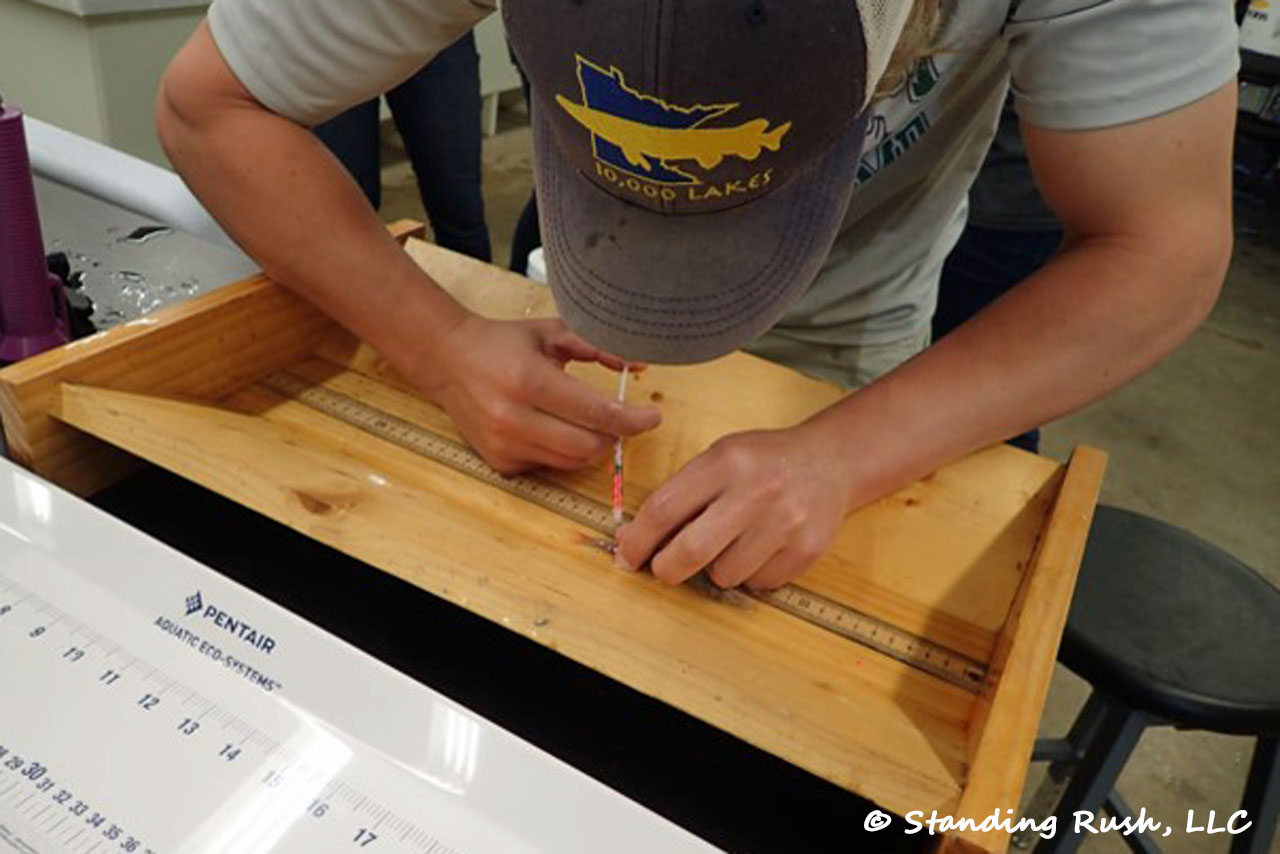
Nate Stott, lead researcher from BGSU, tagging a fingerling northern pike in the TPS lab the day before release
An incoming TPS sophomore helping with fish "tattooing"in the TPS lab last Thursday morning
A newly "tattooed" northern pike at TPS (note florescent dye at base of anal fin)
One enthusiastic bunch -- smiles were broad and fresh stories were already being retold as the students loaded into their vehicles and caravaned the 50 or so miles back to their school . . . so close, but in some ways a world away from the marsh
Terrain alone makes fish sampling in these environments complicated
Fish collecting in wetland environments is notoriously difficult. Gathering representative data on the species diversity and relative abundance of each type of fish present at any given time presents major challenges. Water levels vary (and are often too shallow for sampling using traditional boat-mounted methods). Obstacles are abundant (whether in the form of diverse islands of vegetation, submerged woody debris, and/or soft sediments). Generally, sampler access is rarely easy and opportunities for refuge and sampling evasion are immense.
Fyke net setup just inside the marsh at the
soon-to-be-replaced pump structure
But on the eve of equipment mobilization for our much anticipated "Water Conveyance Replacement Project" in our West Marsh (our biggest restoration activity of the 2018 field season), we had to give it "the old college try" -- quite literally. Yesterday, one day before the start of their fall semester, three graduate students from the Bowling Green State University's Aquatic Ecology & Fisheries Laboratory volunteered to join us for a long, sweaty, and -- for a self-proclaimed "fish freak" like myself -- very FUN day in the marsh.
The goal: Utilize multiple sampling techniques to gather a pre-construction "snapshot in time" as to what fish are currently utilizing the West Marsh and the bayside communities immediately adjacent to the structure that will soon be replaced.
So, it made sense to start at what will become the construction zone. The first Fyke nets were set on either side of the soon-to-be demolished concrete structure -- one on the marsh side and one on the bay side. We then spent the balance of our first hour setting three more trap nets at other strategic locations within the West "Rest Pond" and the "Main Marsh," immediately adjacent to the south.
Fyke net setup just outside the marsh and soon-to-be-replaced
structure, extending into the estuary to Sandusky Bay
Because we were trying to accomplish our sampling blitz all within one field day (and because we also wanted to reduce the probability of turtle mortality in the hoop nets), we opted to shoot to soak the stationary traps for approximately four hours each. While there is always eager anticipation built into this waiting period, we didn't have time to dwell on the waiting game. We spent any "down time" actively sampling a handful of interior locations by pulling a 3-meter seine with an oversized collection bag. This method most certainly has its limitations (we could literally see certain species like carp and largemouth bass swimming out in front of us), but it definitely produced some unique findings.
In my experience, I've found it is a lot more gratifying to frame fish sampling in terms of what you capture (and learn) rather than what you don't. Every sampling event is another learning experience. Time of year, time of day, weather conditions, sampling methods, access capabilities -- they all play major roles. Of course, we would have loved to see more yesterday. But we caught fish!
A pile of young of year sunfish -- predominantly bluegill, pumpkinseeds, orangspotted sunfish, green sunfish,
black crappies and white crappies collected in one Fyke net haul --
nearly every one of these fish was born either this year or last
We have been waiting for a day like yesterday for a long time (for me personally, since day one). So it is normal to wish you could record every last species -- heck, every last fish -- swimming in the marsh! But yesterday was just our first effort. It was the proverbial "snapshot in time." Our human resources were limited (though highly motivated); our methods were limited (we didn't even get to backpack or boat-mounted electrofishing); and, our time was finite (although we busted a lot out between 9AM and 6PM on one humid, 90-degree late summer day).
Identifying and counting sunfish
as they are removed from the net
and released
In the end, our sampling yielded 14 species, most certainly dominated by the Centrarchid Family (the "Sunfishes"):
Bluegill (Lepomis macrochirus)
Pumpkinseed (Lepomis gibbosus)*
Black Crappie (Pomoxis nigromaculatus)
White Crappie (Pomoxis annularis)
Green Sunfish (Lepomis cyanellus)*
Orangespotted Sunfish (Lepomis humilis)
Largemouth Bass (Micropterus salmoides)
Others included:
Gizzard Shad (Dorosoma cepedianum)
Brook Silverside (Labidesthes sicculus)*
Western Mosquitofish (Gambusia affinis)
Common Carp (Cyprinus carpio)
Goldfish (Carassius auratus)
Golden Shiner (Notemigonus crysoleucas)
White Bass (Morone chrysops) -- estuary only
I maintain a master list of species that we have observed since we first started work on the property. My list of fish species is now up to 26 after yesterday's efforts. Those starred above were new finds yesterday. Those that we did not see yesterday that we have seen before on the property include: Channel Catfish, Black Bullhead, Brown Bullhead, Yellow Bullhead, Bowfin, Freshwater Drum, Emerald Shiner, Yellow Perch, White Perch, Smallmouth Bass, Northern Pike, and Steelhead (Rainbow Trout).
It would have been super cool to recapture one or more of the northerns that we stocked in conjunction with TPS this past spring. Nate, one of the BGSU masters students, is actually working on his doctoral degree on how northern pike utilize coastal habitats on Lake Erie. Sounds to me like a reason to keep sampling at Standing Rush!
Here are a few more of my favorite photos from yesterday's efforts. I'll try to post some of the individual fish species that we collected soon.
Deploying, retrieving, processing, and recovering Fyke nets -- like all fish sampling -- is best accomplished as a team
This little guy stuck with us and was completely hands-on for a full twelve hours; I woke him just before 7 AM
and we got home just before 7 PM -- we might possibly have a scientist in the making; he was in hog heaven
Our dedicated crew from BGSU -- they definitely reinforced a common student mantra: "We'll work for food!"
And they did it with smiles and enthusiasm -- appreciate it, guys; hope it can be the start of a continuing collaboration