Showing posts with label northern pintail. Show all posts

January 2021: Turning the Page

While admittedly mostly a psychological victory, there definitely was a sense that a hurdle had been overcome by successfully closing the books on 2020 and welcoming a new year. 

Speaking of "eyes wide open," check out this stare . . . mink always look like they got caught with their paw in the cookie jar when you finally get them on film. This is one of the better ones we've been able to capture (credit: Roy)

It's not that last year was terrible from a professional perspective at the marsh (it could have been a whole lot worse), but the reverberations of the pandemic were (and are) certainly being felt at Standing Rush: understandable but still difficult uncertainty surrounding future funding opportunities; dramatically reduced visitation to the property; significantly less direct educational outreach (although there is definitely some neat stuff on the near-term horizon that was hatched during the current academic year); limited contractor interaction . . . the list could go on. 

But the bottom line is we continued to make progress, even if it was not at the pace we have grown accustom. And there are signs of light at the end of the public health tunnel. So we just need to keep the faith and keep trudging forward with our eyes wide open.

Skim ice was about as much as we could muster in January, with 26 of 31 daytime highs above freezing in Bay View; this made for good conditions for the "puddlers" to keep puddling.

Another typical early winter scene in the Rest Pond.

Gotta love this many swans -- probably a combination of trumpeters and tundras.

Partial evidence as to what continued to draw ducks, geese, and swans to the Rest Pond -- click to zoom in to see the mass of (nutritious) soft-stem bulrush seed, still floating on the water surface in January.

Not all photos have to be National Geographic quality to be cool -- six sandhill cranes stopped by to get in on the action.

Just to confirm Roy wasn't just having fun, dike maintenance continues


And just like that, Mr. Mink is gone again . . . 


Dawn of Another Duck Season

Sunrise on a dawn of a new waterfowl season
We're already more than halfway through the front end of a 60-day "split" waterfowl season, and I've yet to make it into the blind -- with a shotgun, at least. The "big duck" season runs October 13-28 (16 days) and November 10-December 23 (44 days) this year. As long as things don't freeze up solid first, we should have some time.

Due to hot weather, untimely heavy rain, and a busy schedule, I didn't make it out for any of the "early season" (teal/early goose) in September either. It's a little disheartening.

But recent photos, texts, and emails from happy leaseholders and punters help my morale a lot. Fortunately, our hunters have taken advantage of a great stretch of weather -- with consistent, below average temperatures, shifting winds (strong at times), and only a few heavier frosts (no sustained freezing temperatures). Conditions have been excellent, and the hunting has been solid.

I didn't realize until sometime in early August (when my son asked about practicing his duck calling) that literally all of my waterfowl gear had been stolen back in June when our field office and shop were burglarized. I guess I was preoccupied by the missing MULE, tools, and work-related items. I didn't notice at the time that a large camouflage duffel with literally all my calls, most of my shells, and most of my accessories (headlamps, face masks, camo ball caps, winter hats, gloves, etc.) had been taken. I assumed they were all safely tucked away in my basement at home.

Small groups of pintails (above), wigeon, and gadwall made their presence known just a day or two before Opener;
fortunately, they have also shown up in more recent reports from the blinds

Well concealed -- happy hunters in a
freshly grassed blind on the
West Marsh
Knowing that most all of your gear has been taken tends to take the wind out of one's sails. Knowing it likely was sold to outdoorsmen (and I use the term loosely in this context) who are willing to knowingly look the other way is even more frustrating.

But I think the fact that the theft coincided with my dad's passing is what really has had me floundering. I'm coming to the realization that this psychological tie is probably what has prevented me from motivating to get in the blind so far this fall. I'm at a point in my life (with four young kids) where I'm finding myself exasperated by the idea of more "stuff" -- even when it's stuff that is tied to activities that I love. The idea of having to go buy things to replace the things that have been stolen presents even more of an inner struggle.

But it's getting to be time to motivate. I have to get past the frustration and retool. I know that it's taken decades to accumulate what was stolen, so it won't get replaced with one or two trips to the local sporting goods store. But it's time to rebuild. It's time to see the ducks flying overhead and feel the adrenaline from what flies overhead. Dad would want me out there.
__________________________________________

Keeping watch in the West Marsh
Harvest surveys (a document that I ask our hunters to complete to report the quantities of waterfowl that they have harvested) have demonstrated a nice diversity of birds. Species harvested to date have included most all of the usual suspects -- mallards, blacks, wood ducks, gadwall, widgeon, pintails, bluewings, and greenwings. Obviously, that's good to see. A healthy diversity of birds using the marsh is a good indicator of a healthy marsh.

But what has me most excited are the personal accounts from our hunters:

The marsh is looking outstanding. We had tons of fun being out opening weekend!

Had the pleasure of taking my grandson out to the marsh on opening day!  What a joy that was -- 4th generation hunting at the Standing Rush Marsh.  Wow, how time flies! He thoroughly enjoyed the outing, the punt boat ride, all the wildlife (eagles, all the different ducks, kingfishers, even cormorants),  the whole marsh experience. He has kept telling me what a great time he had.

I've never seen the marsh so clear. You could never really see the bottom, or the fish for that matter.  There was a school of what I think were shad (hundreds...) swimming alongside the boat.  Pretty cool to finally see them!  Deer tracks in the muddy bottom, too.  Then seeing all the bulrush and cattails coming in.

I can't tell you how thrilled I am to see the marsh returning to it's glory.  In all the years I've been out there, I've never seen it in better shape, and it will only get better.


About Everything But a Unicorn

A beautiful drake Northern Shoveler (1 of 2) contently taking in the afternoon sun
Yesterday's relative warmth (low fifties) and brilliant sunshine made for ideal conditions to observe spring ducks "being ducks" (see explanation from last spring). We are slowly building a library of solid images of each of these visitors. Yesterday helped, as I kept the camera at the ready as we drove the entire property by truck and by Mule.

Dikes were very dry for this time of year. But we knew that wouldn't last long -- there is soaking rain in the forecast for today and for Thursday of this week and the "winter-like pattern" is supposed to return fast and extend well into April (the ten day forecast now shows plenty of 40s, 30s, and even 20s with decent chances of precip and lots more northeast wind -- yuck, I just hope we don't jump from winter to summer and skip right over spring).

So while we checked water levels,  monitored the extent of dike wash, opened and closed some gates, and filled a good number of low spots on the West Marsh dikes (from a strategically positioned clay stash), the camera was never far from reach. As Roy rightly pointed out, the second you don't have the camera is the second you're sure to see a unicorn.

No unicorns yesterday, but I did see (and photograph) plenty of ducks. I can confirm seeing nine of what I consider our "Top Ten" -- all but the wood duck. Pintails were still dominant with decent numbers of shovelers, gadwall, wigeon, and green-wings. I can also add mallards (though not as many as one would expect), black ducks, common and hooded mergansers. Sprinkle in a few individual blue-wings and blue bills, tons of geese, a dozen or so swans, plenty of grebes, and rafts of coots, and there was plenty to observe and enjoy on the water and on the wing. Makes for a nice way to spend a day.

2 of 2 . . .
Just like last year, these guys are
prevalent in the marsh this spring
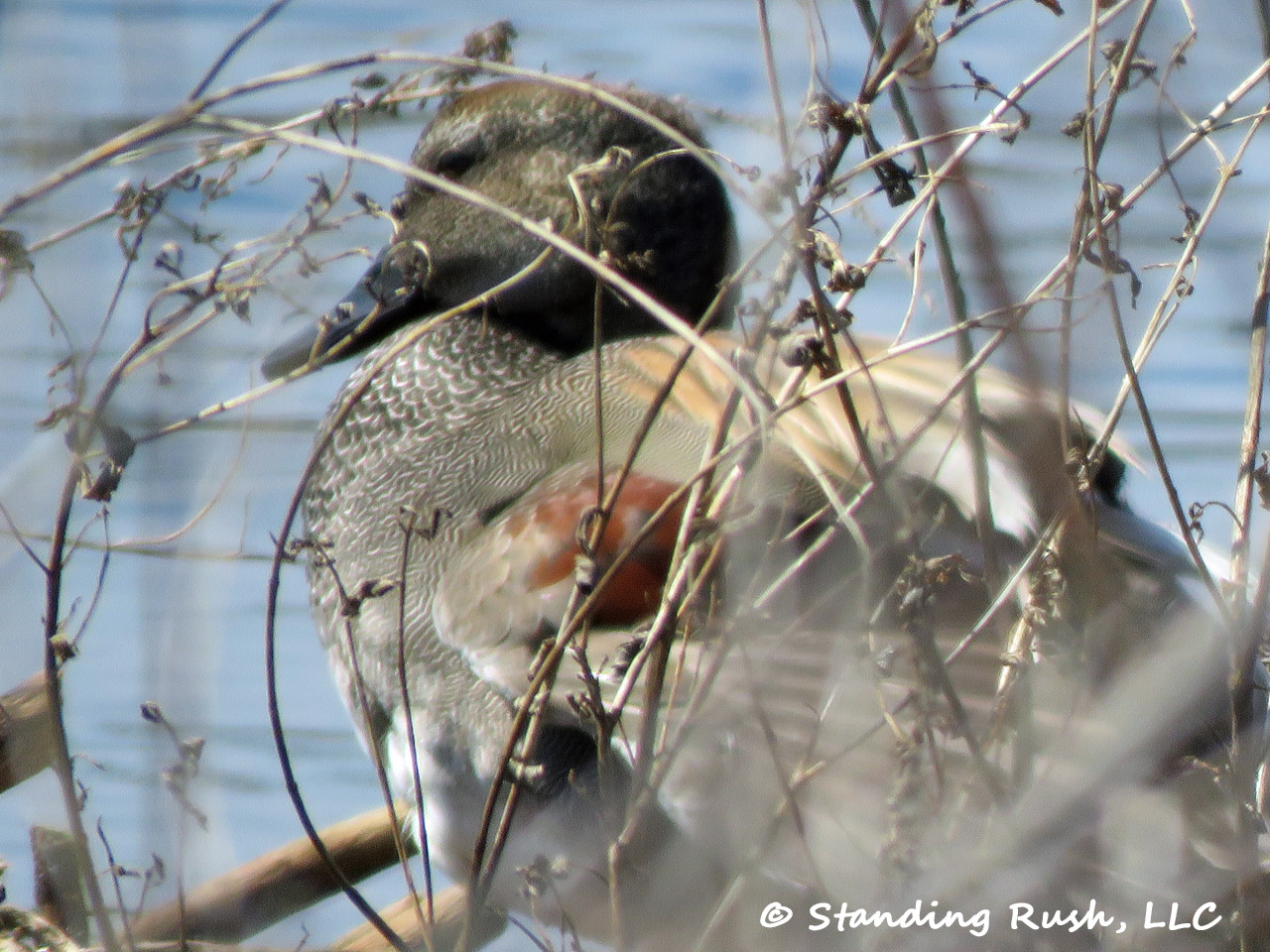
This drake Gadwall was paying careful attention to his full spring plumage;
unfortunately, all his preening took place behind a curtain of willows
and dead loosestrife
While the Pied-billed Grebe is often overlooked as a non-game "fish eater," I never tire of watching and hearing them;
they are to be commended for tireless fishing/hunting and their shrill call takes my mind right to the water
Poor lighting can't even take away from the beauty of these Northern Pintails
-- as of yesterday, they were still the dominant duck in the marsh
with flocks in multiple units approaching, if not exceeding a thousand
Common Mergansers (females or non-breeding males)
uniquely stationed atop a decaying Phrag root clump
(as always, remember to CLICK TO ENLARGE)

Pintails Galore

Drake pintails (with a lone hen hiding in the background); just plain photogenic

I just got back from an annual pilgrimage to extreme northern Minnesota (a very late season ice fishing trip). Seems fitting somehow that I was greeted home by an inbox full of photos of Northern Pintails. Roy has been having some fun while I've been away. While the mercury remains stubborn in the 30s and low 40s for highs with lows often below freezing, the sun continues to gain strength and the day length continues to stretch. Compounded by the shift of daylight savings time, we're definitely in the midst of transition once again. Roy's photographs are a vivid reminder of one big payoff in the marsh that often comes on the heals of a long, tough winter: spring ducks!

Pintails basking on what is officially the
last day of winter
This blog entry is largely going to be a visual tribute, both to the specific waterfowl that dominates these images, but also to all the effort over the last two field seasons that have built to this explosion of life. Quite frankly, this wouldn't have been possible just a couple short years ago. The vegetation simply was not present, so as a result neither were the food options -- via seeds, tubers, stems, and associated invertebrate life.

The congregation of pintails in the image to the left and immediately below are particularly gratifying because this is the Dinky Track, the 100-acre unit that makes up our eastern-most habitat. This area was a largely sterile, almost lunar landscape when we took possession of the property. The dominate physical features were: (1) Phragmites, (2) hundreds if not thousands of massive root clumps from dead and decaying Phrag and loosestrife [still visible amidst last year's vegetation], and (3) open water with little if any vegetation beneath the surface. None of these attributes are apt to attract much less hold waterfowl -- at least in any great numbers or over any notable time period. Already that has changed.
More loafing pintails taking in all the sun can give them

A mix of stately drakes (with the long tails) and less showy but hardly drab hens

Spring pintails on the wing

A comparable aerial explosion out of the West Rest Pond
(second year millet with increasing stands of desirable annuals and perenials)

P.S. I purposefully set this post to go live at 12:15PM on 3/20/18. It is now officially spring! It's also the one-year anniversary of this blog's existence -- my first post was one year ago today, 3/20/17. Man, does time fly!


Top Ten

The Mallard or "Greenhead" is perhaps the most identifiable duck, and it has served as the foundation for waterfowl
hunting for generations

Considering recent posts and repeated reference to teal and "big ducks," I thought it would make sense to provide some visual context. We've already seen more than twenty-five species of waterfowl (ducks, geese, swans) on the property, but those included here probably represent the ten most common duck species.

All but the teal (top right and middle right below) are what we would consider "big ducks." I am collecting a growing portfolio of reference photos, but for consistency, I created this page from stock images available through www.allaboutbirds.org, an incredible online tool produced by the Cornell Lab of Ornithology. If you like (or love) birds and are unfamiliar or haven't spent much time on this website, you need to get acquainted. It's a treasure trove of information.


Spring Ducks "Being Ducks"

A mix of Northern Shovelers (drake in foreground and pair just below fliers), Green-winged Teal (in flight and far right),
and a solitary black duck enjoying last summer's millet crop (March 29, 2017).

One of Roy's common lines that quickly became one of my favorites is some variation of the phrase, "It's nice when you can see ducks being ducks." In essence, what that means to me is that it is rewarding to see situations where waterfowl can behave as they would naturally. This doesn't mean Canada geese on a golf course fairway or mallards in an urban ditch aren't part of nature. It just means that those observations reflect major adaptations made by certain species to adjust to life in a largely human world.

The image above is one of Roy's first from the new Canon SX60. As he's prone to doing, Roy diminishes its quality and reminds me that he has a lot of work to do to knock the rust off his photography skills. First off, we don't necessarily need (or expect) Audubon quality with these images. Secondly, the first batch that he sent me today has some really neat stuff, and I know that they are only going to get better as we get accustom to the equipment. (No pressure, Roy.)

I chose the photo above for a couple reasons. One, I wanted to make a fundamental clarification that while ducks and duck hunting are an absolutely critical element of the local environment's natural history (in terms of wildlife and human interaction with the natural world), and while we most certainly want to encourage environments that attract and benefit ducks (for the sake of the birds and the hunters), this project has set out to manage for holistic ecological benefit. Roy and I appreciate that these birds are a big reason -- maybe the only reason -- that these wetlands are still on the map. Never underestimate the passion of a duck hunter. But we also recognize that there is a tremendous diversity of life that also relies heavily or completely on coastal marsh habitat.

Bottom line: We want to make decisions that are good for ducks but also that will be good for fish, amphibians, reptiles, mammals, and even more obscure groups like insects or freshwater mussels. The list that can benefit is long. And the determination of what benefits is largely driven by vegetation (which is in turn dictated by water levels over time). Management is largely about trade-offs.

I also wanted to include this photo to document that this spring's duck migration (which unfortunately may already be 90% behind us in Sandusky Bay) was marked by several unique observations. The temporary "walking" ice that did form in December was completely gone by late January. While the water did skim over to ice a few times since (shallow water can freeze with just a few cold nights), the migration most certainly started early.

What may be most notable about what we saw this year though was (1) the numbers of Northern Shovelers and Northern Pintails co-mingling in our 40-acres of millet, and (2) how long they stuck around (at least three weeks in big numbers). Shovelers and pintails aren't particularly regular companion species to begin with in the spring, but it was even more unique that we had literally thousands of them hanging out -- sometimes with 40+ Trumpeter Swans -- on a daily basis. We should have bought that camera for Christmas.

ASIDE: Toledo Blade Editorial, 03/30/17: Fight for Lake Erie