Showing posts with label northern shoveler. Show all posts

About Everything But a Unicorn

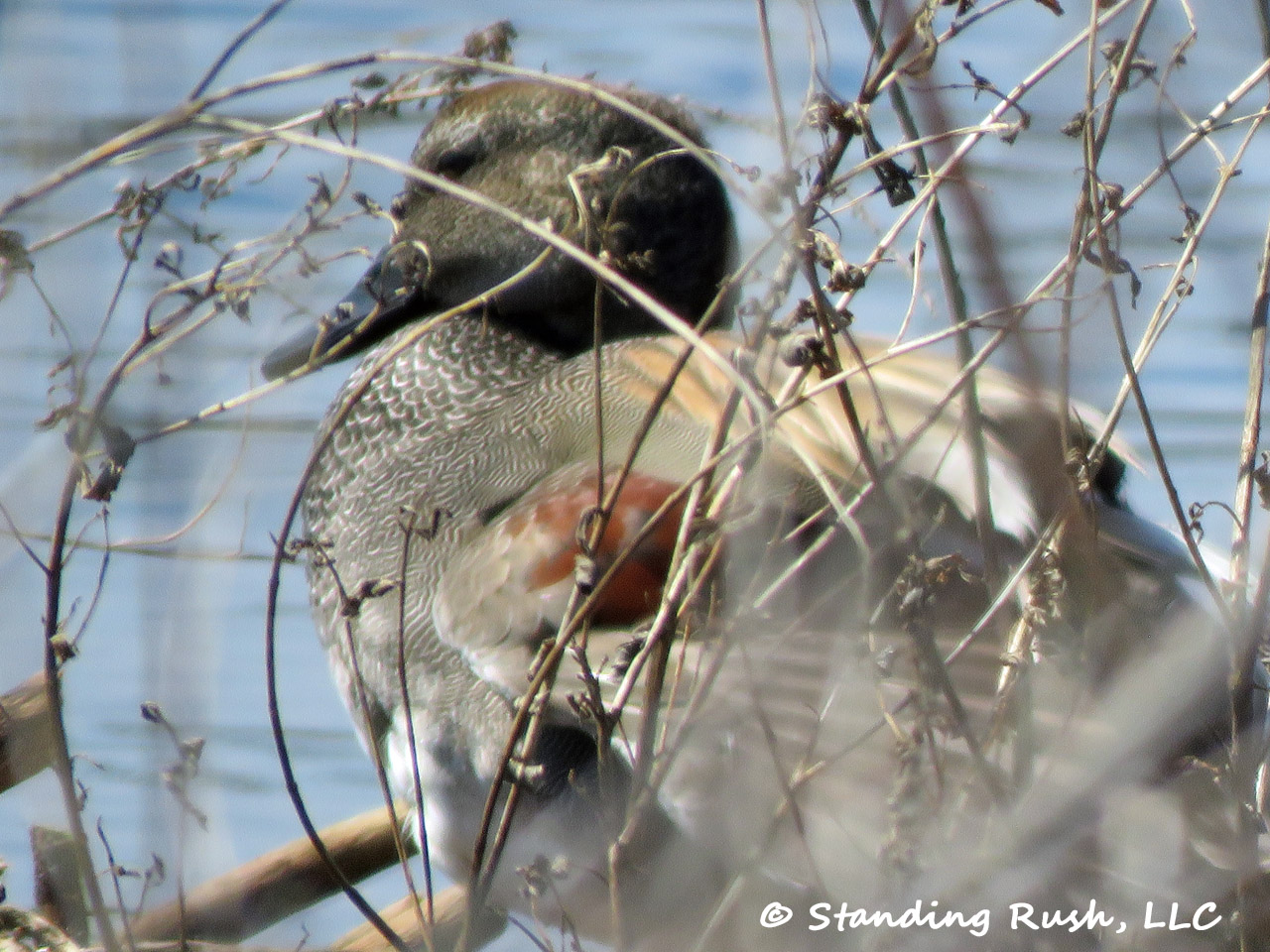
A beautiful drake Northern Shoveler (1 of 2) contently taking in the afternoon sun
Yesterday's relative warmth (low fifties) and brilliant sunshine made for ideal conditions to observe spring ducks "being ducks" (see explanation from last spring). We are slowly building a library of solid images of each of these visitors. Yesterday helped, as I kept the camera at the ready as we drove the entire property by truck and by Mule.

Dikes were very dry for this time of year. But we knew that wouldn't last long -- there is soaking rain in the forecast for today and for Thursday of this week and the "winter-like pattern" is supposed to return fast and extend well into April (the ten day forecast now shows plenty of 40s, 30s, and even 20s with decent chances of precip and lots more northeast wind -- yuck, I just hope we don't jump from winter to summer and skip right over spring).

So while we checked water levels,  monitored the extent of dike wash, opened and closed some gates, and filled a good number of low spots on the West Marsh dikes (from a strategically positioned clay stash), the camera was never far from reach. As Roy rightly pointed out, the second you don't have the camera is the second you're sure to see a unicorn.

No unicorns yesterday, but I did see (and photograph) plenty of ducks. I can confirm seeing nine of what I consider our "Top Ten" -- all but the wood duck. Pintails were still dominant with decent numbers of shovelers, gadwall, wigeon, and green-wings. I can also add mallards (though not as many as one would expect), black ducks, common and hooded mergansers. Sprinkle in a few individual blue-wings and blue bills, tons of geese, a dozen or so swans, plenty of grebes, and rafts of coots, and there was plenty to observe and enjoy on the water and on the wing. Makes for a nice way to spend a day.

2 of 2 . . .
Just like last year, these guys are
prevalent in the marsh this spring
This drake Gadwall was paying careful attention to his full spring plumage;
unfortunately, all his preening took place behind a curtain of willows
and dead loosestrife
While the Pied-billed Grebe is often overlooked as a non-game "fish eater," I never tire of watching and hearing them;
they are to be commended for tireless fishing/hunting and their shrill call takes my mind right to the water
Poor lighting can't even take away from the beauty of these Northern Pintails
-- as of yesterday, they were still the dominant duck in the marsh
with flocks in multiple units approaching, if not exceeding a thousand
Common Mergansers (females or non-breeding males)
uniquely stationed atop a decaying Phrag root clump
(as always, remember to CLICK TO ENLARGE)

Top Ten

The Mallard or "Greenhead" is perhaps the most identifiable duck, and it has served as the foundation for waterfowl
hunting for generations

Considering recent posts and repeated reference to teal and "big ducks," I thought it would make sense to provide some visual context. We've already seen more than twenty-five species of waterfowl (ducks, geese, swans) on the property, but those included here probably represent the ten most common duck species.

All but the teal (top right and middle right below) are what we would consider "big ducks." I am collecting a growing portfolio of reference photos, but for consistency, I created this page from stock images available through www.allaboutbirds.org, an incredible online tool produced by the Cornell Lab of Ornithology. If you like (or love) birds and are unfamiliar or haven't spent much time on this website, you need to get acquainted. It's a treasure trove of information.


Spring Ducks "Being Ducks"

A mix of Northern Shovelers (drake in foreground and pair just below fliers), Green-winged Teal (in flight and far right),
and a solitary black duck enjoying last summer's millet crop (March 29, 2017).

One of Roy's common lines that quickly became one of my favorites is some variation of the phrase, "It's nice when you can see ducks being ducks." In essence, what that means to me is that it is rewarding to see situations where waterfowl can behave as they would naturally. This doesn't mean Canada geese on a golf course fairway or mallards in an urban ditch aren't part of nature. It just means that those observations reflect major adaptations made by certain species to adjust to life in a largely human world.

The image above is one of Roy's first from the new Canon SX60. As he's prone to doing, Roy diminishes its quality and reminds me that he has a lot of work to do to knock the rust off his photography skills. First off, we don't necessarily need (or expect) Audubon quality with these images. Secondly, the first batch that he sent me today has some really neat stuff, and I know that they are only going to get better as we get accustom to the equipment. (No pressure, Roy.)

I chose the photo above for a couple reasons. One, I wanted to make a fundamental clarification that while ducks and duck hunting are an absolutely critical element of the local environment's natural history (in terms of wildlife and human interaction with the natural world), and while we most certainly want to encourage environments that attract and benefit ducks (for the sake of the birds and the hunters), this project has set out to manage for holistic ecological benefit. Roy and I appreciate that these birds are a big reason -- maybe the only reason -- that these wetlands are still on the map. Never underestimate the passion of a duck hunter. But we also recognize that there is a tremendous diversity of life that also relies heavily or completely on coastal marsh habitat.

Bottom line: We want to make decisions that are good for ducks but also that will be good for fish, amphibians, reptiles, mammals, and even more obscure groups like insects or freshwater mussels. The list that can benefit is long. And the determination of what benefits is largely driven by vegetation (which is in turn dictated by water levels over time). Management is largely about trade-offs.

I also wanted to include this photo to document that this spring's duck migration (which unfortunately may already be 90% behind us in Sandusky Bay) was marked by several unique observations. The temporary "walking" ice that did form in December was completely gone by late January. While the water did skim over to ice a few times since (shallow water can freeze with just a few cold nights), the migration most certainly started early.

What may be most notable about what we saw this year though was (1) the numbers of Northern Shovelers and Northern Pintails co-mingling in our 40-acres of millet, and (2) how long they stuck around (at least three weeks in big numbers). Shovelers and pintails aren't particularly regular companion species to begin with in the spring, but it was even more unique that we had literally thousands of them hanging out -- sometimes with 40+ Trumpeter Swans -- on a daily basis. We should have bought that camera for Christmas.

ASIDE: Toledo Blade Editorial, 03/30/17: Fight for Lake Erie