Showing posts with label golden-crowned kinglet. Show all posts

Fall Migrants and More Good News

A small flock of juvenile Yellow-rumped (or Myrtle) Warblers kept me entertained/constantly moving with the camera;
they were just doing what they do: flitting out for groggy bugs between bites of dogwood berries

Appropriately, northwest Ohio in general and the southwestern shoreline of Lake Erie more specifically receive a great deal of attention from birders (bird and bird watching enthusiasts) during the spring. As soon as the snow melts -- and in truth, even before -- a steady and diverse stream of colorful visitors on-the-wing and equally colorful people behind their binoculars begin their annual right of passage.

A rare opportunity to catch a still Yellow-rumped,
enjoying some morning sunshine
For those with feathers, spring "migrants" are making a move from south to north, in preparation for breading wherever they call home for the summer months. For everyone else, it is an opportunity to observe a natural phenomenon that is both unique to our region and significant to a much broader geography (like from the southern tip of South America to the northern reaches of the Arctic Circle).

This particular pulse of life northward is amplified by our Great Lake and its proximity to the others. Huge expanses of huge water become "pinch points," funneling millions of birds that are often weighed in single digit grams over specific land masses. We are one of the biggest beneficiaries -- witnessing hundreds of bird species as they temporarily stop over to rest, and now (as the word continues to get out) witnessing hundreds of thousands of bird lovers who visit our area to participate in this annual spectacle.

One of the main reasons this news has expanded to an ever-increasing number of people ties back to the tireless efforts of a tremendous grassroots organization that has been very good not only to the birds, but to conservation in general and Standing Rush in particular -- the Black Swamp Bird Observatory.

The acrobatic -- and often difficult to photograph --
Ruby-crowned Kinglet

I've certainly written about the great work of BSBO and our recent and ongoing efforts to collaborate. The Biggest Week in American Birding (or "Biggest Week" as it is affectionately abbreviated) has become the culmination of bird loving fun in NW Ohio in the spring. But it's important to realize: (1) that the spring migrants north come back south -- with nice pulses of new visitors visiting the marsh right now; and, (2) BSBO's work is year-round.

If you want to keep up on daily activities at the Observatory, their Facebook page is a treat. Not only do they update on coming events and tours (again, year round), they also include tons of awesome photos with reliable identification -- especially when they are mist netting and banding birds as they are right now. This is an activity that I hope to bring to Standing Rush soon. Not only does it have significant research implications, but banding also provides an incredible educational opportunity for people to gain up-close and personal experiences with these magical little critters.

The tiny Golden-crowned Kinglet;
one of my absolute favorites
(click to enlarge)
My impromptu bird walk yesterday turned out to be very timely for several reasons. First off, I was able to check in on the construction project a couple times while trucks brought clay back to the project site -- a good sign that we are definitely starting to put things back together!

Also, I received two phone calls from BSBO members while I was walking the dikes with binocs in hand. As it turns out, I am thrilled to report that for the second consecutive year, Standing Rush has been unanimously chosen by the Observatory to be the sole recipient of their Biggest Week Conservation Fund -- an unrestricted monetary gift that will go directly to our restoration and preservation initiatives. We are once again humbled, honored, and just so appreciative of this incredible generosity. Once again, all those involved should rest well knowing their resources will be put to very good use! You can read more through BSBO's beautiful quarterly newsletter here.

Finally, my walk was well-timed because not only was I able to count ~30 species in ~90 minutes of walking, as you see here, I was also able to capture a few of them reasonably well on camera. I won't be winning any photography contests any time soon, but it's always tons of fun to have some visual account of some of what I was able to see. (Other highlights included: Northern Waterthrush, Fox Sparrow, Yellow-billed Cuckoo, and Great Horned Owl).

Got lucky with how this one turned out -- love how the striking White-throated Sparrow is still identifiable
behind the well-focused cherry limb
I love how this image of blackbirds -- a hallmark of the transition that is autumn -- almost appears black and white
rather than full color
A slightly more colorful rendition of blackbirds -- obviously this time on the wing
(at some point, I need to write a post on "blackbirds" because there are at least a handful of species that qualify in our area)

Another sure sign that we are in the midst of transition; this image also serves as a good reminder of how
intertwined marsh management (and in fact, the very existence of coastal wetlands) is with row-crop agriculture


Mostly Cloudy (or Partly Sunny?)

While a "large" kinglet weighs about the same as a stack of three pennies (~8 g), these active, little buggers are
one of my absolute favorites; cloudy skies made their yellow-gold-orange crested caps more muted,
but they still put on a show in the tangle of dogwoods, grapes, and willows

After a full week in my office, I have to say I was pretty excited to be driving eastbound on Friday morning for a day in the field. Sunshine was in the forecast for the first time in days, so I had a full itinerary planned for photo-monitoring. Lingering low clouds and a northeast breeze made their presence known during a brief gas station stop en route. By the time I made my final approach to the property, it was clear that "mostly sunny" in Toledo was going to translate to something different on the marsh -- at least for the start of the day.

This is a phenomenon I've gotten pretty accustom to over the last few years, but I have to admit, I was pretty disappointed as "partly sunny" (at best) pretty quickly transitioned to "mostly cloudy." The lighting would be decent for wildlife photography, but I've found that sunshine is a nice addition when taking landscape shots for reference. So, as is so often the case, I audibled to a laundry list of other odds and ends.

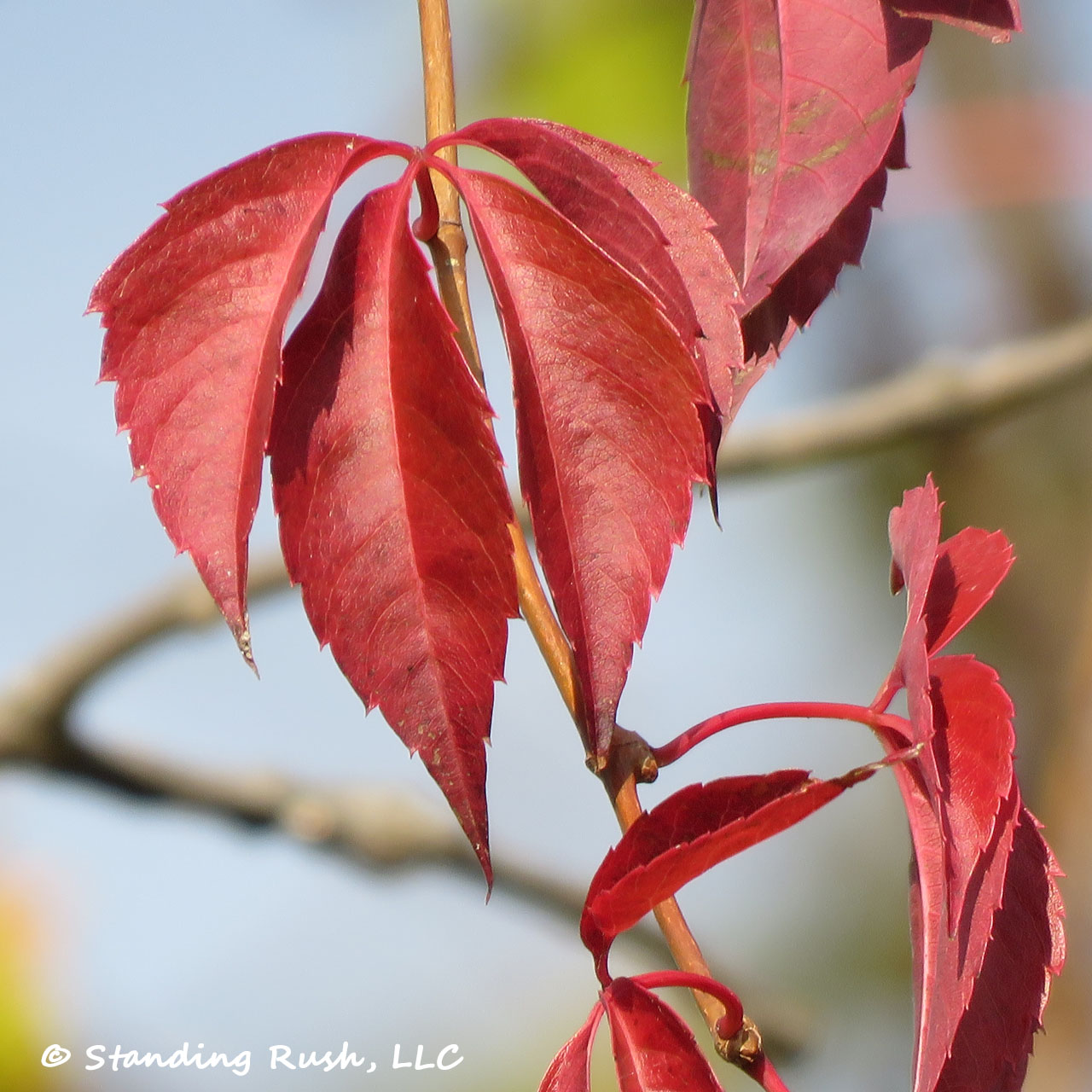
Virginia creeper is nearing its seasonal end, but the vibrant crimson
seemed worthy of the visual memory
Peaks of sunlight kept tempting me to circle back to my original plan, but the power struggle between the temperature in the air (40s to mid-50s by late afternoon) and the temperature of the bay (probably on the lower end of that same range) -- with sustained northeast winds -- were a recipe for nearly constant clouds.

I took the opportunity to sit in one of our newly placed tree stands over my lunch hour (sans lunch), but the wind direction wasn't right for deer movement and it really ended up being more of an impromptu window into current bird activity. The list of observed species grew to more than 20 quickly, but the highlight for me was the nearly constant stream of passing golden-crowned kinglets. These miniature-sized insect-eaters came in twos and threes. And, as is so often the case, they were nearly constantly on the move. Of course, the only one that cooperated and sat still for more than 3 seconds did so about three feet from my right arm, when the camera was back in the truck.

Showy dogwood leaves in sunshine
[ASIDE: Make sure you check out the Cornell Lab's profile of the kinglet (see link above). Like all of their entries, they share so many "cool facts." Example: The tiny Golden-crowned Kinglet is hardier than it looks, routinely wintering in areas where nighttime temperatures can fall below –40° Fahrenheit. I can vouch for this. I first took note of the kinglet during my first winter in college -- in central Minnesota. The temperature that evening was definitely below zero!]

Ironically, it wasn't until about 30 minutes before I promised myself I'd get back on the road home Friday evening that the blue sky really made its full appearance. Better late than never.

As I scrambled around to capture what might be the last stands of certain peak autumn colors for this year (big winds in the forecast for Sunday), I thought to myself, this may also be the last day I could even consider working in a t-shirt. And just a few hours earlier, I had been wishing I had a winter hat.

We'll see though. "Normal" in terms of weather is hard to define anymore. While I really don't want to be, I could be back in short-sleeves yet this month -- or even in December.

The last remaining leaves on the largest cottonwood outside the bunkhouse; note the blue sky and that this was the same
tree that housed an oriole nest that entertained me back in May and June -- when the leaves were green and new

P.S. As the winds calmed and the late afternoon sunshine finally broke through, I heard both chorus frogs and peepers in the reed canary grass off the bunkhouse. Someone needs to tell those peepers that they are Spring peepers -- and it's November!