Showing posts with label bunkhouse trees. Show all posts

November 2020: Not Time for the Parka Just Yet

 Here's a taste of late autumn from Standing Rush:

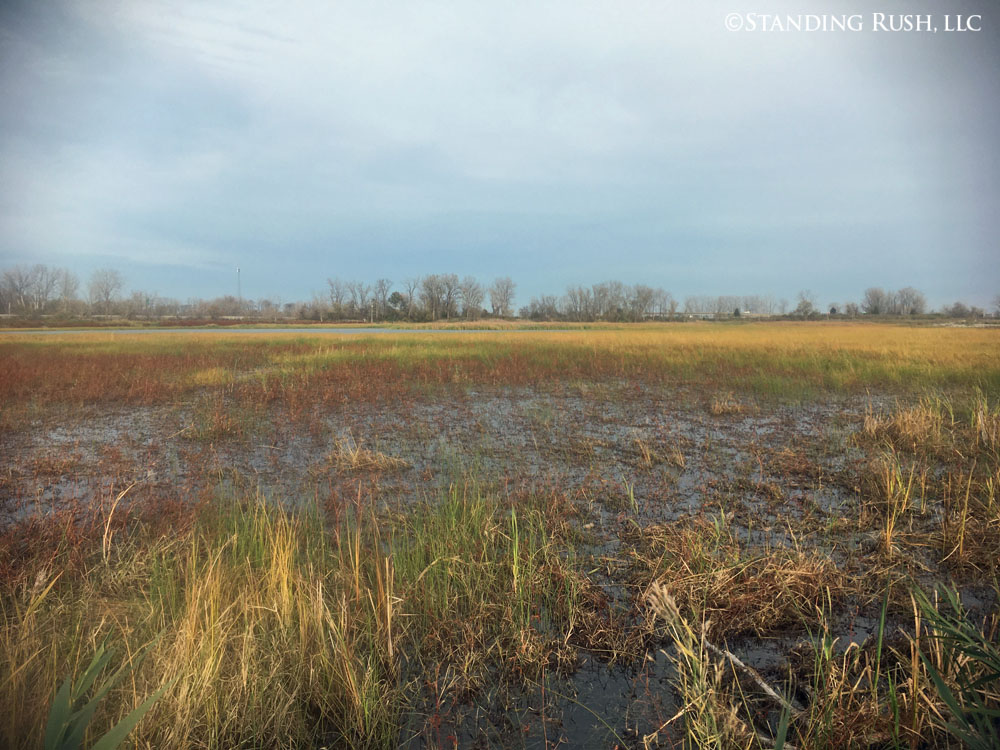
Rest Pond progression, continued . . .
It is truly amazing to compare this image to those taken in spring & summer, just a few, short months ago -- a naturally-occurring waterfowl buffet, but also refuge to countless species of insects, amphibians, fish, reptiles, and birds (of the non-fowl persuasion) . . . just to name a few.


While much of our attention on this website focuses on happenings "inside" the marsh, it is worth noting that water levels have been trending downward on the broader lake and bay over recent months (hard not to, considering the levels we reached over the last couple/few years). Projections -- shaky as they always are -- tentatively show this trend continuing. 

This image shows a particularly low snapshot during a significant SW blow (remember: lots of water can temporarily blow out of Sandusky Bay based on wind direction). It is striking to see the dead and tattered remnants of what was essentially a wooded barrier island just off-shore when we took possession of the property in 2015.What a difference 24-36" of water makes.


Roy was eager to show me progress in the Tower Woods at the backend of a full day at the marsh. I hadn't personally been hands-on with this tree planting in over a year, and it was amazing to see (1) the high percentage of trees of all species that are surviving, and (2) how much they have grown since they were put in the ground as 10-20" seedlings three growing seasons ago. 

Roy proudly attending to a thriving oak (above)
and sycamore (below).


Also worth showing growth of the "Bunkhouse Trees"
-- all are looking good!

NEWS FLASH: The USACE permit application that we worked so hard on over the summer was issued this month -- a big victory; we hope it can pave the way to lots of great things on Standing Rush's East Marsh.

"Ruger" (one of our punter's labs) wanted to point out that duck hunting continued and based on birds in the air, it remained worth keeping poised and ready to shoot -- and retrieve!


13 Special Trees/Happy Father's Day

I noticed last week that the new Tulip Tree just to the left of our entrance
door has already stretched just past the peak of our roof 
Last fall, I wrote a post that alluded to a pretty special addition to our property -- 13 special additions, more accurately. The thirteen large trees planted last November at the entrance to our field office -- or "bunkhouse," as we often affectionately refer to it -- provided some welcomed and tangible benefits right out of the gate: improved privacy from the sometimes loud and surprisingly busy rural highway nearby, a visual softening of the landscape immediately surrounding the building, and a promise of much-needed and much- appreciated future shade . . . at least once the leaves emerge again in the spring (in the case of the hardwoods).

Well, emerge they have . . . And so now it's time to tell the rest of the story. These beautiful trees are not just another tree planting project. They were made possible by a handful of generous donors (who have asked to remain anonymous).

Yesterday, Roy and I -- with the unexpected help of last year's intern, Nate -- placed posts and placards at the base of the first ten trees. My goal was to start to recognize some of the many people who either (1) have loved this marsh over the years, (2) have helped protect this special place, or both. Thirteen trees is hardly enough, so my apologies to anyone who has yet to be formally recognized. Trust that I have plans for more trees -- and more placards!

But I thought it important to start to identify some of the individuals and families who have been stewards of this land . . . and to recognize those who have served as models of stewardship as significant positive influences in my life. Thanks to all who have contributed to this collective effort. As I say nearly every day and have said since the beginning of this project, I feel blessed to be able to see and experience this story as it continues to unfold, one chapter at a time. Again, we look forward to enjoying the solitude and the protection that these trees can provide for years and years to come!


This species holds a special meaning for me personally -- there is a uncharacteristically broad specimen just outside
the kitchen window of the first house my wife and I bought just before we were married; I also planted two on 
the hill beneath  my parents' home when I was just out of college . . . they are growing happily alongside 
many others in the nearby woods and both are now 50'+ tall
Mom & Dad:
heartfelt thanks for all that you have done for me, and now my family, along the way --
Happy Father's Day, Dad!


Nature's Vitamins and New Trees

Gizzard shad -- a welcomed and well-timed morsel in the marsh

Yesterday, I took about twenty images of the individual photographed above before I got the lighting right. (It didn't help that I was using my cell phone and a crude kitchen light in the bunkhouse.) I went to the trouble of getting the shot of this modest (and smelly) "baitfish" because the species always reminds me of this time of year. And their presence in the marsh lead to a few interesting sights as my day progressed yesterday.

One of ten large native trees planted
around the bunkhouse this past weekend
(yellow poplar or tulip tree)
Gizzard shad spawn in huge numbers mainly in larger lakes, reservoirs, and rivers throughout Ohio (and in many states east of the Rockies) in the spring. While adults can exceed 20" in length -- and 3+ pounds -- they are perhaps most important in the food web as they grow to the size pictured above . . . a modest 3-4 inches.

While survival rates are low during early development (largely because they are being eaten along the way), millions -- perhaps billions -- survive their first summer in Lake Erie and its tributaries. As with midges and warblers, nature is setting the table with gizzard shad. Just as temperatures drop in mid- to late autumn, temperature sensitive yearling shad pulse into shallow water in huge numbers. Their fat-rich bodies serve as mobile and essential energy boots not just for other fish (stocking up for a long, tough winter) but for fish-eating birds prepping for or working through a strenuous seasonal migration.

I watched eight hooded mergansers and literally thousands of terns pluck unsuspecting shad from the marsh throughout my morning yesterday. I focused on the ducks carefully for the better part of a half hour, and based on my observation, they were batting a pretty high average. An individual duck would come up with a fish about 50% of the time. Good for the ducks; not so good for the shad.

As a sidebar, I had to smile as I drove the kids to school this morning. Our path follows the banks of the Maumee River, and when we got to the flat, exposed rocks and rapids along Side Cut Metropark, the kids couldn't believe the number of gulls feasting up tight along the shore. There had to be several thousand packed tightly together both low in the air and on the water. We have seined shad together this time of year at that exact location, so everyone knew what was going on. We pulled over briefly to take in the spectacle. Happy gulls, happy kids, happy dad. The seasons march on.

I'll share more of the backstory as to how these awesome trees got planted in a future post, but for now, I just
wanted to point out how much of an improvement they make as you approach from our south entrance
These three oaks are already pushing 15' tall; it will be tons of fun to see them grow to be 75'+!
-- we're excited for the shade they will eventually bring (not to mention the acorns)