Showing posts with label Phrag. Show all posts

Thursday, April 30, 2020

April 2020: More Northern Fun, Assessing Winter Damage & Welcoming Spring

Management and wildlife highlights from this month included the following:


In addition to Roy's regular updates and photo-documentation, images from the property's multiple motioned-triggered trail cameras offer regular -- and refreshingly candid -- glimpses of activity on
and around the marsh (like this awesome impression of a Northern Flicker).

Northern pike trapping and tagging continued; 12 individuals were fitted with transmitters at Standing Rush by BGSU with initial assistance from the Ohio Division of Wildlife. This ~37" female was among the biggest of the 54 individuals tagged in all of the Western Basin of Lake Erie as part of this study.

Individual fish are carefully handled for the brief period leading up to and following their surgical procedure. The transmitter is about half the size of a AA battery, should have a 2-3 year lifespan, and then will ultimately reside harmlessly inside the body cavity. 

2-3 sutures and its time for release.

Management Priority #1:
A bent screw gate on the bayfront dike of the West Marsh
(lower left) was an early discovery after ice-out.

Within a week, Roy had a new gate fitted on the interior side
of the same pipe (insuring that even if the bent gate leaked,
the West Marsh would not inadvertently flood)

Management Priority: Poison Hemlock Spraying;
always scary when a plant gets a jump-start on Phragmites!
We're finding this new invasive is one of the first to green-up.

Management Priority: Phragmites Burning;
we are selective in what and where we burn, but this spring
practice gives us a much better feel for the condition of the
dike hidden beneath last year's growth.

Dike erosion has been a reality, especially amidst
continued historic high water levels
(extremely high water in the lake and bay often
forces managers to keep water levels higher
within the marsh to reduce damaging head pressure).


Spot repairs as part of ongoing dike maintenance gave us the
opportunity to experiment with some pretty versatile track trucks.

And Roy's make-shift stone grading drag proved to be just the
ticket to get the top of dike ready for easy management access.

Wherever we can afford to keep water levels low within the marsh this time of year -- or nearly 
any time of year, for that matter -- shorebirds (like these Lesser Yellowlegs) are sure to find it.

Marsh Mystery: What chewed the entire topside off this sizable willow branch, that in places 
extends 5' or more off the water?

Our guess would be a groundhog, but muskrat or beaver
are not out of the question.


Thursday, September 20, 2018

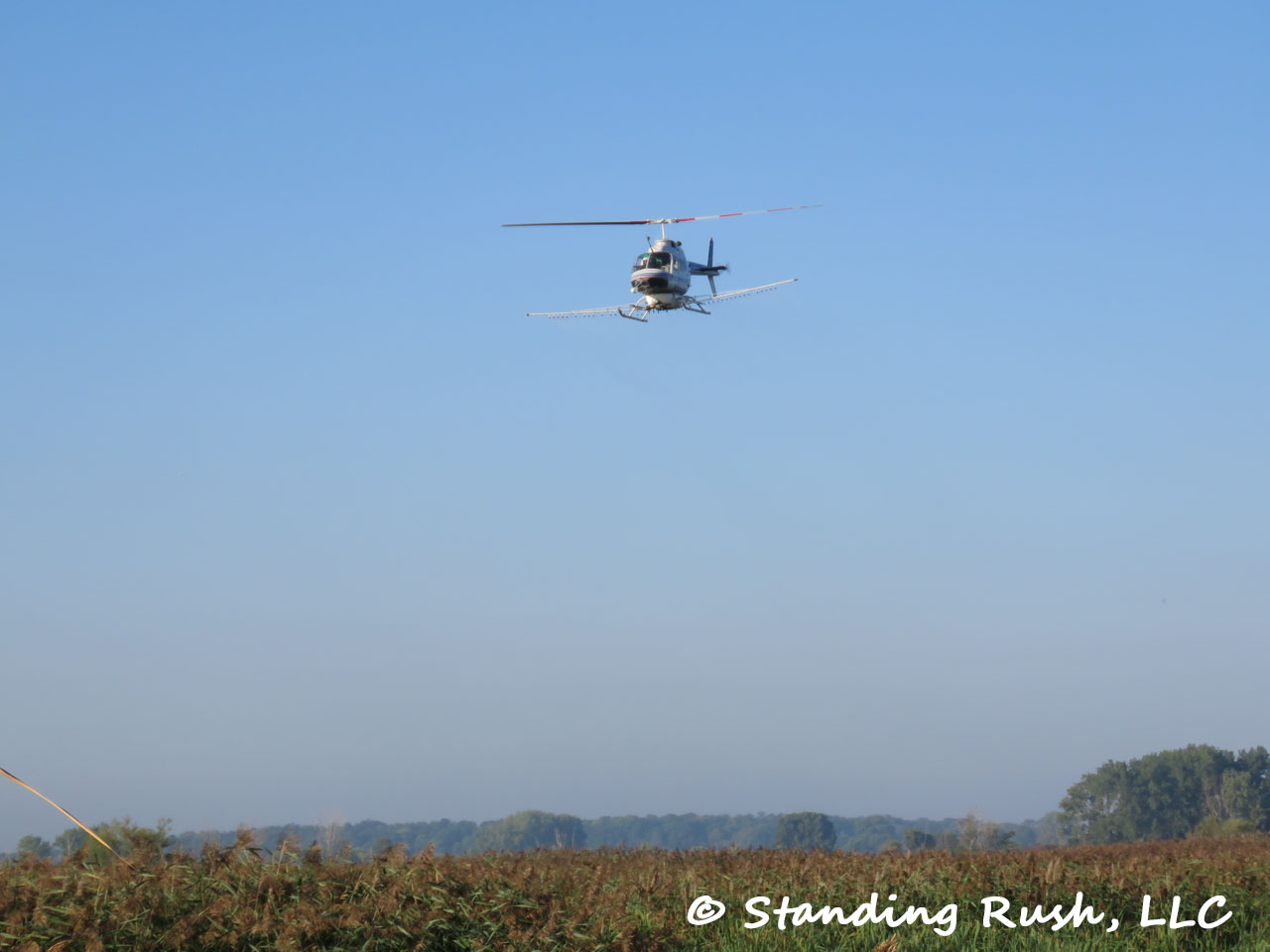
Aerial Spraying: A Critical Tool in Our Toolbox

A "bluebird sky" and next to no wind made for pretty much ideal spraying conditions

Earlier this week Standing Rush was visited by the single most important tool in our fight against Phragmites australis: a specialized helicopter equipped to mist low concentrations of herbicide onto dense stands of the noxious, invasive plant. In less than an hour we were able to effectively treat more than 90 acres of Phragmites monoculture. Because the reed grows so aggressively ("mono" = one; "culture" = plant), we can efficiently target the "bad" (invasive species) with minimal collateral damage to the "good" (desirable native plants).

Unless framed by a dark background (e.g., trees above), it is often very hard to even see the herbicide as it is being applied

Lots of research has gone into what and when to spray for maximum efficacy. A generic cocktail of Rodeo® herbicide (a commonly utilized glyphosphate used in aquatic settings) and water is applied at a 5% solution. While this mix could be considered relatively "hot" (concentrated), the combination of the misting applicator and the circulation of the helicopter blades allows for effective treatment at surprisingly low total volumes. 

Late summer/early fall spraying has proven to be the most effective time of year when targeting Phragmites. There are a couple key benefits to this timing:
(1) the target plants are actively pulling moisture from their above-ground stems and leaves in preparation for winter dormancy (thereby effectively transporting the herbicide throughout the plant and roots), and
(2) if sprayed late enough in the season (as we hope to have this year) any desirable, native vegetation -- on the fringes of spray zones or when less frequently interspersed within the Phrag -- can either be given time to drop viable seed (for future colonization) or be spared completely (due to earlier dormancy).

Most of the work on our end ties back to preparation for spraying day. While we weren't able to fully implement our drone reconnaissance this year, we did manage to establish detailed maps for the pilot to direct both he and his aircraft to the specific areas we wanted sprayed. We ended up reviewing last year's aerial imagery and then ground-truthed and refined our guestimates to establish several dozen discrete "polygons" -- or shapes formed by actual GPS coordinates. By downloading the shape files, the pilot can then let his instrumentation dictate when and where to spray. And all we have to do is sit back and watch!


More Phragmites can get sprayed in this ~30 second video (and often with better accuracy) 
than we could possibly hope to accomplish in an entire day spraying from the ground

Special thanks to a collaboration between the USFWS, the Ohio Division of Wildlife, and Winous Point Marsh Conservancy for allowing this important work to get accomplished. Standing Rush was one of just a handful of properties selected for spraying through the program this year. Not only did we benefit from cost-sharing to defray management costs, the spraying also helped to set the stage for a healthier vegetative community next season and for years to come.


Tuesday, October 24, 2017

Combating an Aerial Assault: Phragmites Seed

A sea of Phragmites (about 20 acres worth) beneath an awe-inspiring blue October sky;
plants propagate quickly by rhizome (rooted expansion), but the broom-like seed heads also set new pioneers by wind

With raindrops steadily falling for the second day in a row, winds howling, temperatures nose-diving, and the possibility of snow showers in the extended forecast for the first time this season, I thought an image of last week's blue sky might be warranted. But for as beautiful as the top of the image above feels, the bottom is pretty ugly. This is an overview taken from the south side of one of our outlying parcels ("Parcel 2") facing northwest toward Sandusky Bay (which is just beyond the cottonwoods in the middle of the image).

Late last week, Phrag seed literally blanketed much of the
downwind vegetation; this dogwood is hardly recognizable
(click to enlarge)
The view encompasses about 20 acres (~20 football fields), but there isn't much visible other than the highly invasive thorn in the marsh community's proverbial side: Phragmites australis. I've spoken on this subject plenty already, but this plant truly is a menace. It can grow from nothing to 16' tall in a single season. It can produce an astounding 200 discrete stems in ONE SQUARE YARD! And as the image above demonstrates, it can make a monoculture out of a marsh in no time flat.

Dry conditions a year ago literally about sucked the life out of this stand. As of last fall, only a few smaller pockets of lush green sustained the dwindling Phrag, and it looked like more upland competition might actually win out. This is not something we are used to seeing. It looked like good fortune.

But note that I said the dry conditions about sucked the life out of the stand. This year's historically high water levels in the lake and bay meant an influx of new moisture, and the Phragmites got the upper hand . . . and then some.

This is our largest wetland area where we do NOT have the ability to manipulate water levels. If the water goes way down, a more upland mix may take root. If the water level goes up, a sea of Phragmites ensues.

Parking lot planter
This is a case not just for the ongoing funding of the aerial Phragmites spraying program (which we participated in back in 2015 but regionally lost funding for in 2017). It is also a case for the merits of marsh management within an earthen levy system (aka diked marshes). Water drives all life; and even an inch or two can make the difference between rich habitat and a virtual vegetative dessert in a wetland setting.

Seed dispersal like we are seeing at present at the marsh is disheartening on one hand, but the good news is we have learned how to minimize the negative impacts by keeping high water on adjacent habitats at this time of year and during the early couple months of next spring/summer. But make no mistake, as the photo-op from a recent visit to a Detroit Airport parking lot makes clear (see right), even the slightest opportunity can be made good by a strategically placed, opportunistic Phragmites seed. Like it or not (and I don't), it's one amazing plant.

[I have consciously decided not to include images taken off-site of the marsh, but this one was just too good -- or bad -- to pass up. Be sure to click to enlarge.]


Friday, March 24, 2017

The Fiercest Invader Yet

What may appear on first blush to be tranquil and serene now amounts to the single largest vegetative management challenge on Lake Erie coastal marshes (and beyond). It may present the biggest management challenge, period.

So, let's recap a bit. A bug can create problems (emerald ash borer) and a bug can solve problems (loosestrife beetles), but one common thread and nearly universal truth already developing is that invasive species tend to be a major problem with far-reaching negative consequences. Therefore, invasive species, particularly plant species, are central to both the marsh landscape and the management of the landscape. To continue the tale then, we move to the next chapter.

Just as researchers and managers on the ground were starting to make headway via the Galerucella beetle and purple loosestrife was starting to show a chink in the armor (late 1990s in the Western Basin), yet another aggressor, Phragmites australis, or "Phrag" as it is affectionately referred to by manywas on deck as the next big invader.

To understand why this invasive was poised to fill any void, the role of water levels should be briefly explained. One common refrain that I'll do my best not to repeat ad nauseum is that water levels -- and the timing and extent of water level fluctuations -- are the engine that drives most all other living things in the marsh. Even an inch or two more or less can mean all the difference as to what plants grow (or don't grow) . . . and the resulting plant diversity (or monoculture) has a profound domino effect on everything else that might visit or rely on the resulting vegetative community.

It is also important to understand that Lake Erie -- and all the Great Lakes, for that matter -- have historically undergone cyclical swings in basin-wide water levels, typically measured over decades. The southwestern Lake Erie region had undergone a significant spike aptly referred to as "high water years" in the early 1970s, but by 2000, Great Lakes water levels had returned to long-term averages. As water levels continued to drop, the table was set for "Common Reed" (P. australis) to become entirely too common.

While there is (or at least was) a native taxa, the Phrag that quickly began forming dense thickets of vegetation unsuitable for any other native fauna was another Eurasian import. The unusually broad growth tolerances in terms of water levels (moist soils to water depths of more than 3' -- unheard of by native species) along with the rapid expansion of above ground biomass (up to 20' horizontally per year) -- meant that Phrag could block light to other plants in an evolutionary instant and convert a broad range of wetland habitats into a Phragmites monoculture very quickly.

And convert it did. Consider further that Phrag can grow up to 20' tall (8-12' on average in Bay View) and so thick that a grown adult is hard-pressed to walk through it, and it becomes clear why Phrag quickly became a force to be reckoned with. At it's worst, Phragmites may have covered 25% of Standing Rush property. The only reason it didn't press further was (1) it was in a turf war with loosestrife early on, and (2) water levels could be intentionally kept high enough, long enough, that Phrag could only go so far.

This is a chapter with many subplots, so more on the oh-so COMMON reed will most certainly follow.