Showing posts with label drawdown. Show all posts

Monday, November 30, 2020

November 2020: Not Time for the Parka Just Yet

 Here's a taste of late autumn from Standing Rush:

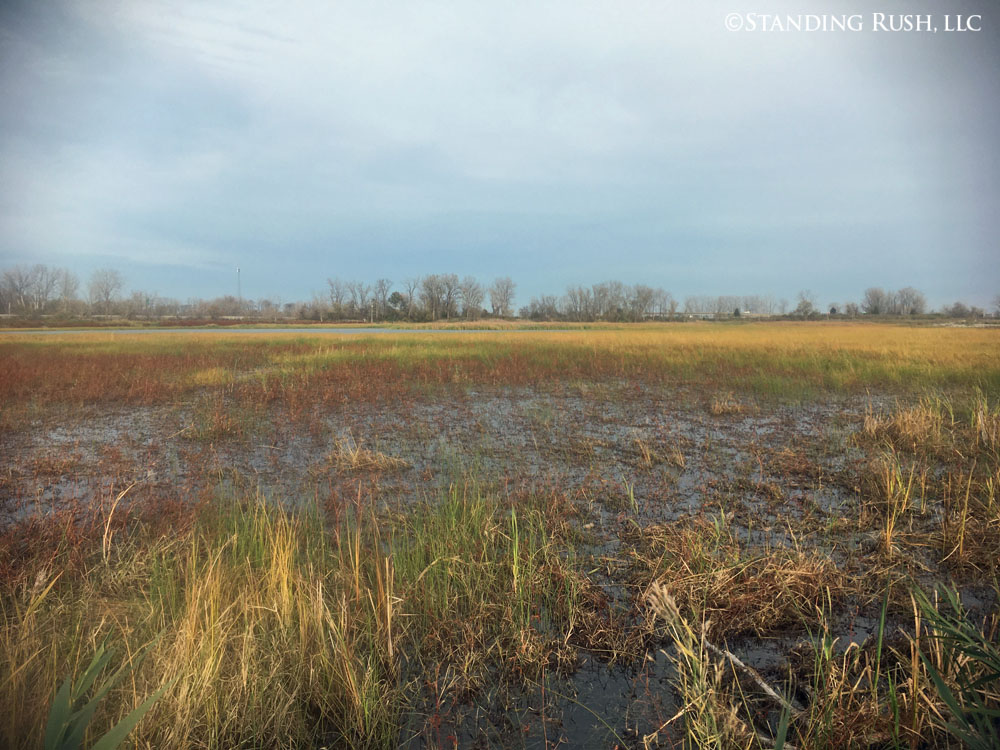
Rest Pond progression, continued . . .
It is truly amazing to compare this image to those taken in spring & summer, just a few, short months ago -- a naturally-occurring waterfowl buffet, but also refuge to countless species of insects, amphibians, fish, reptiles, and birds (of the non-fowl persuasion) . . . just to name a few.


While much of our attention on this website focuses on happenings "inside" the marsh, it is worth noting that water levels have been trending downward on the broader lake and bay over recent months (hard not to, considering the levels we reached over the last couple/few years). Projections -- shaky as they always are -- tentatively show this trend continuing. 

This image shows a particularly low snapshot during a significant SW blow (remember: lots of water can temporarily blow out of Sandusky Bay based on wind direction). It is striking to see the dead and tattered remnants of what was essentially a wooded barrier island just off-shore when we took possession of the property in 2015.What a difference 24-36" of water makes.


Roy was eager to show me progress in the Tower Woods at the backend of a full day at the marsh. I hadn't personally been hands-on with this tree planting in over a year, and it was amazing to see (1) the high percentage of trees of all species that are surviving, and (2) how much they have grown since they were put in the ground as 10-20" seedlings three growing seasons ago. 

Roy proudly attending to a thriving oak (above)
and sycamore (below).


Also worth showing growth of the "Bunkhouse Trees"
-- all are looking good!

NEWS FLASH: The USACE permit application that we worked so hard on over the summer was issued this month -- a big victory; we hope it can pave the way to lots of great things on Standing Rush's East Marsh.

"Ruger" (one of our punter's labs) wanted to point out that duck hunting continued and based on birds in the air, it remained worth keeping poised and ready to shoot -- and retrieve!


Monday, August 31, 2020

August 2020: Ongoing Dike Maintenance

Part of our ongoing management priority is to improve the long-term stability of our earthen dikes by placing erosion protection -- often in the form of fractured limestone -- on the side slopes. We have highlighted this work in previous posts, but the dogdays of summer are an ideal time to get this heavy lifting accomplished. With Structure 1 and now Structure 2 (installed through the dike below) now operational, there is even more incentive to preserve the integrity of these clay berms so that we can do the kind of work described back in July. One project naturally builds on another.

The West Marsh "Center Dike" with a fresh topcoat of erosion protection -- we could not afford to do the entire 3,000 feet in this effort, but as seen above, we made good progress. There was existing stone from when the dike was fully rehabilitated in 2017, but a new surface dressing is simply sound preventative maintenance.

This visual not only shows improved stability, it also highlights the robust growth of the desirable
vegetation that was only feasible through a timely drawdown (again, see July 2020's summary).

Large expanses of open water like the north end of the West Marsh (above) are particularly vulnerable to wind and wave action. There is major peace of mind having this stability in place.


Friday, July 31, 2020

July 2020: Nursing Along the West & Laying the Groundwork for the East Marsh

Much of our energy this month centered around the submittal of a nationwide U.S. Army Corps of Engineers permit application that would allow us to conduct many of the same restoration initiatives we have implemented on Standing Rush's West Marsh on the east. By contrast though, we have been asked to assemble a single "comprehensive" application for the East Marsh. If successful, what we accomplished in handful of discrete permits (on the west) could theoretically be implemented through this single application on the east. 


One of my favorite marsh plants, arrowhead or "duck potato," pioneering its way into a
fully drawn down Rest Pond, July 2020. (These types of vegetative "successes" are
only possible thanks to improvements we have been able to make to both the earthen
infrastructure and the related water control structures on the West Marsh.)

We feel like a broken record, but our common refrain is: "Water levels dictate about everything
else on the marsh." 

Our recently achieved ability to fully remove up to 3-4' of water off large expanses of the West Marsh (even when water levels in the adjacent bay are at or near record highs), allows us -- given the proper seasonal timing -- to establish an environment where a broad diversity of desirable
annual and perennial herbaceous (native!) plants can then flourish. (July 6, 2020)

We have to keep a very close eye on these early emergents to make sure we like what we are seeing:
annual nutsedges and smartweeds along with perennial broadleaf cattail and soft-stemmed bulrush
have become a familiar -- and desirable -- script over recent drawdowns. 

The goal is to encourage as much desirable vegetation as possible to promote native diversity
and high nutritional value before gradually adding water back into the system 
-- in an effort to mimic natural processes and to discourage the germination or rhizomatous spread
of our usual suspects of invasive species. (July 16, 2020) 

But undesirables (invasives) are a reality, and we have gotten pretty aggressive about singling out
noxious flowering rush, even if it is one isolated clump among a sea of desirable plants (see below).
Spot-treatment for solitary plants has become a mainstay of our management efforts throughout
the summer months.

While this might look like a dog stain in your front yard, it is actually the aftermath of a spot
herbicide treatment to eliminate a solitary flower rush plant (highlighted with the red arrow).
Unfortunately, it can take two or even three applications to eliminate both the stems and the 
even more persistent roots and nutlets beneath the soil.

As an aside, one of the byproducts of a full drawdown is finding things that have been submerged, sometimes for a long time.
This pile of "tufa rock" (a local calcium carbonate derived geological anomaly related to marl and worthy of its own future post) is a good example.
Our guess is that it was imported by duck hunters many years -- like maybe 50-100 years -- ago
to create a more stable base for blinding. A lot of work . . . all in the name of ducks!
At some point, we want to obtain a geologists perspective.


Tuesday, June 30, 2020

June 2020: Another Nearly 200 Acres of Coastal Wetland Permanently Protected

While the typical management activities of early summer (mowing, spraying, seeding, grading) marched on as the days continued to lengthen, June 2020 was headlined by the realization of another major project milestone. With the official execution of Standing Rush's second federally protected easement (~195 acres), nearly 400 acres of the bayside site are now secured as Lake Erie wetland, forever.

Standing Rush, West: With the exception of the extreme upper-left corner of this image, 
all of the ~195-acre marsh south of Route 2 (upper-right) and west of SR 269 (lower-right) is now 
under the perpetual protection of the USDA/NRCS's Wetland Reserve Easement (WRE) program.

The West Marsh Rest Pond from Structure 1 nearly three months into an early season drawdown.
Note the deep water canal in the foreground and a robust stand of broadleaf cattail in the background.
This is among the habitats now permanently protected.

Dozens of great egrets (among a broad spectrum of other wildlife diversity)
enjoying the productivity of the Rest Pond, June 2020.

A personal favorite perspective of the main West Marsh, August 2017.
Again, this is among the habitats now permanently protected.

Tuesday, March 31, 2020

March 2020: Life Marches On

Management and wildlife highlights this month included the following:


Due to the solitary nature of the research, Bowling Green State University was able to continue its multi-year investigation into northern pike reproduction and the top predator's dependency on coastal wetlands as critical spawning habitat.

The 40-acre Rest Pond was intentionally drawn down over several pumping events to move relatively warm marsh water from within the wetland into the (comparably cold) adjacent bay to coincide with ice-out. Bay water was then allowed to flow freely back into the marsh, inundating desirable spawning habitat (note deep water canal above and emergent vegetation below). This carefully timed water movement through Standing Rush's "fish-friendly" Structure 1 was intended to encourage pike passage into the marsh just as they and their future offspring would benefit from its refuge.

A Fyke net (aka fish trap) set by BGSU researcher Nate Stott just inside Standing Rush's West Marsh (see black framed structure highlighted by the red arrow in the left channel of the Rest Pond).

Two male northern pike trapped in the estuary off of Sandusky Bay immediately adjacent to Standing Rush's Structure 1.

A major goal of this year's research is to fit individual adult northern pike with small radio transmitters that can be harmlessly inserted into the abdomen to track future movements in and around the wetland, the bay, and broader Lake Erie over the next 2-3 years.


A true sign of spring -- one of three nesting pairs of "our eagles" -- birds that have set up residence on or immediately adjacent to Standing Rush.

How many bald eagles can you count in one willow tree? Many of these birds are juveniles, likely offspring of "our eagles."


Trail camera images retrieved late this month demonstrate why I may not have seen many deer the couple times I got in the stand this past season.

Our inability to secure a trapper this spring (due to the pandemic) has direct consequences in the marsh. The badly injured muskrat immediately above -- aside a healthy specimen for comparison -- shows the outcome of finite food and space availability, especially during the spring breeding season. It is not unusual for muskrats to battle to the death as populations grow and competition for mates escalates.

Beaver activity just north of our Tower Woods -- while SO COOL to see on one hand, a bit ominous on the other; these water-loving structural engineers are persistent and can be very destructive!


Thursday, August 10, 2017

Did Someone Say Mud?

My post from earlier in the week set the stage for what we are experiencing now in on the East Marsh. All our water management over the last several months has finally allowed us to reach our goals, and we are experiencing the extensive "late season drawdown" that we established as our primary 2017 restoration objective for nearly 200+ acres of marsh.

The vegetative response will be very interesting to watch. If we like what we see, we let it ride. If we don't, we always have the option of re-flooding one or more of the management units and essentially starting over.

But one thing we definitely can see is that the timing of our newly exposed mud is setting the stage for what we hope will be a bonanza of shorebirds. Dozens of species like the one pictured to the left are specifically adapted to capitalize on these situations. Their feet are typically long and well suited for "snowshoeing" through the wet mud, and long legs don't hurt anything when the mud is soft and the bugs are plentiful.

What amazes me most about this group of birds? (1) Their diversity [I have a lot to learn to differentiate all the subtleties that differentiate the species]; (2) Their ability to find and exploit new mud [they seem to appear out of nowhere the instant water goes away]; and, (3) Their metabolism [most of these species seem to never stop moving!]. Identification is tough (I'm always looking for positive id's from those who know more than me), but photography can be even more challenging. We hope to spend more time in the marsh with a camera over the days and weeks to come.

This medium-sized hunter of the shallows let me get pretty close yesterday while I was photo monitoring.
Can anyone ID?

Just like shorebirds, bird watchers seem to appear out of no where as soon as new opportunities arrive. I witnessed six vehicles and nearly a dozen individuals armed with scopes and telephoto lenses on the roadside to the west of our East Marsh late on Wednesday afternoon. Word is out that we have "fresh mud." Seasoned birders are well aware that the shorebirds are sure to follow.

For perspective, here are some comparison photos from the same vantage points: June versus August. The "after" shots were just taken yesterday.

BEFORE: Very sparse emergent vegetation and turbid water dominate in the Tower Marsh; June, 2017

AFTER: Millet and other annuals are beginning to fill in opportunistically thanks to the dry conditions that are conducive
to germination; August, 2017
BEFORE: Broad expanses of shallow water dominate the 100-acre Dinky Track, leaving little but dead and decaying
loosestrife clumps in the background; June, 2017

AFTER: The same perspective following drawdown -- shorebird activity is picking up and so is the germination of new
annuals in the mud; August, 2017

Tuesday, August 8, 2017

Clean Slate, Fingers Crossed

After months of effort, we have finally accomplished a full drawdown on the main Tower Marsh.
This image shows the ~half of the ~80-acres that we hope will evolve into a broad diversity of desirable wetland
vegetation. It's been decades since this has been done though, so it's a "fingers crossed" experiment.

For two years now, Roy and I have been using the term "clean slate" to describe the starting point that we face -- or in some cases strife for -- with our management units when we contemplate restoration activities. While it seems somewhat counterintuitive, the broad expanse of mud depicted in the image above is about as "clean" of a slate as we can get on our property.

In reality, we don't ever have the luxury of starting fresh. All of the land targeted for restoration has a history, and each individual target area confined by earthen dikes ("management unit") has its own specific past, present, and future. Our goal is to help provide environmental circumstances that promote the most ecologically desirable future. And it all starts with water (or in some cases, the lack thereof) and plants. As I've discussed in previous posts, many of our units were dominated by invasive species at one time or another over the last several decades. Some were dominated when we took possession of the property in 2015.

Others, like the "South Tower" unit pictured above have had enough water on them long enough that there isn't much growing. Two to three feet of standing water tends to limit emergent vegetation, especially if the water levels are sustained. And if the water tends to be murky (like ours was), even submergent vegetation (below the water level) tends to be limited.

But every unit has a "seed bed," a residual reservoir of plant seeds made up of several to many species -- deposited over years and even decades -- that resides in the shallow surface "mud" that in several cases, we have now exposed. The gamble is what is that seed composition, and what can we trigger to germinate?

In the case of last year's effort in the West Rest Pond, we weren't confident that we'd like what we'd see in the seed bed, so we flew in millet to help promote desirable plants (read more here, if you haven't already, to better understand how we try to stack the deck using millet). We are implementing a similar tactic on the far East Dinky Marsh because we are concerned there may be high percentages of Phragmites and loosestrife seed (reminder: both "bad guys").

But the Tower is a roll of the dice we are willing to entertain. Only time will tell if the gamble will pay off. I'll get more into the impacts of drawdown as we witness what unfolds.

P.S. The only plant material visible in the image above is a small amount of aquatic smartweed in the foreground, the ring of Phragmites that we are allowing to grow on the far dikes to help keep soils stabilized (dark green plant in the background), and the bright green millet (background, but in front of Phrag) that we flew in a few weeks back to try to minimize the spread of Phragmites from the surrounding dikes. It is still short, but it is coming on well.


Tuesday, May 23, 2017

Three Birds of Note: Ibis & Pelicans

This glossy ibis was one of four that visited the millet late last week. By Saturday morning, they were accompanied by an equally rare relative, a pair of white-faced ibis.

Birding is all about timing. Right place, right time. And speaking of time, I just haven't had much to report on several exciting visitors over the last several days. But before I do, some backstory . . .

Millet by Thursday afternoon
(note egrets in mud to right of channel,click to enlarge)
Last Thursday, we started the West pump in an effort to expose more "mud" in what was 40-acres of millet last fall. We were at a tipping point. What might have been 4-8" of water over 20 acres to start the day shrunk to maybe half as much water over half as much area over the course of the entire day of moving water.

Our goal in pumping this unit at this point in the season is to expose more soil to direct sunlight because even a few inches of water can prevent the germination of the desirable vegetation we are trying to promote. It's somewhat of a cat and mouse game with precipitation.

This stage of a drawdown tends to be pretty dynamic -- not only in terms of the change in water levels, but in how the wildlife responds. I unfortunately couldn't be there myself, but Roy tells me that by early afternoon, the dwindling water was simultaneously visited by 146 great egrets (he counted!) and four individuals that literally had cars pulling over on the Route 2 overpass. Glossy ibis are known for their curved bills and their propensity to East Coast living. This burgundy to black wader looks like something out of Dr. Seuss, and it typically resides along the Atlantic Coast, from Maine to Florida, into the Caribbean and even Central and South America. But according to the ODNR, this species may not make it into Ohio for multiple years at a time, so seeing four at once (three in one blurry camera frame) was pretty exciting!

Eager bird watchers (apparently alert even when driving by at 65 mph) congregated on the shoulder of our exit with spotting scopes from Thursday until Saturday morning -- when the ibis ultimately pulled out. Fresh rains pushed the water up another few inches, making a mealtime dip uncomfortable even for the larger egrets. [They are like walking staff gauges; great egrets only like water <6" deep, while great blue herons will frequent water up to 12" deep.]

But before the rains fell, one particularly enthusiastic and seasoned birder from Cincinnati confirmed Roy's hunch. Four ibis had become six, and the last two to join the party were an even rarer visitor, the strikingly similar white-faced ibis. The two share feeding behaviors, and both apparently like to wander far afield of their typical range. The white-faced is widely distributed west of the Mississippi, and even takes up year-round residence in mid- to southern South America. Unfortunately for us, they don't like to have their pictures taken!

Documented on "East Medusa Marsh"
through former site Aves.net
One final birding note worth noting: as we closed up shop for the evening today, we were treated to a flyby from three of the biggest birds one can see in Ohio: the American white pelican. With a wingspan up to 9.5', they are tough to miss, but again, they are not a common sight in the Buckeye State. I have come across historical photo evidence that they have been documented on our East Marsh in the past. While they seemed to give it a look (breaking their wings to interrupt their telltale glide), they apparently had their minds set on something even further east -- even further from their typical range.

Pretty neat stuff.