Showing posts with label autumn. Show all posts

November 2020: Not Time for the Parka Just Yet

 Here's a taste of late autumn from Standing Rush:

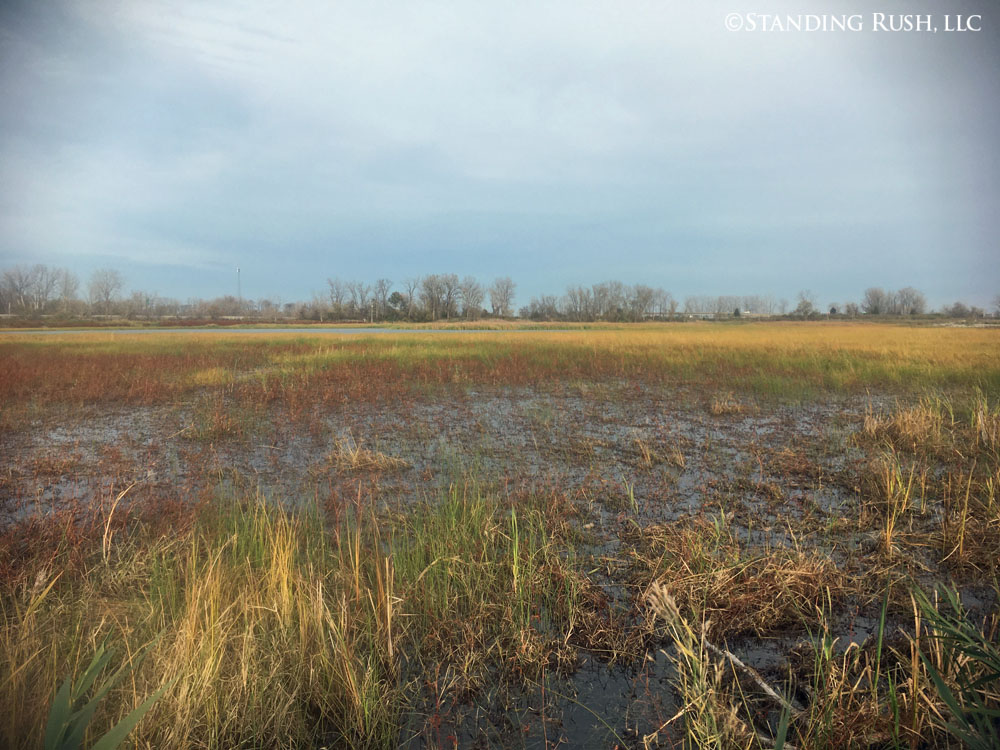
Rest Pond progression, continued . . .
It is truly amazing to compare this image to those taken in spring & summer, just a few, short months ago -- a naturally-occurring waterfowl buffet, but also refuge to countless species of insects, amphibians, fish, reptiles, and birds (of the non-fowl persuasion) . . . just to name a few.


While much of our attention on this website focuses on happenings "inside" the marsh, it is worth noting that water levels have been trending downward on the broader lake and bay over recent months (hard not to, considering the levels we reached over the last couple/few years). Projections -- shaky as they always are -- tentatively show this trend continuing. 

This image shows a particularly low snapshot during a significant SW blow (remember: lots of water can temporarily blow out of Sandusky Bay based on wind direction). It is striking to see the dead and tattered remnants of what was essentially a wooded barrier island just off-shore when we took possession of the property in 2015.What a difference 24-36" of water makes.


Roy was eager to show me progress in the Tower Woods at the backend of a full day at the marsh. I hadn't personally been hands-on with this tree planting in over a year, and it was amazing to see (1) the high percentage of trees of all species that are surviving, and (2) how much they have grown since they were put in the ground as 10-20" seedlings three growing seasons ago. 

Roy proudly attending to a thriving oak (above)
and sycamore (below).


Also worth showing growth of the "Bunkhouse Trees"
-- all are looking good!

NEWS FLASH: The USACE permit application that we worked so hard on over the summer was issued this month -- a big victory; we hope it can pave the way to lots of great things on Standing Rush's East Marsh.

"Ruger" (one of our punter's labs) wanted to point out that duck hunting continued and based on birds in the air, it remained worth keeping poised and ready to shoot -- and retrieve!


September 2020: The More Things Change, the More They Stay the Same

As summer evolved to "Indian Summer" and eventually full-fledged autumn, the seasonal cycles continued to play out at Standing Rush, independent of a vastly changed outside world.

I'm struck at how many of our 2020 photos are like the one above, void of people. Site tours were put on hold for all of 2020 unless absolutely necessary, school groups did not assemble for field trips, and even contractor activities were minimized unless we were absolutely sure we could operate safely given the backdrop of an ever-changing public health crisis.

I was lucky to have averaged a trip to the marsh every month in 2020, as opposed to the 50+ times per year I averaged for the first five years of the project. I deer hunted once (for an hour), duck hunted a grand total of three evenings, and had specific need to be on-site for work no more than a handful of times -- although I came up with excuses to make it out maybe twice as much. Roy became my eyes and ears even more than before (the vast majority of 2020 photos were taken with him on the other end of the camera). I focused on strategic planning, grant administration, financing, supporting Roy . . . and keeping myself, my family, and my immediate circle healthy. 

One habit I tried to keep was taking a short walk every time I made it to the marsh.
This image was captured on the lane behind our bunkhouse. It is wild asparagus loosing its photosynthetic green for the season. Like so many things in 2020, I found myself appreciating it in a different way -- pausing to notice rather than just walking by.

One silver lining of autumn was that duck hunting could carry on amidst COVID,
a familiar ritual and a seasonal bookend for those who live to rise early and keep eyes to the sky.
As this double-limit of teal attests, things started off strong and
-- fortunately for everyone's collective and individual morale --
stayed that way throughout the 2020 waterfowl season.

Off to the blind . . . 


Plenty To Be Thankful For

A large family of Trumpeter Swans preparing for -- or perhaps in the midst of -- a migration (photo by Art Weber);
the photo was taken on the two-track that leads to one of my favorite tree stands -- the one I hunted in tonight

I spend a good amount of my time on this online journal trying to describe just a fraction of the amazing diversity of subjects that we are blessed to witness at Standing Rush -- both in our work and in our play. The marsh is a visual spectacle that unfolds before one's eyes in a different way with each passing day . . . in fact, with each passing "MOMENT" (hence the name of the blog).

Despite our collective efforts with a camera, we could never capture, much less share, anywhere close to what we are fortunate enough to see in person. We do our best. But tonight, as I reminisce on the day that I just had and on the day that lies immediately ahead, I feel compelled to express my gratitude for another of my God-given senses -- the gift of hearing.

This afternoon marked my first sit in a tree stand. This season thus far, my deer hunting pursuits have been much like my time (or lack thereof) in a duck blind: filled with great intentions, but filled even further with personal and professional responsibilities that most often supersede a hunt. I have explained in past posts that I tend to get philosophical when I'm perched in a tree. This evening, my mind consistently wandered to my dad. It is fitting, because I consider my deer hunting outings to be sacred time -- opportunities not only to observe wildlife and the natural world, but also to observe all the blessings in my life. Dad, who passed in June, was certainly one of my greatest blessings. He was also one that, on the eve of a holiday specifically built to "give thanks," was a master at being humbly grateful. Our family is working hard to carry on one particularly special aspect of his legacy, his favorite "prayer," which was either an internal or audible "thank you, thank you, thank you!"

So tonight, on the eve of Thanksgiving, I am thankful not only for Dad but for the gift of hearing. Here's my attempt at a comprehensive list of what I heard tonight from the stand:
Red-winged Blackbird
(Photo by J. Flanagan, used with permission);
Click Here for a library of wildlife calls 

  • A typical mix of "tweety" birds -- cardinals, blue jays, juncos, and marsh sparrows -- either flitting close enough to hear wing beats or chirping in the understory beneath my feet, particularly as the light faded. A brown creeper and white-breasted nuthatch, scooting along rough willow bark just a few feet from my head, periodically chastising each other for invading each other's invisible territory. A covey of mourning doves, spontaneously flushing from dangers I certainly couldn't detect. Periodic flocks of chatty blackbirds, able to be heard way longer than they could be seen.
  • Cattail and Phragmites rustling more-or-less constantly in the unrelenting (and less than ideal) wind. A clump of remnant grape leaves doing their best to hold on for one more day. A broken cottonwood bough creaking in the crotch of a mulberry tree behind me.
  • Man-made sounds: the familiar and distant drone of highway traffic as the wind swung from west to northwest; periodic jets overhead; the lonely but somehow soothing wale of train whistles; random volleys from shotguns on adjacent marshes and farm fields; solitary shots as deer hunters prepped for next week's main "gun season;" a dog barking either because he has been chained too long or because he is just ready to come inside.
  • Whistling wigeon rocketing overhead toward the marsh; wings and the telltale subtle quacks of several flocks of mallards on the wing; solitary and unmistakable quacks from within the marsh, sometime followed by a "high-ball" chorus of enthusiastic clucks and quacks that always makes me feel like I missed out on a joke told by a mallard comedian. Small (and sometimes not so small) pods of Canada geese noisily announcing their need to find a restful landing zone to spend the night. A bevy of trumpeter swans, who I could tell just by the range in their strained and curious calls, where looking around -- per usual -- as they surveyed where they might land in the marsh.
  • Several bald eagles, a single red-tailed hawk, and plenty of gulls (probably of several different makes and models) and great blue herons (whose calls seem to bend like their long necks as they spook and change course in the air).
  • A noisy 'possum (so easily mistaken for a big buck), rambling from the base of one willow snag to another beneath me; a fox squirrel squeaking through the tough outer shell of an imported walnut; a nearly inaudible cottontail (who I may have heard due to a quick rustle of leaves but more likely because I saw its reaction to a silent northern harrier, gliding silently through my main shooting lane).
  • One pair of great horned owls, echoing to each other as I climbed down my ladder.


All of this was in about two hours; all before nightfall fully set in. And all was "observed" with my ears rather than my eyes (although I must admit, I would sneak a peak whenever possible and a nearly full moon would have made for some more fun observation, if I wouldn't have been under-dressed). Unfortunately, I never did hear what is often the almost incomprehensibly subtle approach of a whitetail underfoot, or the nearly equally thrilling sound of the arrow being released from my bow. Next time. Obviously, still plenty to be thankful for.


Nature's Vitamins and New Trees

Gizzard shad -- a welcomed and well-timed morsel in the marsh

Yesterday, I took about twenty images of the individual photographed above before I got the lighting right. (It didn't help that I was using my cell phone and a crude kitchen light in the bunkhouse.) I went to the trouble of getting the shot of this modest (and smelly) "baitfish" because the species always reminds me of this time of year. And their presence in the marsh lead to a few interesting sights as my day progressed yesterday.

One of ten large native trees planted
around the bunkhouse this past weekend
(yellow poplar or tulip tree)
Gizzard shad spawn in huge numbers mainly in larger lakes, reservoirs, and rivers throughout Ohio (and in many states east of the Rockies) in the spring. While adults can exceed 20" in length -- and 3+ pounds -- they are perhaps most important in the food web as they grow to the size pictured above . . . a modest 3-4 inches.

While survival rates are low during early development (largely because they are being eaten along the way), millions -- perhaps billions -- survive their first summer in Lake Erie and its tributaries. As with midges and warblers, nature is setting the table with gizzard shad. Just as temperatures drop in mid- to late autumn, temperature sensitive yearling shad pulse into shallow water in huge numbers. Their fat-rich bodies serve as mobile and essential energy boots not just for other fish (stocking up for a long, tough winter) but for fish-eating birds prepping for or working through a strenuous seasonal migration.

I watched eight hooded mergansers and literally thousands of terns pluck unsuspecting shad from the marsh throughout my morning yesterday. I focused on the ducks carefully for the better part of a half hour, and based on my observation, they were batting a pretty high average. An individual duck would come up with a fish about 50% of the time. Good for the ducks; not so good for the shad.

As a sidebar, I had to smile as I drove the kids to school this morning. Our path follows the banks of the Maumee River, and when we got to the flat, exposed rocks and rapids along Side Cut Metropark, the kids couldn't believe the number of gulls feasting up tight along the shore. There had to be several thousand packed tightly together both low in the air and on the water. We have seined shad together this time of year at that exact location, so everyone knew what was going on. We pulled over briefly to take in the spectacle. Happy gulls, happy kids, happy dad. The seasons march on.

I'll share more of the backstory as to how these awesome trees got planted in a future post, but for now, I just
wanted to point out how much of an improvement they make as you approach from our south entrance
These three oaks are already pushing 15' tall; it will be tons of fun to see them grow to be 75'+!
-- we're excited for the shade they will eventually bring (not to mention the acorns)


A Picture-Perfect Night in the Tree Stand

A view of the West Marsh -- looking W/NW -- from one of my favorite perches
(as always, click to enlarge to enjoy more of the detail)

It's amazing how perspective changes 16' off the ground. This might be especially true in marsh country, where topography changes are just as often measured in inches rather than feet. But as a deer hunter who has spent countless hours each autumn for decades now in a tree stand, I can attest that it really doesn't matter where you are, if you are up in the air.

Last evening was one of those unanticipated but memorable nights on this remarkable land. A full morning of meetings in Sandusky fostered some pretty exciting discussions about the possibility of future improvements not only to our site, but to neighboring land and water. Roy and I then reconvened back at the bunkhouse to talk through the details of a tree planting effort that is slated to happen around our field office this weekend (more on that in a post hopefully early next week). He then gave me just the nudge I needed to get suited up for my first official deer hunt of the season. I was on the fence about going (so much to do), but boy am I glad I went.

My preferred shooting window; never a bad way to spend an autumn afternoon
(note Phrag patch in the upper-left, as mentioned below)
While last night's hunt took place about two months later in the season than it would have four kids ago, it was worth the wait. [Spoiler alert: I never released an arrow. But it was still just what I needed.]

I have found real rejuvenation in sitting quietly in the elements, especially -- for whatever reason -- when it's cold. Fishing and hunting are often my chosen means to put "some extra fresh air on my face," as I like to say. I'd be lying if I didn't admit that I loved the heart-thumping anticipation associated with the approaching movement in the nearby Phragmites stand that methodically started five minutes after I sat down. There is not much better than intensely watching and listening to nature.

And of course, I loved seeing the six deer that walked unknowingly beneath my statued gaze -- first, two does and two yearlings at ~60 yards, then (<5 minutes later) a seasonally-excited 4-point buck in hot pursuit, and finally (just before sunset), a mature 8-point.

The view over my right shoulder just as the sunset is hitting a golden mulberry and a sea of autumn dogwoods --
truly awesome!
But what I maybe like most of all about deer hunting is the quiet and the solitude. I love observing nature being natural. I also love that my brain can quiet itself, and decide whether it wants to think about a challenge at work, a situation on the home front, or whether or not it's a rabbit, a squirrel, or a 10-point buck creeping up behind me. I get to choose.

I have come to use my time in the stand not only as an avenue to put choice protein in the freezer while culling a population that has unintentionally ballooned way beyond its carrying capacity in much of Ohio. I also use it as a means to really focus on the things most important in my life.

I bring my personal intentions to the tree and try to think hard and long for all those people and things in need of the most prayer. But the thoughts come more easily somehow in a tree stand. Over the last couple seasons, I've tried to really focus on one particular person each time out. Last night, it was an aunt, who passed away earlier this week. She died as gracefully as she lived for more than 86 years. And like every other way she touched my life, my interaction last night was yet another beautiful gift. I know it is my second informal memorial in as many weeks, but thank you, Aunt Mary Jo. You will truly be missed.


Mostly Cloudy (or Partly Sunny?)

While a "large" kinglet weighs about the same as a stack of three pennies (~8 g), these active, little buggers are
one of my absolute favorites; cloudy skies made their yellow-gold-orange crested caps more muted,
but they still put on a show in the tangle of dogwoods, grapes, and willows

After a full week in my office, I have to say I was pretty excited to be driving eastbound on Friday morning for a day in the field. Sunshine was in the forecast for the first time in days, so I had a full itinerary planned for photo-monitoring. Lingering low clouds and a northeast breeze made their presence known during a brief gas station stop en route. By the time I made my final approach to the property, it was clear that "mostly sunny" in Toledo was going to translate to something different on the marsh -- at least for the start of the day.

This is a phenomenon I've gotten pretty accustom to over the last few years, but I have to admit, I was pretty disappointed as "partly sunny" (at best) pretty quickly transitioned to "mostly cloudy." The lighting would be decent for wildlife photography, but I've found that sunshine is a nice addition when taking landscape shots for reference. So, as is so often the case, I audibled to a laundry list of other odds and ends.

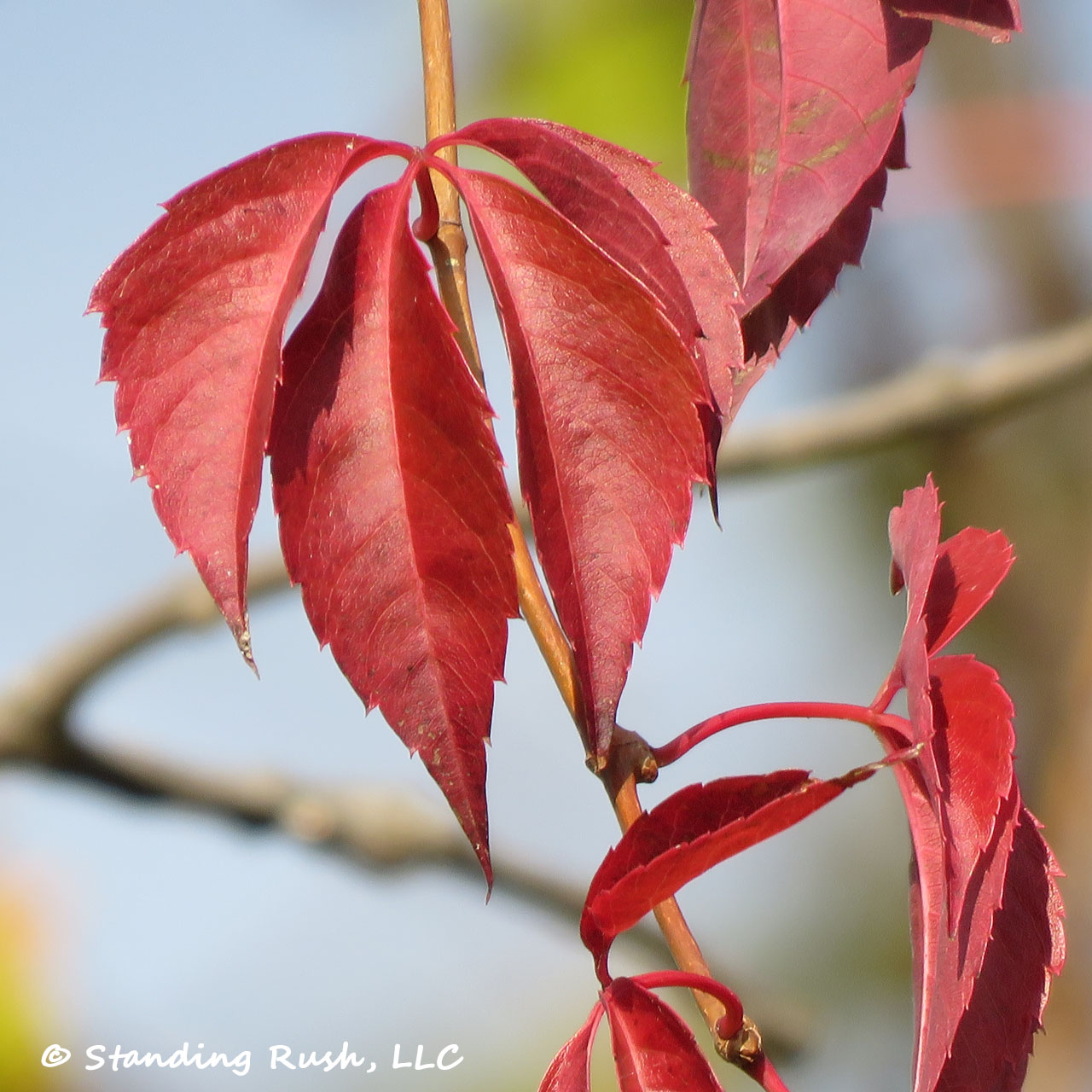
Virginia creeper is nearing its seasonal end, but the vibrant crimson
seemed worthy of the visual memory
Peaks of sunlight kept tempting me to circle back to my original plan, but the power struggle between the temperature in the air (40s to mid-50s by late afternoon) and the temperature of the bay (probably on the lower end of that same range) -- with sustained northeast winds -- were a recipe for nearly constant clouds.

I took the opportunity to sit in one of our newly placed tree stands over my lunch hour (sans lunch), but the wind direction wasn't right for deer movement and it really ended up being more of an impromptu window into current bird activity. The list of observed species grew to more than 20 quickly, but the highlight for me was the nearly constant stream of passing golden-crowned kinglets. These miniature-sized insect-eaters came in twos and threes. And, as is so often the case, they were nearly constantly on the move. Of course, the only one that cooperated and sat still for more than 3 seconds did so about three feet from my right arm, when the camera was back in the truck.

Showy dogwood leaves in sunshine
[ASIDE: Make sure you check out the Cornell Lab's profile of the kinglet (see link above). Like all of their entries, they share so many "cool facts." Example: The tiny Golden-crowned Kinglet is hardier than it looks, routinely wintering in areas where nighttime temperatures can fall below –40° Fahrenheit. I can vouch for this. I first took note of the kinglet during my first winter in college -- in central Minnesota. The temperature that evening was definitely below zero!]

Ironically, it wasn't until about 30 minutes before I promised myself I'd get back on the road home Friday evening that the blue sky really made its full appearance. Better late than never.

As I scrambled around to capture what might be the last stands of certain peak autumn colors for this year (big winds in the forecast for Sunday), I thought to myself, this may also be the last day I could even consider working in a t-shirt. And just a few hours earlier, I had been wishing I had a winter hat.

We'll see though. "Normal" in terms of weather is hard to define anymore. While I really don't want to be, I could be back in short-sleeves yet this month -- or even in December.

The last remaining leaves on the largest cottonwood outside the bunkhouse; note the blue sky and that this was the same
tree that housed an oriole nest that entertained me back in May and June -- when the leaves were green and new

P.S. As the winds calmed and the late afternoon sunshine finally broke through, I heard both chorus frogs and peepers in the reed canary grass off the bunkhouse. Someone needs to tell those peepers that they are Spring peepers -- and it's November!


Sights and Sounds of the Season

Two of the eleven trumpeter swans I got to watch as I worked my way around our eastern-most unit yesterday
(click to enlarge and enjoy the detail)

I love days like yesterday. After I assisted with the breakfast and day prep routine, my wife and kids were on the road to school. I got through my emails, ran through the snail mail, paid a couple bills, and was out the door not long after. A couple quick errands (to buy grass seed and pick up a trimmer part) prolonged my commute to work by a few minutes each, but by just after 9:00, I was at our field office.

The color pallet of sumac is typically an early indicator that more
leaf change is not far off
The day started with a Mule tour on the west side. I was pleased because I was finally able to show a friend from our church around the property a bit. Our schedules kept conflicting, so it was good to make it happen. While the cloud cover held on longer than had been forecast, and despite the fact that wildlife viewing was very modest (because we had punters prepping duck blinds in the marsh), he really seemed to enjoy himself.

After a little tire kicking around the bunkhouse, he was on his way home, and I was on to an afternoon of photodocumentation on the East Marsh. Besides the primary objective of gathering regular reference photos from the exact same vantage points and orientations at dozens of locations around the property, this discipline also affords me the unique opportunity to walk portions of the marsh with a camera in my hand -- and if I'm lucky, with very little distraction.

Black-legged Meadow Katydid;
sound familiar?
The photos included here were all taken as part of my broader efforts with the camera. So in addition to gathering great reference imagery on a landscape scale (for comparison through time as the habitat evolves), this monthly exercise has served as an informal way to build a timely photo journal.

From the changing leaves of staghorn sumac (above) to the intricate detail and familiar sounds of autumn insects (left and below), there is no doubt that we are once again in the midst of a major transition. Temperatures (70s and even 80s) have been summer-like, but the evidence of a new season is everywhere.

An additional fringe benefit of a few dedicated hours with a camera is that I can take reference photos of native plants. This time of year, I'm particularly interested in those that flower -- and eventually go to seed. If the plant is something that we see benefit in having more of on the property, I will often capture a GPS location of larger stands (both on-site and at other locations regionally). Assuming permission, I can then come back and collect seed that can be redistributed for our project.

The asters below are good examples both of a sign of the times (flowering asters in Ohio = autumn) and of native species that are desirable -- in this case, in the sense that they attract pollinators (not to mention they are beautiful). SIDEBARS: (1) I love how I can be taking a closeup photo of a plant or animal, and then find that I was inadvertently capturing other plants or animals in the frame (see below); (2) Asters can actually get pretty aggressive/invasive, so introduce them into a landscape with caution.

This image is like a Where's Waldo for insects -- can you find three?
Click to enlarge for a closer look

This little pollinator, which I believe is some type of hover fly, was kind
enough to pose again on a choice backdrop

I'll close this post with a vibrant image of a Differential Grasshopper -- a common species that was literally about
everywhere in the tall grasses yesterday; per usual, I love how this camera can capture the detail -- in this case,
not just of the insect, but also of the burdock leaf he is loafing on