A new month meant sustained cold. Only 10 of the 28 days got above freezing and most of those were on the front end of February. Lows were routinely in the teens or single digits, and we even dipped below zero on a few occasions. While we speculated whether we'd even get "walking ice" or a sustained stretch of "real winter," both ultimately came -- and in earnest.
Toledo tied an all-time record with 19 inches of snow on the ground on February 18, 2021. Most of that was thanks to a single event that brought more accumulation in a single snowfall than any other in my life's history (even more than the fabled "Blizzard of '78").
Most of our attention turned to planning for the upcoming field season. But even as the marsh froze solid, there were tons of opportunities to see the strong pulse of life alive amongst a persistent blanket of snow and ice.
Big ducks (mainly mallards with a few pintails) rise above a mostly frozen early February marsh to a rising sun and a setting moon.
"Our eagles" start to show consistent nesting behaviors in the massive tangle they have carefully constructed in the cottonwood next to the estuary.
It must be even colder up there in that seemingly constant wind.
Pretty hard to miss the nest (or even the protruding head/s of eagles) from afar (as always, click to enlarge).
Despite sometimes biting cold, Roy never misses the opportunity to take advantage of conditions to keep the place up. Here, brush mowing helps to maintain dikes and access while not interfering with nesting songbirds.
Even a stark haircut will grow back fast, but it keeps large, potentially destructive trees from getting established on dike slopes and it also gives visual evidence of spots that need special attention.
We were able to take advantage of a completely frozen dike and a few thousand residual dollars in an open grant to carry on the erosion protection we started last August.
This work took place to augment the installation and operation of Structure 2, could be squeezed in between major snowfalls, and can be tidied up as needed this coming summer (although something tells me Roy will find a way to get it done before then).
During the coldest of the cold, Roy spent a couple days exploring with his camera. His finds are worth highlighting here (including this active seep on the edge of the West Marsh, a groundwater spring that remained open all day and night despite temperatures well below zero).
Roy caught these candid shots of a coyote crossing over the south dike with a snowy package of mystery meat -- maybe a muskrat? -- being downwind with lots of fresh snow must have helped keep Roy "concealed" from the distracted canine.
Coyotes are plentiful at Standing Rush (as evidence from our active trail cameras), but it's not very often we even catch a glimpse during broad daylight.
A couple cool shots of another common (but largely nocturnal) mammal of the marsh.
Even in bitter cold, moving water near Structure 1 kept small areas open with shad (in beak above) swimming beneath. This made for some distant (and therefore grainy) images of canvasbacks.
Speaking of grainy, we're still yet to get a good crisp image of one of my favorite marsh birds, the "marsh hawk" or northern harrier. Roy saw individuals scanning the fresh snow on several occasions.
Unfortunately for this mouse, it was oblivious both of Roy and of the dangers lurking from above. Maybe it was distracted by the sub-zero temps that had it out feeding in the sun when this image was captured.
Roy's return to the same vicinity the next day gave evidence that the mouse (or at least a mouse) and the marsh hawk (or a marsh hawk) were "introduced." (Click to enlarge)
Management and wildlife highlights this month included the following:
Due to the solitary nature of the research, Bowling Green State University was able to continue its multi-year investigation into northern pike reproduction and the top predator's dependency on coastal wetlands as critical spawning habitat.
The 40-acre Rest Pond was intentionally drawn down over several pumping events to move relatively warm marsh water from within the wetland into the (comparably cold) adjacent bay to coincide with ice-out. Bay water was then allowed to flow freely back into the marsh, inundating desirable spawning habitat (note deep water canal above and emergent vegetation below). This carefully timed water movement through Standing Rush's "fish-friendly" Structure 1 was intended to encourage pike passage into the marsh just as they and their future offspring would benefit from its refuge.
A Fyke net (aka fish trap) set by BGSU researcher Nate Stott just inside Standing Rush's West Marsh (see black framed structure highlighted by the red arrow in the left channel of the Rest Pond).
Two male northern pike trapped in the estuary off of Sandusky Bay immediately adjacent to Standing Rush's Structure 1.
A major goal of this year's research is to fit individual adult northern pike with small radio transmitters that can be harmlessly inserted into the abdomen to track future movements in and around the wetland, the bay, and broader Lake Erie over the next 2-3 years.
A true sign of spring -- one of three nesting pairs of "our eagles" -- birds that have set up residence on or immediately adjacent to Standing Rush.
How many bald eagles can you count in one willow tree? Many of these birds are juveniles, likely offspring of "our eagles."
Trail camera images retrieved late this month demonstrate why I may not have seen many deer the couple times I got in the stand this past season.
Our inability to secure a trapper this spring (due to the pandemic) has direct consequences in the marsh. The badly injured muskrat immediately above -- aside a healthy specimen for comparison -- shows the outcome of finite food and space availability, especially during the spring breeding season. It is not unusual for muskrats to battle to the death as populations grow and competition for mates escalates.
Beaver activity just north of our Tower Woods -- while SO COOL to see on one hand, a bit ominous on the other; these water-loving structural engineers are persistent and can be very destructive!
Even though mink are a relatively common sight at the marsh,
seeing them through a camera, in focus (without Phrag right
in their face) has proven to be another humbling pursuit
Temperatures climbed well beyond the forecasted high yesterday afternoon (probably approaching 70 degrees), but unfortunately, so did the wind velocity (sustained 25+ mph out of the west with gusts probably well over 40). I scrapped plans for an inaugural paddle in new kayaks (more on that to come) and decided to scout for drain tiles to better understand runoff coming from the farm fields to our south. This audible offered the opportunity to carry the camera for a couple hours.
After clicking a few landscape shots for future reference, I got my first chance at wildlife images as one of the parent bald eagles from one of our nests made its presence known. Its shrill call was enough to get my attention -- even over the howling wind -- so I knew it was close. I spent 15 minutes chasing it in the air with the camera, a humbling experience for sure. It then maneuvered itself through bud-laden cottonwood branches before perching back on its two-year-old nest.
The unrelenting wind constantly tested the huge bird's balance. The feathers on its head and back pulsed "against the grain" every time the wind surged, making him look a little like my boys when they get out of the bed in the morning. While I was 50 yards or more away from the base of the tree, he (or she? -- hard to tell without a mate for comparison) seemed unaffected by my presence. But the shot below was the only time the bird presented its head for a photo. (I could have taken dozens of images of its posterior, however.) This again got me thinking about how everything has to work out just right for photography of wildlife to work out.
The eagle certainly had an easier time balancing itself than I did the camera in 25-40 mph winds
Three decent shots among three dozen bad ones -- gotta love digital technology; most of my images were out of focus,
very poorly framed, or both (click to enlarge)
My not-too-unusual finished product when attempting to take close-up photos of eagles (or any bird) in flight;
yesterday's wind actually helped because my subject tended to hold steady in one place longer than is typical
(not that you'd know it from this shot) . . . I just need to get a better monopod to help steady the camera
Bonaparte's Gull on the bayfront, taking on the black cap that is characteristic of spring breeding
Palm Warbler -- again in spring breeding plumage -- in a tangle of dogwood
One of dozens of Red Admiral butterflies that I witnessed either sipping early nectar or probing for minerals
(as this one is) in moist spring soil
I purposefully focused this shot on this Garter Snake's midsection; a recent meal made
for the easiest subject of the day -- dark soil, warming sunshine, and serious digestion
kept this typically slithery subject essentially motionless and clearly content
As Roy said, there could be an endless list of captions written for this image, taken yesterday on the marsh
I'd characterize last week's weather as plenty of bark and a bit of bite. The climaterrorists were definitely in full effect with measurable snow in the forecast for about four or five straight days. Guestimates ranged all the way up to 10 or 12"+ (in Toledo, at least) for the storm set to arrive last Thursday night into Friday, but in actuality, we got closer to three inches. (School was, of course, still cancelled.) And a forecast of 1-3" seemingly on repeat for the daytime and overnights Friday, Saturday, and Sunday amounted to not much other than some nasty freezing rain Sunday morning.
Last night flirted with zero, but somehow, it just feels like spring is coming fast. Recent sunshine and a ten day forecast with more mid-40s than below freezing are one decent indicator. So is the noticeable extension in day length. The stretch is now noticeable both in the morning and in the evening. Tonight may offer my last (sketchy) opportunity for hard-water pond fishing this season -- at least locally.
A budding relationship with the Natural Sciences Technology Center at TPS (Toledo Public Schools) has me working on a variety of projects. Yesterday, I was in the classroom with a dozen and a half seniors presenting a "Fundamentals" lecture on habitat management. I see increasing opportunity for collaboration with Standing Rush's mission. More on that to come.
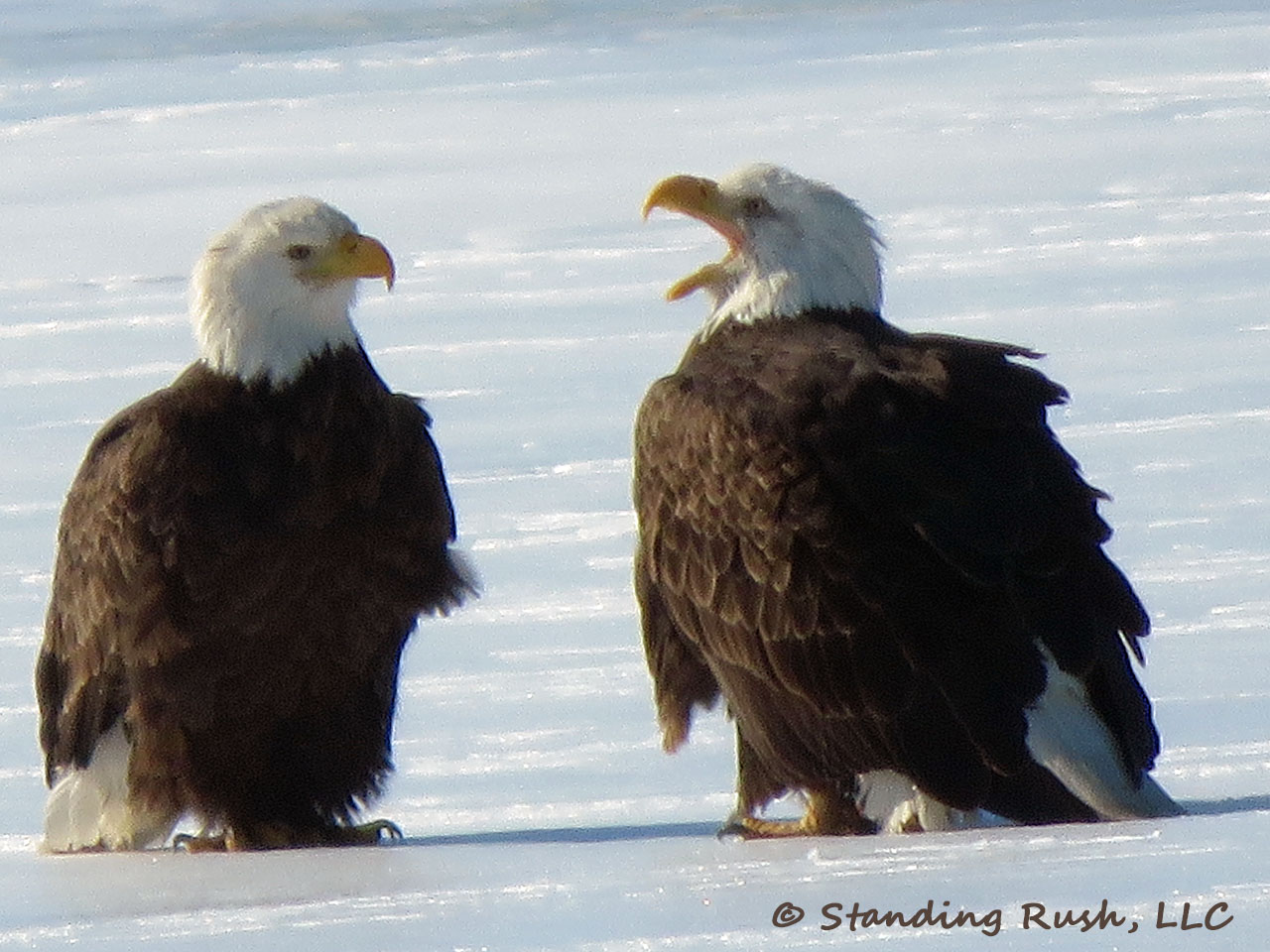
But for now, enjoy the scene of a couple expressive eagles. I'm not sure which I like more: the exuberant one on the right, or the stern-faced one on the left (seemingly unamused by the enthusiasm being shown by his partner). Reminds me of my twin boys -- or maybe even more my oldest son exhausting his older sister.
(P.S. Speaking of expressions, check out the new "Reactions" buttons on the bottom of each post. This is another great way to offer quick feedback and help me better understand what content people are enjoying/benefiting from.)
Eagles have more or less been a constant fixture on the new West dike since we have begun drawing water down
off the 40-acre Rest Pond
I feel like the proverbial "broken record," but water levels drive activity on the marsh. That has become a recurring theme not only in my day-to-day reality, but has been a constant for the broad diversity of wildlife that utilizes the property. Our Rest Pond (last year's millet) is now drawn down to the point that the remaining basin fluctuates between maybe 5 acres of skim water after a decent rain to maybe 3 acres after a few hours of pumping (15-30 minutes at a time).
Every time we run the pump, what was relatively calm surface water begins to boil with nervous fish. Isolated splashes gradually progress to exposed backs and frantic runs for deeper water. Deep is a relative term. The remaining basin is no more than 12-18" deep at its deepest, but most of the area now holds 6" of water or less. Still, it is likely serving as refuge for hundreds, if not thousands, of carp along with a modest diversity of other species (e.g. bowfin, bullheads, bluegills, largemouth bass, and lots and lots of topminnows).
I spent probably an hour one evening late last week watching juvenile eagles hover in a stiff southwest wind just over the water's surface. Occasionally, one would awkwardly land and stumble over a carp's back. The muscular fish would often deter anything beyond an exploratory prod with the talons and swim off to live another day (or at least another few minutes). The most determined eagles would eventually sink their claws -- and then beaks -- into the cornered fish.
I was amazed at how often the most determined birds did the catching only to get flushed off their kill by another eagle. Juveniles relented to each other, but most often, I was watching the young struggle to get a catch, only to get pushed away by a larger, bolder adult.
I'm taking these photos/video from nearly 1,000 feet away, so the resolution isn't great. But they start to give a feel for the daily ritual. It has become common to see up to a dozen (or more) eagles on the dike at any given time. They seem to enjoy balancing their days between sunning, squawking, fishing, and just stretching their wings.
It has become increasingly difficult not to take these incredible birds for granted. It seems strange to use the word, but they are most certainly "common." I don't have a good feel for how many are actively using the marsh right now, but it has to be dozens. I'd love to gain a better understanding for where they were all hatched and what their daily/seasonal ranges are apt to be.
Pretty impressive silhouette -- off to another fishing hole
Here's a true "moment in the marsh" that might give you the best feel for what I witnessed the other night (complete with 35+mph sustained winds -- sorry for the shaky video; but not bad at 800+ feet away, using a monopod!) . . .