Showing posts with label duck hunting. Show all posts

November 2020: Not Time for the Parka Just Yet

 Here's a taste of late autumn from Standing Rush:

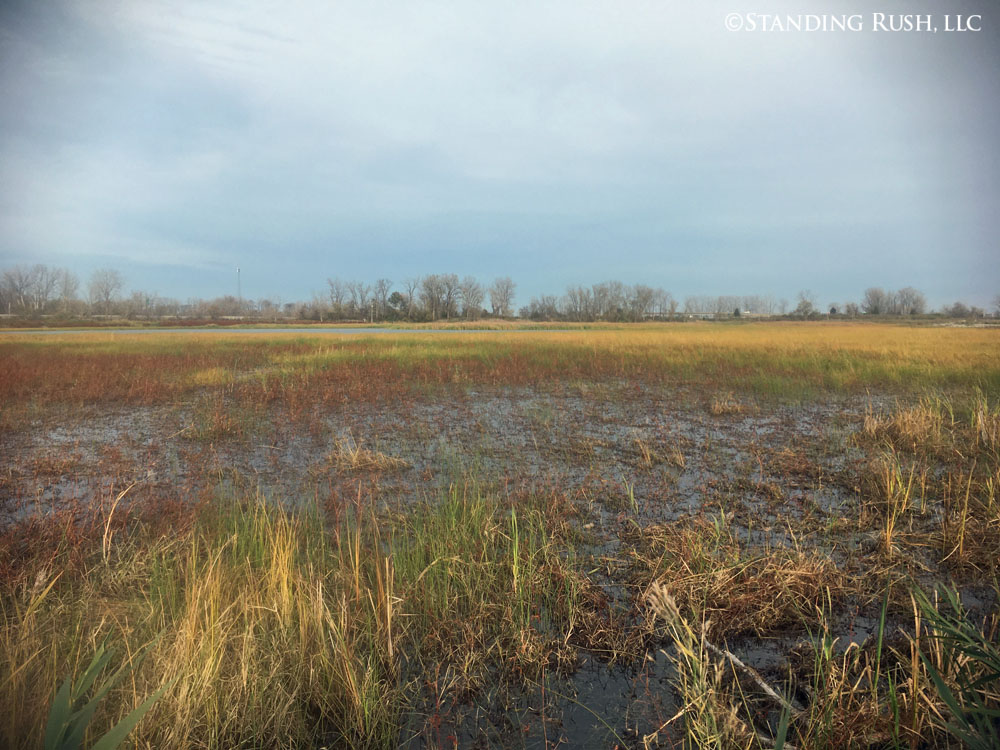
Rest Pond progression, continued . . .
It is truly amazing to compare this image to those taken in spring & summer, just a few, short months ago -- a naturally-occurring waterfowl buffet, but also refuge to countless species of insects, amphibians, fish, reptiles, and birds (of the non-fowl persuasion) . . . just to name a few.


While much of our attention on this website focuses on happenings "inside" the marsh, it is worth noting that water levels have been trending downward on the broader lake and bay over recent months (hard not to, considering the levels we reached over the last couple/few years). Projections -- shaky as they always are -- tentatively show this trend continuing. 

This image shows a particularly low snapshot during a significant SW blow (remember: lots of water can temporarily blow out of Sandusky Bay based on wind direction). It is striking to see the dead and tattered remnants of what was essentially a wooded barrier island just off-shore when we took possession of the property in 2015.What a difference 24-36" of water makes.


Roy was eager to show me progress in the Tower Woods at the backend of a full day at the marsh. I hadn't personally been hands-on with this tree planting in over a year, and it was amazing to see (1) the high percentage of trees of all species that are surviving, and (2) how much they have grown since they were put in the ground as 10-20" seedlings three growing seasons ago. 

Roy proudly attending to a thriving oak (above)
and sycamore (below).


Also worth showing growth of the "Bunkhouse Trees"
-- all are looking good!

NEWS FLASH: The USACE permit application that we worked so hard on over the summer was issued this month -- a big victory; we hope it can pave the way to lots of great things on Standing Rush's East Marsh.

"Ruger" (one of our punter's labs) wanted to point out that duck hunting continued and based on birds in the air, it remained worth keeping poised and ready to shoot -- and retrieve!


October 2020: Some Welcomed Familiarity

October was so refreshing because it ushered in at least a sense of relative normalcy. Roy was able to join his wife for the better part of a month of quiet in Michigan's north woods (chasing grouse and NOT spraying flowering rush), and my family and the lease holders stayed gleefully occupied back home either chasing ducks or thinking about chasing ducks (my area of expertise, particularly since having children). 


My nephew Josh, who shot his first duck at Standing Rush six seasons ago now (somehow), is now a senior in high school -- and still a deadeye with a shotgun. Great kid; great sunset!

Pre-hunt tailgate shot of my three boys (a tradition) just before striking out for the blind for their first hunt of the season -- and mine. My oldest shouldered a gun, and the little guys blew feverishly on calls. I missed ducks, but fortunately settled down and shot a few, too.

Comfortably blinded at 18:
We had good activity and decent shooting each time we went out. But more importantly, we laughed and smiled A LOT. My guys seem to be cut from a very similar cloth; they are "bit by the bug" and want to be outside whenever they can be.

The thrill of a pass was never lost on these three, and what I love most is they spend as much time admiring a bird after the retrieve as they do when they're on the wing.

Woodies were plentiful, but the diversity was there.

My nephew and brother got out a half-dozen times together, despite crazy, hectic lives.

My brother snuck away for a solo birthday hunt -- with his son solo in an adjacent blind;
not a bad birthday bag, especially considering he didn't have a dog.

I've said it before and I'll say it again: Sunrise and sunset on the marsh are spiritual experiences.
These are memories none of us will forget.


September 2020: The More Things Change, the More They Stay the Same

As summer evolved to "Indian Summer" and eventually full-fledged autumn, the seasonal cycles continued to play out at Standing Rush, independent of a vastly changed outside world.

I'm struck at how many of our 2020 photos are like the one above, void of people. Site tours were put on hold for all of 2020 unless absolutely necessary, school groups did not assemble for field trips, and even contractor activities were minimized unless we were absolutely sure we could operate safely given the backdrop of an ever-changing public health crisis.

I was lucky to have averaged a trip to the marsh every month in 2020, as opposed to the 50+ times per year I averaged for the first five years of the project. I deer hunted once (for an hour), duck hunted a grand total of three evenings, and had specific need to be on-site for work no more than a handful of times -- although I came up with excuses to make it out maybe twice as much. Roy became my eyes and ears even more than before (the vast majority of 2020 photos were taken with him on the other end of the camera). I focused on strategic planning, grant administration, financing, supporting Roy . . . and keeping myself, my family, and my immediate circle healthy. 

One habit I tried to keep was taking a short walk every time I made it to the marsh.
This image was captured on the lane behind our bunkhouse. It is wild asparagus loosing its photosynthetic green for the season. Like so many things in 2020, I found myself appreciating it in a different way -- pausing to notice rather than just walking by.

One silver lining of autumn was that duck hunting could carry on amidst COVID,
a familiar ritual and a seasonal bookend for those who live to rise early and keep eyes to the sky.
As this double-limit of teal attests, things started off strong and
-- fortunately for everyone's collective and individual morale --
stayed that way throughout the 2020 waterfowl season.

Off to the blind . . . 


Oh, What a Night -- Sharing a Blind with the Kids

Nothing like a duck blind selfie!

Two happy spotters
Conditions were just too ideal not to get out in the marsh last night. Truthfully, it was even more ideal for the hunters than it was for the birds. Temps were in the low 50s, the sun was shining bright, and the colors were rich and vibrant in the marsh -- plus, our guys don't have school today, so a little later Sunday night was no problem.

This was literally just my second time out (regretfully) thus far this season. Not a single outing during teal season. Life has just been TOO CRAZY.

The good news: The kids and I enjoyed birds in the air more or less all night, and there definitely seemed to be a shift to more mallards flying than woodies (as compared to a week ago). Ducks are using the marsh. We always had something to watch, be it waterfowl, heron, eagle, or "Tweety bird" (anything that isn't a duck when we are duck hunting).

The bad news (at least from a hunting perspective): Very few individuals or groups responded to my calls or really decoyed in the slightest. I took one shot at a big greenhead that came in from directly behind us. One of those shots where you find yourself laughing as you pull the trigger because you know you don't have a snowball's chance. But man, was it a nice way to spend an evening. Lots of smiles, lots of laughs, tons of fun. Need to find more time for nights like last night. So blessed.

A decoy round-up is always a great way to wrap up a great evening in the marsh


West Marsh Structure 2: Update #3 (& Duck Opener!)

Woodies should be part of mixed bags this
coming weekend
The only day without progress on the job site this past week was on Friday (today) -- the eve of this year's duck opener. We asked that the guys move the construction trailer and relocate the larger equipment in preparation for what we hope will be a fun weekend for our hunters.

So Friday was all quiet in the marsh -- at least from a construction standpoint. But as the photos below will show, the crew made hay in nice weather Monday - Thursday and got a lot of welding accomplished. We'll have to feel our way through the next couple weeks (first split of the waterfowl season closes October 27th), and then hopefully the weather will cooperate to really push toward completion during the break (which runs October 28 - November 8th this year).

Our lease groups recognize that restoration activities have to be priority number one, especially while pressures from high lake levels are so acute. But we still want to do all that we can to encourage waterfowl activity and successful hunting. As I've written about several times before, responsible hunting is just too much a part of this amazing place's heritage.

I stuck around past sunset one evening mid-week and saw a decent number of birds "working" the marsh -- preparing to settle in for a restful overnight. Our punters had some similarly encouraging reports. It is supposed to drop from the mid-70s (this afternoon) to the mid-30s (by sunrise tomorrow). We'll see how it goes!

Structure 2 at the end of the work day on Thursday

Cross braces and angle steel, mid-installation

Once plate steel is added to the top of this angle, the crew will move on to prep for the floor and dike crossing


Be Prepared for the Unexpected and Enjoy the Ride -- Ed Moxley

Ed Moxley
2/2/47 - 3/22/19
Another dear friend and local champion of wetland conservation passed -- almost fittingly -- while I was on my recent adventure to Manitoba (ice fishing). Ed Moxley was not only proud of his northern Ohio roots, he was also more than happy to pursue his #1 passion (duck hunting) both near and far-afield.

For more than six decades, Ed pursued ducks and geese across the U.S. and Canada, in Mexico, Argentina, Colombia, and even Botswana -- just to name the regions he specifically spoke of to me. To say he was avid would be a woeful understatement. Ed beamed over ducks. And, especially over recent decades, he tirelessly advocated for their well-being and conservation.

How could someone who prided himself in being such a student of the sport (the sport of harvesting birds) love these animals, arguably to the point of an obsession? Ducks and duck hunting were not just a past-time to Ed, they were a way of life.

For more than four decades, Ed and his family owned and operated Moxley's Marsh, immediately to the east of Standing Rush. Ed lived and breathed his quiet corner of Sandusky Bay. He knew where the birds would be and when they would be there. He knew where they would fly and where to be to be in best position for the shot -- either with a shotgun, with a video camera, or with both. Sometimes "marsh management" took the form of single-elimination varmint control, as Ed crept along familiar two-tracks craftily wielding his .22 -- he was a dead-eye to put it mildly.

Ed and Roy initiated a long and lasting friendship -- and mutual respect -- back in the 1970s when Roy was formulating his duck nesting studies as a Master's student. Ed not only supported the work in principle, he offered his family's marsh as the epicenter for the research. I caught up with Ed a couple decades later, when he and his long-time shooting partner Dave Brunkhorst invited me out to test a product I was developing that held potential in remedying holes caused by problematic muskrats and groundhogs (at least those that somehow eluded Ed's crosshairs).

Six shots = six ducks for Ed
(photo from A Waterfowler's Scrapbook II, by Edward J. Moxley)
Roy and I have recently reminisced about how we were both instantly drawn to Ed's infectious enthusiasm and broad smile. We have fond memories of Ed's proclivity to scout for our vehicles, so he could catch up with us in the marsh to "chew the fat." Whether it was duck behavior, the controversies surrounding land conversion, or the next invasive species, Ed was always game to talk shop.

I'll have at least two lasting memories regarding Ed Moxley (and Dave Brunkhorst). The first is that if I was ever in a blind across the marsh from those two seasoned veterans and heard a quick volley of six shots, I knew they were already half-way to a two-man limit. These guys were "wetland assassins," and took modest pride in the fact that they dispatched their pursuits efficiently and humanely -- leaving time to sip coffee, watch the steam rise from the marsh, swap war stories, and then watch ensuing pods of birds land warily into shooting holes before the hunters called it a day.

Beyond Ed's marksmanship, I'll also never forget a bit of unsolicited advice he offered just a few weeks after I closed on the transaction to buy Standing Rush. He (and Dave) were visibly excited about Roy and me as new neighbors. The early spring air outside and the concrete on the floor of their makeshift duck shack were both cold and raw, but the radiator heat and the conversation in the room were both warm and inviting. "Marsh management is a marathon, Eric, not a sprint. Some people will think you're nuts. But it's magical. Be prepared for the unexpected, and enjoy the ride."

Thank you, Ed, for your optimism, your enthusiasm, your friendship, your wisdom, and your loyalty to conservation. You, like your longtime buddy in the blind, will be sorely missed.

Thanks, Ed Moxley, for helping to keep me from wading too long in the "Dark swamp of despair"
when this whole project seems too big, too crazy, too unorthodox
(click to enlarge)


Duck Season: Act 2 & Project Update #8 (Still Welding)

The original of Haus and Home, a 12x20" oil on canvas, is one of my favorite paintings by Jim Rataczak;
appropriately, it resides on my parents' fireplace mantle (in the "Kraus Haus" where I was raised)

Tomorrow marks the opening of the main duck season on Lake Erie. While weather was unseasonably cool for the first "half" of this season (which closed on October 28th) -- a good thing for waterfowlers -- this is the stretch that all camo-laden comrades of the duck blind eagerly await.

Wood duck still life;
8x14" oil on canvas
by Jim Rataczak
Appropriately, the mercury dropped to near freezing by the time I walked the dog last night. The first big leaf round-up was behind me. It was calm and clear as the dog crunched over newly frosting grass, and the forecast came through with the season's first snowflakes overnight. Not much stuck to the ground, but I drove through near white-out conditions as I returned from dropping the kids to school. The wind was blowing; scores of leaves were plummeting toward the ground, laden with snow mixed with rain. It just felt like duck season.

Once again, life will keep me out of the marsh for opening day -- and more likely for all of opening weekend. I've yet to sit in a deer stand. I'm just at a very busy point in life right now.

But I do have the vision of a solitary pair of wood ducks, much like those pictured above, swooping in front of our "#15 blind," just as my brother and I were loading our guns to start a morning hunt. It was a full two weeks ago now already, and it was one of only two chances I've had thus far to get in a blind this season. But my first shot connected with the lead duck (not a bad way to start a season). Duck activity the rest of that morning was pretty quiet (I only took one more shot, and Phil never connected with a bird). But we had a great time sitting back and catching up. After all, that's really what all of this camouflage is about.

ASIDE: The artist featured here is a dear friend. Jim Rataczak (www.jimrataczak.com) is married to my first cousin, Joan, and they served as an integral part of my "Minnesota family" while I attended college -- all the sudden lots of years ago now. I will forever cherish our shared time around their table and in the field. Whether it was chasing grouse, sneaking after northern pike by canoe, or just exploring recent and in-process projects in Jim's home studio, I always felt -- and feel -- welcome.

Jim is a purist who paints with the utmost integrity. His subjects -- almost exclusively birds -- are true because he witnesses and sketches all of them in the field, only to be fully captured in the studio. He is a keen observer. He is biologically trained, formally with a Masters in ornithology, and his God-given talents are meticulously communicated to anyone lucky enough to see his award-winning work. His land ethic and understanding of natural processes is only matched by his deep appreciation for the natural world. While he resides more than 600 miles away, I'm trying to twist his arm (not too much twisting required) to get him to Standing Rush. I'm keenly interested in making prints of a commissioned piece -- WHICH HE HAS AGREED TO! --  and perhaps one or two of his incredible field watercolors, available as prints. (Check out his website for examples.) They will help us carry out our mission, and help put me back in the blind . . . even when I can't be there in person.

PROJECT UPDATE:

Here are several project photos since my Halloween update. As anticipated, we lost a handful of days due to weather. Reports from as little as a mile away suggested up to 5" of rain in 24 hours late last week. We might of gotten more like 2" in the marsh, but it was plenty enough to cause delays and make for a muddy mess.

The structure from the marsh side after nearly a week of drying time after last week's rain
(Mike welding away in the background, middle)

This photo depicts both the sheet pile cap installation (foreground) and the preparation for
the dike crossing bridge pour (step-down in the steel in the background)

Another perspective of what will soon be a poured concrete deck across the newly installed steel sheet pile channel

The structure from the bay side -- no photo can capture the amount of work it has taken to trudge through
all this mud to get ready for what we hope will be next week's concrete pour


Dawn of Another Duck Season

Sunrise on a dawn of a new waterfowl season
We're already more than halfway through the front end of a 60-day "split" waterfowl season, and I've yet to make it into the blind -- with a shotgun, at least. The "big duck" season runs October 13-28 (16 days) and November 10-December 23 (44 days) this year. As long as things don't freeze up solid first, we should have some time.

Due to hot weather, untimely heavy rain, and a busy schedule, I didn't make it out for any of the "early season" (teal/early goose) in September either. It's a little disheartening.

But recent photos, texts, and emails from happy leaseholders and punters help my morale a lot. Fortunately, our hunters have taken advantage of a great stretch of weather -- with consistent, below average temperatures, shifting winds (strong at times), and only a few heavier frosts (no sustained freezing temperatures). Conditions have been excellent, and the hunting has been solid.

I didn't realize until sometime in early August (when my son asked about practicing his duck calling) that literally all of my waterfowl gear had been stolen back in June when our field office and shop were burglarized. I guess I was preoccupied by the missing MULE, tools, and work-related items. I didn't notice at the time that a large camouflage duffel with literally all my calls, most of my shells, and most of my accessories (headlamps, face masks, camo ball caps, winter hats, gloves, etc.) had been taken. I assumed they were all safely tucked away in my basement at home.

Small groups of pintails (above), wigeon, and gadwall made their presence known just a day or two before Opener;
fortunately, they have also shown up in more recent reports from the blinds

Well concealed -- happy hunters in a
freshly grassed blind on the
West Marsh
Knowing that most all of your gear has been taken tends to take the wind out of one's sails. Knowing it likely was sold to outdoorsmen (and I use the term loosely in this context) who are willing to knowingly look the other way is even more frustrating.

But I think the fact that the theft coincided with my dad's passing is what really has had me floundering. I'm coming to the realization that this psychological tie is probably what has prevented me from motivating to get in the blind so far this fall. I'm at a point in my life (with four young kids) where I'm finding myself exasperated by the idea of more "stuff" -- even when it's stuff that is tied to activities that I love. The idea of having to go buy things to replace the things that have been stolen presents even more of an inner struggle.

But it's getting to be time to motivate. I have to get past the frustration and retool. I know that it's taken decades to accumulate what was stolen, so it won't get replaced with one or two trips to the local sporting goods store. But it's time to rebuild. It's time to see the ducks flying overhead and feel the adrenaline from what flies overhead. Dad would want me out there.
__________________________________________

Keeping watch in the West Marsh
Harvest surveys (a document that I ask our hunters to complete to report the quantities of waterfowl that they have harvested) have demonstrated a nice diversity of birds. Species harvested to date have included most all of the usual suspects -- mallards, blacks, wood ducks, gadwall, widgeon, pintails, bluewings, and greenwings. Obviously, that's good to see. A healthy diversity of birds using the marsh is a good indicator of a healthy marsh.

But what has me most excited are the personal accounts from our hunters:

The marsh is looking outstanding. We had tons of fun being out opening weekend!

Had the pleasure of taking my grandson out to the marsh on opening day!  What a joy that was -- 4th generation hunting at the Standing Rush Marsh.  Wow, how time flies! He thoroughly enjoyed the outing, the punt boat ride, all the wildlife (eagles, all the different ducks, kingfishers, even cormorants),  the whole marsh experience. He has kept telling me what a great time he had.

I've never seen the marsh so clear. You could never really see the bottom, or the fish for that matter.  There was a school of what I think were shad (hundreds...) swimming alongside the boat.  Pretty cool to finally see them!  Deer tracks in the muddy bottom, too.  Then seeing all the bulrush and cattails coming in.

I can't tell you how thrilled I am to see the marsh returning to it's glory.  In all the years I've been out there, I've never seen it in better shape, and it will only get better.


That Time of Year Again (Somehow)

Jim navigating our new brush mower over the aftermath of a 4" rain from a week ago;
this season has definitely been loyal to the old adage, "when it rains, it pours"

Somehow, we're in the midst of the annual scramble to ready the marsh for another year of duck hunting. Leases are squared away, and the heavy lifting (the actual habitat management) is an ongoing effort that continues to "trend in the right direction" (as Roy likes to say), but the latter half of August has customarily brought a flurry of hunting-specific activity. Teal season (one of my favorites) opens September 1 -- that's a week from tomorrow!

Jim mowing down a heavily overgrown
spur dike looks more like a game
of Where's Waldo
The punters (remember, those are duck hunting guides) and, to a lesser extent, the hunters have done most of the heavy lifting (literally) over the last few years in this capacity. Prepping blinds is one major project. Structural repairs must inevitably be done. (It's a tough environment for wood construction.) Grasses and cover vegetation ("grassing") needs to be shored up. Some creature-comfort accessories are often added. And typically, some unwanted guests -- e.g., muskrats, hornets, etc. -- must be "discouraged" from continuing to set up shop. Nothing beats sharing a blind with good friends, but long-toothed rodents and paper wasps don't qualify.

Often, there is a desire to improve "shooting holes" (open water expanses intended to draw ducks). Sometimes, these efforts involve manual cutting and clearing of small areas of emergent plants -- in our case, typically cattails. But because we have been holding water high (historically high, actually), that won't be necessary this year.

There is also the matter of prepping punt boats and decoy skiffs . . . varnishing punt poles . . . organizing and tending to decoys. These are fun things that add to the custom, ritual, and the anticipation. But make no mistake: they are work.

Yesterday, we had the opportunity to get after another annual right of passage -- "mowing" (trailblazing) paths to each of the blind access locations. As you can see in the photos above/right, we now have an incredible tool for the job -- thanks to the initiative and generosity of one of our faithful lease holders (THANKS, JOE!). This brush mower is an absolute beast! And while it's hard not to work up a sweat any time this project is on the docket, the right tool makes it so much simpler, safer, and effective.

There are -- and have been -- a ton of projects picking up momentum in the marsh. I'll be elaborating on each of them (e.g., a pending conservation easement, a pending real estate sale, a pending water conveyance improvement project) individually over weeks and months ahead. But yesterday afternoon, it was fun to get a good sweat going and just think about the ducks that should soon be overhead.

One of my projects yesterday was adding the 10" board on the far left (above) to one of our existing hunter boardwalks;
it's only about 30' long, but until the end of the day yesterday, it was only about 26" wide -- the increased
width makes taking the new mower across much less stressful


The Power of Passion: Thank You Dave Brunkhorst

This family just knows how to smile; here are a few of the subsequent
generations who will be carrying on Dave's legacy in the marsh

The entire Lake Erie marsh community, waterfowling, and Standing Rush recently lost a very dear friend. Dave Brunkhorst was not just a neighbor. He was a perennial smiling face, a regular visitor, a helping hand, a tireless cheerleader, a modest mentor, a great story teller, an unbelievable shot, and one hell of a duck hunter . . . just to hit a few high points! I encourage you to read more on Dave's many accomplishments and life experiences, but to me, Dave will stand as a testament to the power of a passion.

Dave Brunkhorst
1948-2017
Dave LOVED duck hunting. He loved duck camp. He loved duck trips. He loved the feel of a shotgun in his hand. He loved turning clay pigeons into clay powder (like 998 out of 1000 times). But more than all that, in the relatively short time I really got to know Dave, I could tell that what he really loved was combining his passion for the outdoors with his passion for being with people.

Roy has known Dave for decades. I first met him about 12 years ago. At that time, he was the County Engineer for Ottawa County, and I was a young snot courting him on a new engineering product. I wrote him a letter and asked if I could come into his office and introduce the technology that I was working on. He could have taken that as "this guy wants to pitch me a product," and simply ignored the letter. But instead, he invited me to the office -- and ultimately to his marsh . . . which I realized about a day into learning about this Bay View adventure, was right next door to the marsh that (a decade later) I was trying to buy.

A further skeptic could say Dave was just accommodating because I had a potential solution to one of his marsh problems (e.g. muskrat holes). That may have contributed, I'll concede, but Dave was just the kind of guy who would hear you out. We hit it off right from the start, and I was fortunate enough to get to know he and his long-time friend and conservationist, Ed Moxley, based on that initial marsh tour.

[As an aside: Dave and Ed leased our far east unit, the "Dinky Track," the first year we owned it. I always marveled when I'd hear no more than a few shots at a time coming from their blind. The reason: "Dr. Death" and "Mr. Doom" never missed. If you were a duck flying over their blind, you were a dead duck. Now Dave's nephew carries on that tradition as a leaseholder -- and also as a hell of a shot, I might add.]

The world lost this particular waterfowler too early. But Dave has family ready to continue to carry the torch. And we will do all that we can to be there to help. Thanks, Dave, for all that you brought to the world.

Dave (far left), perhaps the way he liked it best: with family, ducks, and a dog
(special thanks to the Brunkhorst family for permission to use these great photos)


Another Waterfowl Species in the Marsh: A Goose of the Sea

An adult Brant, distinguished from a juvenile by the white comma behind its head, winters by the tens of thousands
on the Atlantic Coast; we are lucky to see a handful in Ohio each year
Photo courtesy of the The Cornell Lab of Ornithology

We picked up another bird species on the official site-specific tally this week, and fittingly considering the season, it was a waterfowl species. I have to admit though, I've never "added" a species to a property total quite so literally. (Usually the verification comes by way of binocular or camera lenses -- not shotgun shell.)

Tuesday morning, one of our West Marsh blinds harvested a Brant, a small goose most at home on the Atlantic and Pacific coastlines. Noticeably smaller than a Canada goose but larger than a mallard (one of our biggest common ducks), this gray-tone fowl had the guys scratching their heads a bit. The solitary bird passed low over the decoys, and ultimately presented well enough to justify a shot.

While abundant -- even to the point of approaching nuisance levels -- in their traditional ranges, Brant are categorized by the Ohio Division of Wildlife as "rare to uncommon." They are one of 94 bird species that the ODNR identifies as historically present within its borders, but they are asterisked in that they "may not occur annually."

Adult Brant (Atlantic variety)
Photo courtesy of the The Cornell Lab of Ornithology
The Brant breeds in the high Arctic tundra and those that make their way past us are en route to winter grounds along the Atlantic Coast. (Pacific fliers were once thought to be a separate species, but near as I can tell, they are still considered one taxonomically.)  Independent of the coastline, they are definitely birds of the sea, so any observation inland is a temporary stop-over. Virtually all Ohio records are from the shoreline of Lake Erie.

Brant typically occur regionally as single birds or very small groups. Our experience this week fit that description. The guys were pretty sure they saw a second individual later in the morning, feeding in the open water a couple hundred yards from the blind. To make it very clear, harvesting Brant is completely legal. In fact, they are managed just as Canada geese are in the Buckeye State. Seasons mirror each other, as does the daily bag (three birds per hunter).

While the beauty of a bird is seldom captured too long after the shot, there is some discussion of having this
specimen mounted to help replicate its handsome look on the wing -- it's pretty unlikely the hunter will shoot another one . . .
at least in Ohio

A Successful First Weekend


While I wasn't able to be at the marsh for opening weekend this year, I still really enjoyed getting the intermittent updates from happy hunters and satisfied punters. Despite a warm weekend with plenty of swirling southerly winds, many limits were taken. And yet again, my phone was barraged with encouraging texts and photos with full grins.

The daily bag is six birds per hunter, but as the smiling faces above demonstrate, it's not about the numbers. The only number important to these three hunters was one -- as in the first. Two of these three are lease holders, a father/son duo who have plenty of history with our specific marsh; the third -- their 11-year old son/grandson -- was just indoctrinated with his first duck (or ducks, to be more accurate). Cool to have three generations in one photo; even cooler to know that if the stars align they could have four generations hunting together this year.

We ask each lease holder to inventory what was harvested with each hunt -- e.g. species, gender, and quantity -- on what we call our Waterfowl Volunteer Survey. We fully understand that this information gathering is biased and incomplete, but it at least offers us a snap shot.

While I haven't seen much of the data yet, my hunch is that most of the weekend harvest was made up of mallards, blue-winged teal, wood ducks, and maybe a few of a few other species (e.g. pintail, green wings, wigeon, and gadwall).
A pretty solid weather front Sunday afternoon has ushered in cool, dry air with overnight lows these last couple nights flirty with 40 degrees. This is the coldest weather we've seen this season, so it will be interesting to see and hear how that alters what's flying.

A couple more happy hunters (and limits); one of the things I love most
about waterfowl hunting is that it brings friends and family together outside