Showing posts with label Rest Pond. Show all posts

Monday, May 31, 2021

May: Sometimes Green Leads to Improved Water Quality

Beyond the characteristic influx of spring migrants passing through on the wing (see previous post), May was defined by an emphasis on water quality. 

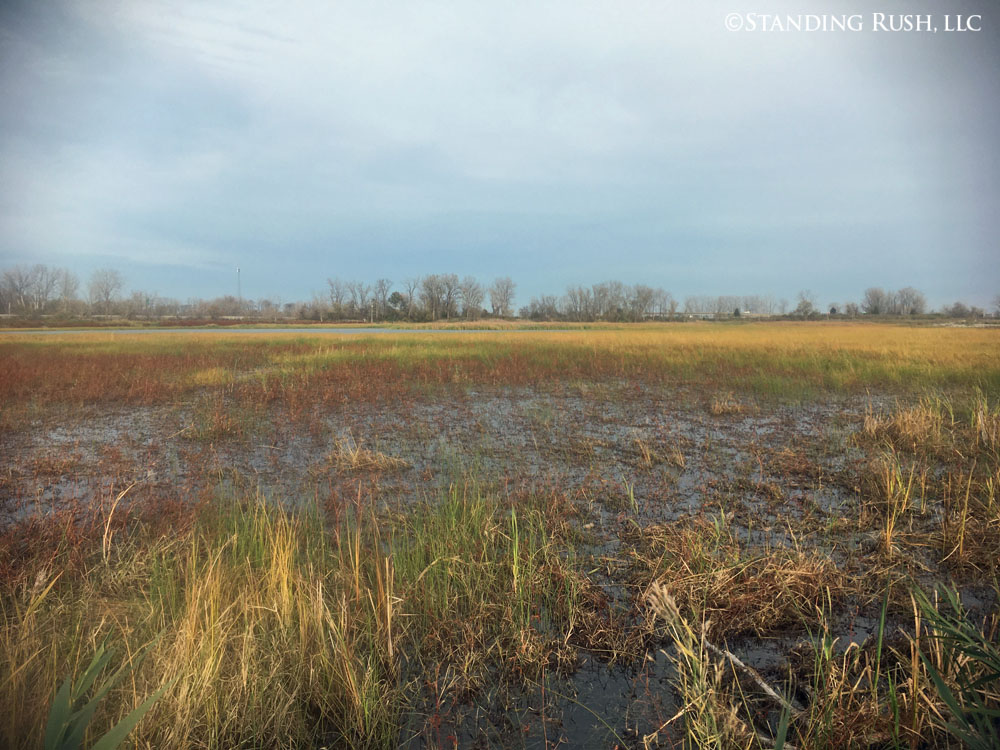
Spring may be historically stubborn to yield new green growth in the marsh, but May's warm temps certainly got the bulrushes going (as evidenced by this dense stand of soft-stem emerging from the Rest Pond -- photo taken 5/50/21. 

One evolving project that we are extremely excited about brings many of our favorite things together: marsh restoration & management, water quality, interactive education, emerging technologies, and functional data collection & analysis. At the invitation of our friends from Toledo Public Schools, we have been asked to host a water quality data collecting buoy that is being developed by an incredibly gifted collection of scientific minds. This unique collaboration was conceived and is being spear-headed by a robotics and software engineer from the NASA Langley Research Center. You can read more about the early development of the project here. We are thrilled to be one of two locations in the country (the second being Yorktown, VA on the Chesapeake Bay) where prototypical equipment has been deployed.

Preliminary testing not only yielded real-time data collection on useful water quality parameters including temperature, pH, dissolved oxygen, and nitrates, it also provided high school students a glimpse into a wetland world that is often as foreign as outer space. We are flattered to be a part of this team and this worthwhile project, and we are excited that the first iteration prototype yielded enough positive feedback to prompt the development of a second generation. Wetland Buoy 2.0 is currently under development and should be ready to be deployed in the fall. Updates will follow.

Roy delivering real-time water quality data from Standing Rush to the classroom at Toledo Public School's Natural Science Technology Center (NSTC).

New signage marks the newly completed Structure 2 connection between the Main West Marsh (behind the camera) and the Rest Pond (pictured), the management unit where water quality data is being collected.

This open canopy of free-flowing water between the Main West Marsh (behind the camera) and the Rest Pond (top of image) was the primary impetus behind the construction of Structure 2. This dramatically increased exchange of water benefits not just water quality, but also all of the biodiversity (both plants and wildlife) that thrive in these recently restored habitats.


This Eastern Foxsnake (or Fox Snake) neonate (or hatchling) -- a Species of Concern only found in marsh habitats of the Western Basin of Lake Erie in Ohio -- fittingly made its presence known while we were deploying the water quality buoy.

This nearly 5' Eastern Foxsnake specimen (which greeted Roy at the container door to the shop) did a little growing up -- and demonstrates that the species is thriving at Standing Rush.

Another shot of the emerging sea of green, taken in the Rest Pond toward the end of this month.


Sunday, January 31, 2021

January 2021: Turning the Page

While admittedly mostly a psychological victory, there definitely was a sense that a hurdle had been overcome by successfully closing the books on 2020 and welcoming a new year. 

Speaking of "eyes wide open," check out this stare . . . mink always look like they got caught with their paw in the cookie jar when you finally get them on film. This is one of the better ones we've been able to capture (credit: Roy)

It's not that last year was terrible from a professional perspective at the marsh (it could have been a whole lot worse), but the reverberations of the pandemic were (and are) certainly being felt at Standing Rush: understandable but still difficult uncertainty surrounding future funding opportunities; dramatically reduced visitation to the property; significantly less direct educational outreach (although there is definitely some neat stuff on the near-term horizon that was hatched during the current academic year); limited contractor interaction . . . the list could go on. 

But the bottom line is we continued to make progress, even if it was not at the pace we have grown accustom. And there are signs of light at the end of the public health tunnel. So we just need to keep the faith and keep trudging forward with our eyes wide open.

Skim ice was about as much as we could muster in January, with 26 of 31 daytime highs above freezing in Bay View; this made for good conditions for the "puddlers" to keep puddling.

Another typical early winter scene in the Rest Pond.

Gotta love this many swans -- probably a combination of trumpeters and tundras.

Partial evidence as to what continued to draw ducks, geese, and swans to the Rest Pond -- click to zoom in to see the mass of (nutritious) soft-stem bulrush seed, still floating on the water surface in January.

Not all photos have to be National Geographic quality to be cool -- six sandhill cranes stopped by to get in on the action.

Just to confirm Roy wasn't just having fun, dike maintenance continues


And just like that, Mr. Mink is gone again . . . 


Monday, November 30, 2020

November 2020: Not Time for the Parka Just Yet

 Here's a taste of late autumn from Standing Rush:

Rest Pond progression, continued . . .
It is truly amazing to compare this image to those taken in spring & summer, just a few, short months ago -- a naturally-occurring waterfowl buffet, but also refuge to countless species of insects, amphibians, fish, reptiles, and birds (of the non-fowl persuasion) . . . just to name a few.


While much of our attention on this website focuses on happenings "inside" the marsh, it is worth noting that water levels have been trending downward on the broader lake and bay over recent months (hard not to, considering the levels we reached over the last couple/few years). Projections -- shaky as they always are -- tentatively show this trend continuing. 

This image shows a particularly low snapshot during a significant SW blow (remember: lots of water can temporarily blow out of Sandusky Bay based on wind direction). It is striking to see the dead and tattered remnants of what was essentially a wooded barrier island just off-shore when we took possession of the property in 2015.What a difference 24-36" of water makes.


Roy was eager to show me progress in the Tower Woods at the backend of a full day at the marsh. I hadn't personally been hands-on with this tree planting in over a year, and it was amazing to see (1) the high percentage of trees of all species that are surviving, and (2) how much they have grown since they were put in the ground as 10-20" seedlings three growing seasons ago. 

Roy proudly attending to a thriving oak (above)
and sycamore (below).


Also worth showing growth of the "Bunkhouse Trees"
-- all are looking good!

NEWS FLASH: The USACE permit application that we worked so hard on over the summer was issued this month -- a big victory; we hope it can pave the way to lots of great things on Standing Rush's East Marsh.

"Ruger" (one of our punter's labs) wanted to point out that duck hunting continued and based on birds in the air, it remained worth keeping poised and ready to shoot -- and retrieve!


Friday, July 31, 2020

July 2020: Nursing Along the West & Laying the Groundwork for the East Marsh

Much of our energy this month centered around the submittal of a nationwide U.S. Army Corps of Engineers permit application that would allow us to conduct many of the same restoration initiatives we have implemented on Standing Rush's West Marsh on the east. By contrast though, we have been asked to assemble a single "comprehensive" application for the East Marsh. If successful, what we accomplished in handful of discrete permits (on the west) could theoretically be implemented through this single application on the east. 


One of my favorite marsh plants, arrowhead or "duck potato," pioneering its way into a
fully drawn down Rest Pond, July 2020. (These types of vegetative "successes" are
only possible thanks to improvements we have been able to make to both the earthen
infrastructure and the related water control structures on the West Marsh.)

We feel like a broken record, but our common refrain is: "Water levels dictate about everything
else on the marsh." 

Our recently achieved ability to fully remove up to 3-4' of water off large expanses of the West Marsh (even when water levels in the adjacent bay are at or near record highs), allows us -- given the proper seasonal timing -- to establish an environment where a broad diversity of desirable
annual and perennial herbaceous (native!) plants can then flourish. (July 6, 2020)

We have to keep a very close eye on these early emergents to make sure we like what we are seeing:
annual nutsedges and smartweeds along with perennial broadleaf cattail and soft-stemmed bulrush
have become a familiar -- and desirable -- script over recent drawdowns. 

The goal is to encourage as much desirable vegetation as possible to promote native diversity
and high nutritional value before gradually adding water back into the system 
-- in an effort to mimic natural processes and to discourage the germination or rhizomatous spread
of our usual suspects of invasive species. (July 16, 2020) 

But undesirables (invasives) are a reality, and we have gotten pretty aggressive about singling out
noxious flowering rush, even if it is one isolated clump among a sea of desirable plants (see below).
Spot-treatment for solitary plants has become a mainstay of our management efforts throughout
the summer months.

While this might look like a dog stain in your front yard, it is actually the aftermath of a spot
herbicide treatment to eliminate a solitary flower rush plant (highlighted with the red arrow).
Unfortunately, it can take two or even three applications to eliminate both the stems and the 
even more persistent roots and nutlets beneath the soil.

As an aside, one of the byproducts of a full drawdown is finding things that have been submerged, sometimes for a long time.
This pile of "tufa rock" (a local calcium carbonate derived geological anomaly related to marl and worthy of its own future post) is a good example.
Our guess is that it was imported by duck hunters many years -- like maybe 50-100 years -- ago
to create a more stable base for blinding. A lot of work . . . all in the name of ducks!
At some point, we want to obtain a geologists perspective.


Tuesday, June 30, 2020

June 2020: Another Nearly 200 Acres of Coastal Wetland Permanently Protected

While the typical management activities of early summer (mowing, spraying, seeding, grading) marched on as the days continued to lengthen, June 2020 was headlined by the realization of another major project milestone. With the official execution of Standing Rush's second federally protected easement (~195 acres), nearly 400 acres of the bayside site are now secured as Lake Erie wetland, forever.

Standing Rush, West: With the exception of the extreme upper-left corner of this image, 
all of the ~195-acre marsh south of Route 2 (upper-right) and west of SR 269 (lower-right) is now 
under the perpetual protection of the USDA/NRCS's Wetland Reserve Easement (WRE) program.

The West Marsh Rest Pond from Structure 1 nearly three months into an early season drawdown.
Note the deep water canal in the foreground and a robust stand of broadleaf cattail in the background.
This is among the habitats now permanently protected.

Dozens of great egrets (among a broad spectrum of other wildlife diversity)
enjoying the productivity of the Rest Pond, June 2020.

A personal favorite perspective of the main West Marsh, August 2017.
Again, this is among the habitats now permanently protected.

Thursday, April 30, 2020

April 2020: More Northern Fun, Assessing Winter Damage & Welcoming Spring

Management and wildlife highlights from this month included the following:


In addition to Roy's regular updates and photo-documentation, images from the property's multiple motioned-triggered trail cameras offer regular -- and refreshingly candid -- glimpses of activity on
and around the marsh (like this awesome impression of a Northern Flicker).

Northern pike trapping and tagging continued; 12 individuals were fitted with transmitters at Standing Rush by BGSU with initial assistance from the Ohio Division of Wildlife. This ~37" female was among the biggest of the 54 individuals tagged in all of the Western Basin of Lake Erie as part of this study.

Individual fish are carefully handled for the brief period leading up to and following their surgical procedure. The transmitter is about half the size of a AA battery, should have a 2-3 year lifespan, and then will ultimately reside harmlessly inside the body cavity. 

2-3 sutures and its time for release.

Management Priority #1:
A bent screw gate on the bayfront dike of the West Marsh
(lower left) was an early discovery after ice-out.

Within a week, Roy had a new gate fitted on the interior side
of the same pipe (insuring that even if the bent gate leaked,
the West Marsh would not inadvertently flood)

Management Priority: Poison Hemlock Spraying;
always scary when a plant gets a jump-start on Phragmites!
We're finding this new invasive is one of the first to green-up.

Management Priority: Phragmites Burning;
we are selective in what and where we burn, but this spring
practice gives us a much better feel for the condition of the
dike hidden beneath last year's growth.

Dike erosion has been a reality, especially amidst
continued historic high water levels
(extremely high water in the lake and bay often
forces managers to keep water levels higher
within the marsh to reduce damaging head pressure).


Spot repairs as part of ongoing dike maintenance gave us the
opportunity to experiment with some pretty versatile track trucks.

And Roy's make-shift stone grading drag proved to be just the
ticket to get the top of dike ready for easy management access.

Wherever we can afford to keep water levels low within the marsh this time of year -- or nearly 
any time of year, for that matter -- shorebirds (like these Lesser Yellowlegs) are sure to find it.

Marsh Mystery: What chewed the entire topside off this sizable willow branch, that in places 
extends 5' or more off the water?

Our guess would be a groundhog, but muskrat or beaver
are not out of the question.