Showing posts with label northern pike. Show all posts

March 2021: Thawing Out (Fast)

As abruptly as "real winter" came, it went. We went from 6-8" of solid ice on Sandusky Bay in late February (with some starting to venture out onto the hardwater of the big lake) to completely open water in a matter of a week. All 31 days of the month held highs above freezing and temps soared into the 70s on a couple occasions. 

Nate's research has transitioned from trapping/tagging northern pike (2020) to tracking them (2021) using a portable receiver and multiple receivers scattered throughout the nearshore waters of the Western Basin. 

We are fortunate to have helped secure funding for three submerged tag receivers at Standing Rush (thank you, Office of Coastal Management!): one in the estuary (behind Nate in the image above), one in our Rest Pond (just on the marsh side of Structure 1), and one in our main West Marsh ("upstream" of Structure 2). These devices were deployed ahead of active spawning (late February) and will monitor and record any pike that swims by with an implanted tag. Each tag is fish-specific, so Nate will be able to see who swam by, when, and how often. 

This data will not be available until he retrieves the receivers in May, but his handheld unit gives him a glimpse into what may be going on beneath the surface of the water. It was a thrilling day in March when he detected a very large, tagged female that had made her way through Structure 1 and into the Rest Pond. Based on her movements, it was highly probable that she was spawning -- a practical victory that helps to justify all our efforts to get this new and improved water control structure installed.

It will be very interesting to see the balance of Nate's data and to continue to watch his research evolve. The plan is to deploy the receivers again next year, at least, so we will be able to continue to watch how northern pike are utilizing Standing Rush in the spring.

The spring thaw couldn't be all fun (chasing fish); but my hunch is Roy gets some annual satisfaction out of our selective prescribed burns -- nothing like watching a mass of invasive species disappear before your very eyes. (NOTE: We are very proactive with our local fire departments. They are always informed before we plan to burn, and they are generally very supportive of our efforts.)

A decent "before" (right) and "after" (left) showing the instant impact of burning the narrow ribbons of Phragmites that grow along many of our dikes. Again, we do this selectively, mainly to assess the condition of the dike slope and to improve visibility within and across management units.

Burning Phrag looks dramatic, but it tends to burn itself out fast, particularly when there is only one year's worth of "fuel" (dead stalks and stems). The key is picking the day when the humidity, ground moisture, and wind are all right. Clearly, this is not to be attempted without training and experience.


April 2020: More Northern Fun, Assessing Winter Damage & Welcoming Spring

Management and wildlife highlights from this month included the following:


In addition to Roy's regular updates and photo-documentation, images from the property's multiple motioned-triggered trail cameras offer regular -- and refreshingly candid -- glimpses of activity on
and around the marsh (like this awesome impression of a Northern Flicker).

Northern pike trapping and tagging continued; 12 individuals were fitted with transmitters at Standing Rush by BGSU with initial assistance from the Ohio Division of Wildlife. This ~37" female was among the biggest of the 54 individuals tagged in all of the Western Basin of Lake Erie as part of this study.

Individual fish are carefully handled for the brief period leading up to and following their surgical procedure. The transmitter is about half the size of a AA battery, should have a 2-3 year lifespan, and then will ultimately reside harmlessly inside the body cavity. 

2-3 sutures and its time for release.

Management Priority #1:
A bent screw gate on the bayfront dike of the West Marsh
(lower left) was an early discovery after ice-out.

Within a week, Roy had a new gate fitted on the interior side
of the same pipe (insuring that even if the bent gate leaked,
the West Marsh would not inadvertently flood)

Management Priority: Poison Hemlock Spraying;
always scary when a plant gets a jump-start on Phragmites!
We're finding this new invasive is one of the first to green-up.

Management Priority: Phragmites Burning;
we are selective in what and where we burn, but this spring
practice gives us a much better feel for the condition of the
dike hidden beneath last year's growth.

Dike erosion has been a reality, especially amidst
continued historic high water levels
(extremely high water in the lake and bay often
forces managers to keep water levels higher
within the marsh to reduce damaging head pressure).


Spot repairs as part of ongoing dike maintenance gave us the
opportunity to experiment with some pretty versatile track trucks.

And Roy's make-shift stone grading drag proved to be just the
ticket to get the top of dike ready for easy management access.

Wherever we can afford to keep water levels low within the marsh this time of year -- or nearly 
any time of year, for that matter -- shorebirds (like these Lesser Yellowlegs) are sure to find it.

Marsh Mystery: What chewed the entire topside off this sizable willow branch, that in places 
extends 5' or more off the water?

Our guess would be a groundhog, but muskrat or beaver
are not out of the question.


March 2020: Life Marches On

Management and wildlife highlights this month included the following:


Due to the solitary nature of the research, Bowling Green State University was able to continue its multi-year investigation into northern pike reproduction and the top predator's dependency on coastal wetlands as critical spawning habitat.

The 40-acre Rest Pond was intentionally drawn down over several pumping events to move relatively warm marsh water from within the wetland into the (comparably cold) adjacent bay to coincide with ice-out. Bay water was then allowed to flow freely back into the marsh, inundating desirable spawning habitat (note deep water canal above and emergent vegetation below). This carefully timed water movement through Standing Rush's "fish-friendly" Structure 1 was intended to encourage pike passage into the marsh just as they and their future offspring would benefit from its refuge.

A Fyke net (aka fish trap) set by BGSU researcher Nate Stott just inside Standing Rush's West Marsh (see black framed structure highlighted by the red arrow in the left channel of the Rest Pond).

Two male northern pike trapped in the estuary off of Sandusky Bay immediately adjacent to Standing Rush's Structure 1.

A major goal of this year's research is to fit individual adult northern pike with small radio transmitters that can be harmlessly inserted into the abdomen to track future movements in and around the wetland, the bay, and broader Lake Erie over the next 2-3 years.


A true sign of spring -- one of three nesting pairs of "our eagles" -- birds that have set up residence on or immediately adjacent to Standing Rush.

How many bald eagles can you count in one willow tree? Many of these birds are juveniles, likely offspring of "our eagles."


Trail camera images retrieved late this month demonstrate why I may not have seen many deer the couple times I got in the stand this past season.

Our inability to secure a trapper this spring (due to the pandemic) has direct consequences in the marsh. The badly injured muskrat immediately above -- aside a healthy specimen for comparison -- shows the outcome of finite food and space availability, especially during the spring breeding season. It is not unusual for muskrats to battle to the death as populations grow and competition for mates escalates.

Beaver activity just north of our Tower Woods -- while SO COOL to see on one hand, a bit ominous on the other; these water-loving structural engineers are persistent and can be very destructive!


No Replacement for Hands-On Learning: #TPSProud

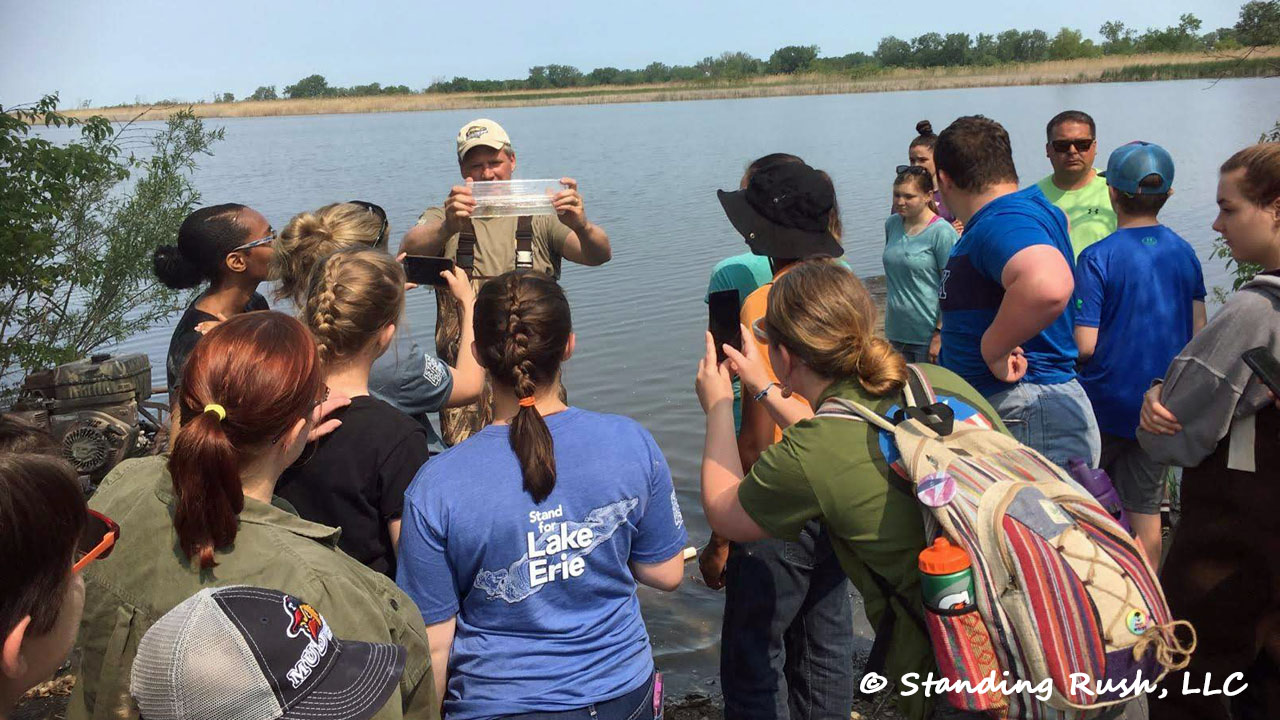
Students from Toledo Public School's Natural Science Technology Center (TPS-NSTC) help process the catch from a Fyke net
set at Standing Rush last Friday morning; a voluntary field trip to release fish provided the perfect opportunity to catch fish
(not to mention identify them, hold them, and marvel at their unique physical features and incredible diversity that can
best be appreciated through hands-on learning)

If the first half of May was dominated by birds at Standing Rush (and with the awesome diversity, it sure felt like it was), our migratory visitors on the wing were forced to share the stage with fish during the latter half of last month. Considering that the U.S. Army Corps of Engineers just recorded water levels on Lake Erie to be the highest ever recorded in the month of May, I guess it's fitting. Whether we like it or not, water, water (truly is) everywhere . . .

This year's northern pike release featured fingerlings
that started off smaller and ended up bigger
(on average) as compared to last year
But lucky for us, so are fish. And thanks to TPS's Natural Science Technology Center -- through an ongoing collaboration with Standing Rush and now Bowling Green State University -- we've just added more than 100 more healthy, happy northern pike fingerlings to the watery fray.

The release took place on a picture-perfect late spring morning late last week. But for the dozen or so students (and dozen or so parents, families, teachers, and adoring fans), it was actually one of the first days of summer vacation. That made the turn-out to Standing Rush even more impressive.

It was truly gratifying and awe-inspiring to witness the enthusiasm. And after another semester of working together, it was wholly satisfying to witness the attentiveness, genuine interest, and passion with which these kids experienced the marsh. Volunteers were eager to pull on hot neoprene waders to lend a hand, to get mud boots muddy, and to zip on life jackets to accompany there carefully nurtured foster fish to their new homes.

Roy returning with a couple happy students and an empty plastic bag, having released a couple dozen more
northern pike fingerlings into the West Marsh
Students were as eager to learn fish identification (as with
this black crappie) as they were to man the 15' seine net
used to catch 
And while releasing fish was the primary focus of the day, we wanted to make sure that we gave these students the hands-on opportunity to do some "sampling" as well. Fish sampling or monitoring goes way beyond capture by hook and line. It is important not only because it provides a glimpse into the diversity of fish species using a specific water resource, it also offers hints on population trends as well as how the environment can be augmented to support either higher numbers, use of the habitat by specific targeted species, or in some cases, both.

Sampling is also very important to this collaboration because (a) follow-up monitoring by BGSU with the hope of recapture of a subset of the released individuals will hopefully shed more light on the reproduction and early development of northern pike that is central to their specific research, (b) because fish monitoring in general can help us better understand how our newly improved connection to Sandusky Bay is improving fish stocks within our specific marsh [and shed light on how similar structures can help fish stocks in similar habitats on Lake Erie and beyond], and (c) because Standing Rush is assisting TPS in building a reference and teaching collection of the fish of Ohio -- I'll write more on this exciting project very soon.

A forth reason fish sampling is important is it's just plain fun. It gives people a unique glimpse into an underwater world that can be difficult to see and appreciate otherwise. And especially for young people, seeing and handling all the different shapes, sizes, and colors can ignite a spark of interest. In my particular case, that spark was fortunate enough to be nurtured into a lifetime flame -- a lasting passion for all things fish.

Here are some more photos from a great day in the field (and in the water) and from the final day in the lab leading up to the release.

Three students made hauling in the Fyke net a lot easier on Roy (foreground, left)
and me (center, top near float)
A captive audience taking in the details about another (temporarily) captive fish

Me with a couple of TPS's most devout fish enthusiasts (both holding nets) with their equally enthusiastic and devoted
instructor, Laura Schetter Kubiak [note all four of us are donning our Standing Rush graphic T's!]

Nate Stott, lead researcher from BGSU, tagging a fingerling northern pike in the TPS lab the day before release

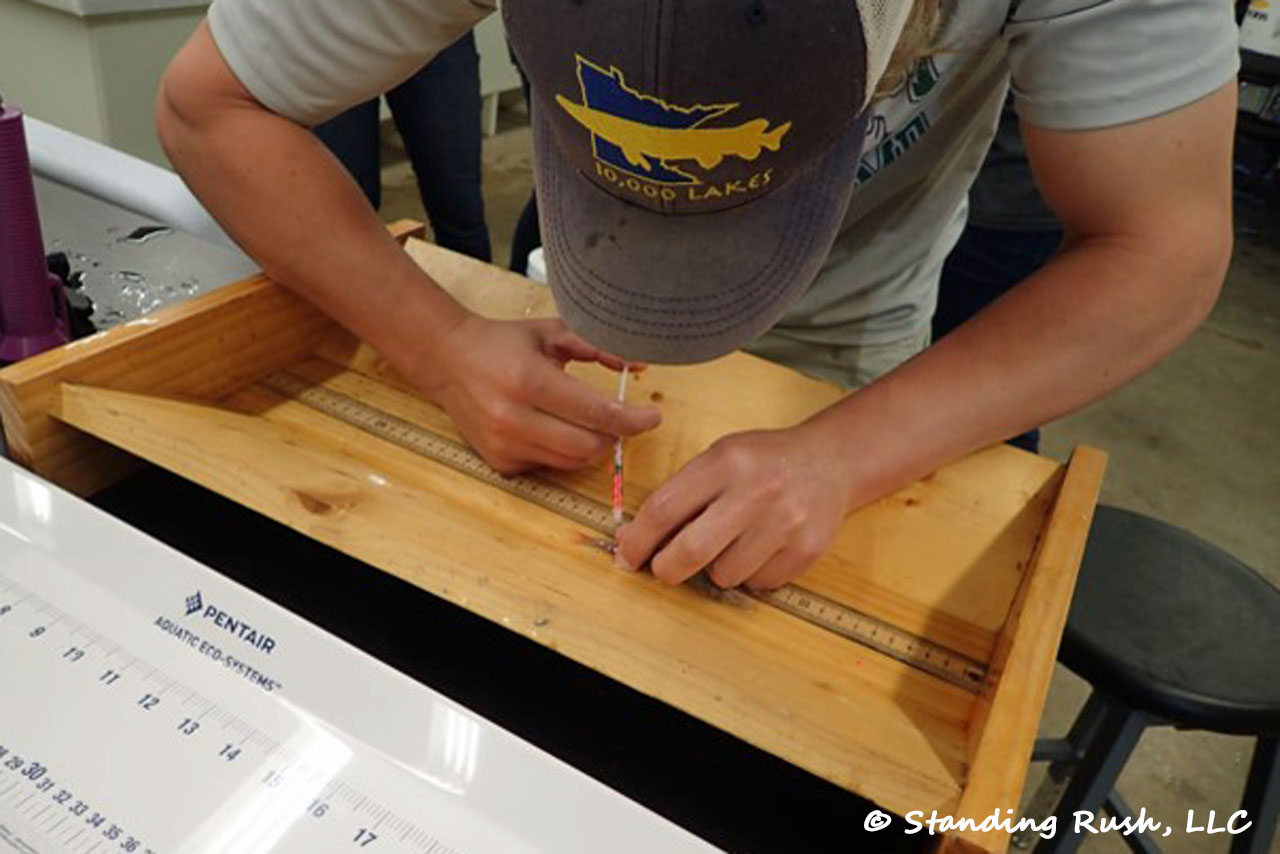
An incoming TPS sophomore helping with fish "tattooing"in the TPS lab last Thursday morning

A newly "tattooed" northern pike at TPS (note florescent dye at base of anal fin)


One enthusiastic bunch -- smiles were broad and fresh stories were already being retold as the students loaded into their vehicles 
and caravaned the 50 or so miles back to their school . . . so close, but in some ways a world away from the marsh

1,200 More Reasons to be Excited About Restoration & Scientific Research

Nate Stott of BGSU and Laura Kubiak of TPS prep to release bags of ~300 early fingerling northern pike into a 1,200-gal
aquaculture tank that was generously donated to Toledo Public Schools and Laura's lab by Castalia Trout Club;
Standing Rush facilitated a site visit to tour the Club's hatchery and rearing house last fall so students could better
appreciate the operation and where their new aquaculture system was coming from

Call it foreshadowing, but the cover article of the most recent Ohio Outdoor News that Standing Rush was featured in (see below) was entitled "Spring Prime Time for Pike" -- we couldn't agree more. That's why we are once again teaming with Toledo Public Schools NSTC (Natural Science Technology Center), the ODNR Division of Wildlife, and the NJDEP Division of Fish & Wildlife to raise fingerling northern pike for release into the marsh.

One of ~1,200 four-week-old northern pike hatched in
Hackettstown, NJ and delivered to TPS'
Natural Science Technology Center last Thursday
You can read all about last year's inaugural efforts by visiting historical posts. While last spring was a resounding success in its own right, we felt compelled to make a few noteworthy modifications to this year's methodology. The first, and the most significant, is the addition of another foundational partner: Bowling Green State University's Department of Biological Sciences.

As it so happens, BGSU's fisheries lab (which I was a participant in 20 years ago) has a graduate student by the name of Nate Stott who happens to be concentrating his research on the reproduction and early stage development of northern pike in the Western Basin of Lake Erie. He is through his Master's but as we've gotten to know each other more, we've mutually determined that it makes sense to utilize Standing Rush for his doctoral research over the next two to three years.

A related modification from last year is that Nate plans to tag each individual pike (a process that does not harm the fish in any way) in the hope that a subset can be recaptured in the marsh after they are released into the wild. This will both further Nate's research and give us a better understanding of broader fish usage (beyond this single species) on the property. All involved are excited about what can be learned from these future field efforts. (I plan to elaborate on Nate's research in a future post.)

A final key modification from last year is the quantity of fish we plan to raise for release. In 2018, we started with ~225 individuals with a goal of releasing at least 100 advanced fingerlings (5-6" in length). In 2019, we are starting with more like 1,200 individuals with a lofty goal of releasing as close to 1,000 fish as possible. Not only are we starting with significantly MORE fish as compared to last year, we are also starting with significantly SMALLER fish . . . ~2" on average as opposed to ~4" on average. (Much of this size disparity has to do with a delayed spring in New Jersey this past February/March.) The goal will again be to "grow" these tiny predatory fish as much as possible between now and late May/early June -- getting them to eat as much as possible without eating each other! This year, both Nate and I will be interacting closely with the high school students. The idea is to have them take ownership in the project so that it really means something to them when they see the fish released into the wild.

An overview of the young northern pikes' new home -- at least for the next month or so -- at TPS' NSTC lab/classroom

Approximately 300 fingerling northern pike being moved from their transport cooler
(where they spent about 10 hours in the bed of a truck); aeration kept the small fish
healthy until they could be acclimated and released into their new home in TPS' lab


Completion of a critical first step -- the last of the newly arrived northern pike are added to their new surroundings at TPS


R.I.P. "Beast"


This 60-second video clip demonstrates not only how hardwired northern pike are to be voracious predators, it also shows how one 8" fish can quickly capture the imagination -- not only of a high school student, but really . . . of anyone who is willing to marvel at this amazing creature's innate ability to hunt and grow.

The fish recorded here was affectionately called "Beast" in the TPS lab. At the time of this filming, it was just 10 weeks old. Isolated for its proclivity to eat its neighbor (even if it was the same species), Beast's aggression and appetite ultimately became its downfall. Record-setting heat late last week coupled with too many emerald shiners in the tank (going belly-up before they were all eaten) led the water to sour. It was a loss for the lab, but taught yet another lesson.

A handful of fingerlings were held back from the release earlier this week. As surrogate "parents" for the summer months, my kids and I will house them in our basement. The tank was set up last evening. The goal will be to keep at least a couple pike alive and grow them as much as possible until they can be returned to the TPS students next fall. The biggest challenge will be keeping them well-fed enough that they don't eat each other! Something tells me my 10-year-old son is up to the challenge.


TPS Proud -- Northern Pike Release: The Final 65 Miles!

A successful aquaculture project can be measured in healthy fish, but in our case, it can also be measured
in broad smiles and a hands-on introduction to the marsh . . . for all those involved

Back on February 28th, several dozen mature northern pike -- both females and males -- were collected on an unseasonably mild, early spring afternoon from Budd Lake in northern New Jersey. Housed in holding troughs, they made what must have seemed to be a lengthy (and bumpy) ~6.5-mile commute to a state hatchery and rearing facility in nearby Hackettstown.

These early spawners would serve as the broodstock for tens of thousands of fry that began hatching on March 8th at the NJ Division of Fish and Wildlife's Hackettstown State Fish Hatchery. While our planning started well before, this is where a unique collaboration was born -- quite literally. Within this multitude of growing fish was a very small subset of young fingerlings that would soon be making a much more lengthy over-the-road journey -- another 521 miles to Toledo Public School's Natural Science Technology Center.

Some might consider these guys the stars of the show . . .
they were obviously important, but the true stars
are pictured below
Earlier posts document how this diverse partnership grew and evolved, but yesterday, as we successfully released 150 healthy, happy 5-6" northern pike fingerlings into the marsh at Standing Rush, I couldn't help but think of those first 6.5 miles. Because between 2/28/18 and 5/29/18, our little northerns traveled no fewer than 592.5 miles by road -- with the final 65 miles being via escorted caravan to their new home along Sandusky Bay.

Some might think that's a lot of fuss for a few bags of fish. But for those involved, I think yesterday brought consensus that there was a "greater good" at play. The students not only handled the media and agency representatives with grace, they got to get their hands dirty -- again, quite literally -- in the marsh. To me, that's what this is all about.
____________________________________

Some of my favorite "moments" from yesterday, in pictures:

Three dozen northerns (and one student) -- all eagerly awaiting an introduction to a new home

Release #1 (first of four locations where fingerlings were released over ~185 acres of Standing Rush's West Marsh)

Always cool how every release brings anticipation and excitement

Special thanks to (left to right): Laura Kubiak (TPS Wildlife & Sustainability Instructor) and ODNR, Divisional of Wildlife representatives Travis Hartman, (Lake Erie Program Administrator) & Kevin Kayle (Fish Hatchery Program Administrator); not only was ODNR administratively supportive, they also took the time to be with us in person to support the kids’ effort

Ms. Laura Kubiak (back, left in sunglasses) with six of her proud students
just prior to the final release

NOTE: These students were so invested in this project, that they came to Standing Rush on one of their first full days of summer vacation. Quite a group.

P.S. Thanks to WTOL (11)/WUPW (36) for their coverage of our efforts yesterday on their evening news. Keep an eye out for additional coverage via other local media outlets. We appreciate good news being made newsworthy!