If you haven't seen their work already, you owe it to yourself to check them out. Either way, enjoy their first-hand account below. Pretty awesome.

Showing posts with label spring ducks. Show all posts
Showing posts with label spring ducks. Show all posts
Blue Bill Encore
As a final postscript to my post from this past Monday, April 9th, I couldn't resist reaching out to Toledo Aerial Media after my visit to East Harbor State Park. I had a really nice exchange with one of their co-owners, Phil Myers, and before long, I had him set up to come out to see -- and record -- things for himself.
If you haven't seen their work already, you owe it to yourself to check them out. Either way, enjoy their first-hand account below. Pretty awesome.
If you haven't seen their work already, you owe it to yourself to check them out. Either way, enjoy their first-hand account below. Pretty awesome.
A "Spectacular Concentration" of Divers
 |
| This afternoon's view of Middle Harbor (just north of Sandusky Bay); "One of the most spectacular concentrations of ducks I've ever seen in Ohio. . . Unbelievable!" -- E. Moxley |
While my family and I were down in South Carolina for spring break (the cause for my ~week absence here), the next installment of "Spring Ducks" was building in the Western Basin of Lake Erie. Roy reported "swarms" of blue wings and green wings (teal) along with persistent numbers of pintails, gadwall, wigeon, and shovelers and a typical smattering of other species (blacks, mergansers, etc.) at Standing Rush over the last 7-10 days.
The woodies haven't arrived yet, but that's not unusual, especially considering how stubborn it's been to warm up. One of the only other common species yet to be common thus far this season -- ironically -- is the most iconic of them all: the mallard. We just aren't seeing big numbers. That is strange.
 |
| Less than ideal lighting makes these bluebills (Greater vs. Lesser Scaup) even more difficult to differentiate |
While all of these "divers" are accustom to gathering in large groups as they migrate (in spring and fall), this is a regionally significant push of birds. I've come to learn it is unusual when Roy is taken aback in the marsh, and when a 350-acre expanse of recently restored open water harbors an estimated 100,000 birds, it's grounds for being taken aback.
In fact, the quote that accompanies the first caption is from a friend, former neighbor, and long-time Erie County landowner who has seen A LOT OF DUCKS in A LOT OF PLACES. But he has spent a lifetime tracking them along the shores of Lake Erie. His enthusiasm for this specific gathering is telling. There is a natural spectacle underway. Nothing beats seeing it in person, but at least these images provide a taste.
 |
| Greater or Lesser? -- I'd say Lesser, but you decide . . . |
 |
| Blue-winged Teal (two drakes and a hen) |
 |
| Green-winged Teal (solitary drake) |
Back at Standing Rush
. . . just a touch of early spring color
(as always, click to enlarge)
 |
| Two more bluewings on the feed in our West Rest Pond |
About Everything But a Unicorn
 |
| A beautiful drake Northern Shoveler (1 of 2) contently taking in the afternoon sun |
Dikes were very dry for this time of year. But we knew that wouldn't last long -- there is soaking rain in the forecast for today and for Thursday of this week and the "winter-like pattern" is supposed to return fast and extend well into April (the ten day forecast now shows plenty of 40s, 30s, and even 20s with decent chances of precip and lots more northeast wind -- yuck, I just hope we don't jump from winter to summer and skip right over spring).
So while we checked water levels, monitored the extent of dike wash, opened and closed some gates, and filled a good number of low spots on the West Marsh dikes (from a strategically positioned clay stash), the camera was never far from reach. As Roy rightly pointed out, the second you don't have the camera is the second you're sure to see a unicorn.
No unicorns yesterday, but I did see (and photograph) plenty of ducks. I can confirm seeing nine of what I consider our "Top Ten" -- all but the wood duck. Pintails were still dominant with decent numbers of shovelers, gadwall, wigeon, and green-wings. I can also add mallards (though not as many as one would expect), black ducks, common and hooded mergansers. Sprinkle in a few individual blue-wings and blue bills, tons of geese, a dozen or so swans, plenty of grebes, and rafts of coots, and there was plenty to observe and enjoy on the water and on the wing. Makes for a nice way to spend a day.
 |
| 2 of 2 . . . Just like last year, these guys are prevalent in the marsh this spring |
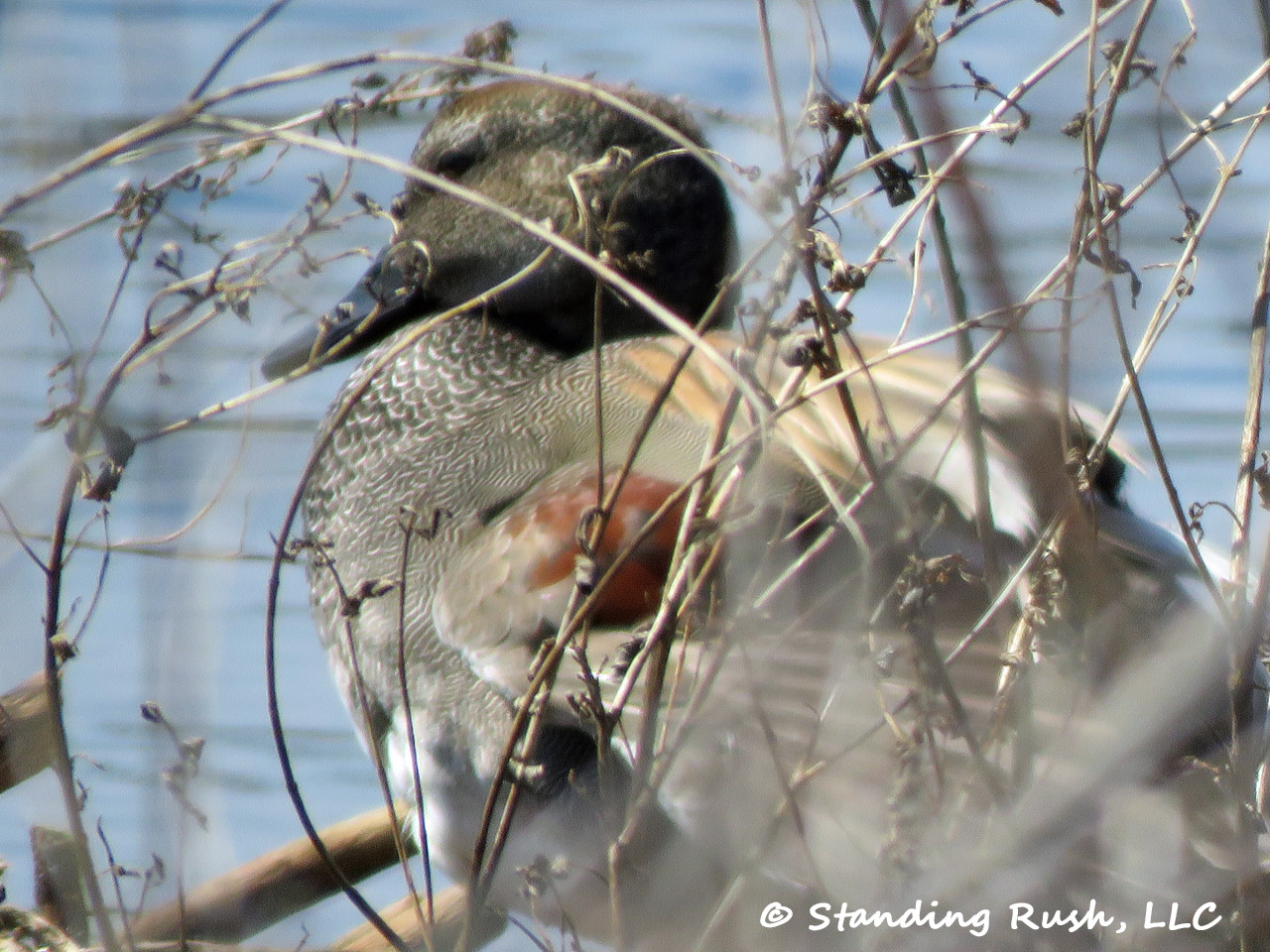 |
| This drake Gadwall was paying careful attention to his full spring plumage; unfortunately, all his preening took place behind a curtain of willows and dead loosestrife |
 |
| While the Pied-billed Grebe is often overlooked as a non-game "fish eater," I never tire of watching and hearing them; they are to be commended for tireless fishing/hunting and their shrill call takes my mind right to the water |
 |
| Poor lighting can't even take away from the beauty of these Northern Pintails -- as of yesterday, they were still the dominant duck in the marsh with flocks in multiple units approaching, if not exceeding a thousand |
 |
| Common Mergansers (females or non-breeding males) uniquely stationed atop a decaying Phrag root clump (as always, remember to CLICK TO ENLARGE) |
Pintails Galore
 |
| Drake pintails (with a lone hen hiding in the background); just plain photogenic |
I just got back from an annual pilgrimage to extreme northern Minnesota (a very late season ice fishing trip). Seems fitting somehow that I was greeted home by an inbox full of photos of Northern Pintails. Roy has been having some fun while I've been away. While the mercury remains stubborn in the 30s and low 40s for highs with lows often below freezing, the sun continues to gain strength and the day length continues to stretch. Compounded by the shift of daylight savings time, we're definitely in the midst of transition once again. Roy's photographs are a vivid reminder of one big payoff in the marsh that often comes on the heals of a long, tough winter: spring ducks!
 |
| Pintails basking on what is officially the last day of winter |
The congregation of pintails in the image to the left and immediately below are particularly gratifying because this is the Dinky Track, the 100-acre unit that makes up our eastern-most habitat. This area was a largely sterile, almost lunar landscape when we took possession of the property. The dominate physical features were: (1) Phragmites, (2) hundreds if not thousands of massive root clumps from dead and decaying Phrag and loosestrife [still visible amidst last year's vegetation], and (3) open water with little if any vegetation beneath the surface. None of these attributes are apt to attract much less hold waterfowl -- at least in any great numbers or over any notable time period. Already that has changed.
 |
| More loafing pintails taking in all the sun can give them |
 |
| A mix of stately drakes (with the long tails) and less showy but hardly drab hens |
 |
| Spring pintails on the wing |
 |
| A comparable aerial explosion out of the West Rest Pond (second year millet with increasing stands of desirable annuals and perenials) |
P.S. I purposefully set this post to go live at 12:15PM on 3/20/18. It is now officially spring! It's also the one-year anniversary of this blog's existence -- my first post was one year ago today, 3/20/17. Man, does time fly!
January Thaw
 |
| West Marsh, late last Friday afternoon |
 |
| Common Goldeneye enjoying the newly thawed estuary |
As anticipated, we have concentrated on a lot of the "inside priorities" that I alluded to in my last post . . . now over a month ago, somehow. We have made good headway on a variety of fronts. But amazingly, until last Friday, it had been since before Christmas that I had set foot on the property. That's way too long.
Trail cameras displayed little activity other than solitary coyotes, rabbits, squirrels, cardinals, and a stray cat. Literally no deer on camera since the first of the year except for a couple does and a couple yearlings by the bunkhouse -- one time. The only other thing of note on camera was the -16 degrees Fahernheit recorded a couple times in early to mid January. That's real cold, and activity was down.
All that changed last week. Snow was replaced by rain (my nemesis during winter months); winds shifted southwest and brought temperatures into the fifties. A couple consecutive nights stayed well above freezing and the combination of all these factors not only put an end to ice fishing on Lake Erie, but even to reliable ice on the inland waters that the kids and I enjoyed several times together.
But I have to admit, the sunshine felt good on my face on Friday. I found myself breathing deeply, trying to suck in as much of that spring-like air as possible. My long underwear was too much. My plans to close out the day in the tree stand (archery closes this week) were altered by both the lack of activity on the trail cameras and the near constant flow of geese overhead (also still open through this coming weekend). I audibled from my bow to a shot gun, a camera, and a walk down the dike.
Here are a few of my favorites from the more than 250 that Roy and I took Friday afternoon:
 |
| Several hundred geese were basking in the glory of mid-winter sunshine in the millet on the West Marsh |
 |
| Somehow, these northern honkers are so much more majestic than the golf course variety we see for so much of the year |
 |
| Ducks were also taking advantage of the heat wave; these loafing birds are mostly mallards, but there is diversity among them, if they give you time to look -- I saw blacks, wigeon, gadwall, shovelers, and even pintails |
 |
| Bird identification when they are bunched like this always reminds me of Where's Waldo |
 |
| Cool to see these mallards crashing into last year's millet; note how they are concentrating on a band of vegetation within the millet (cattail? softstem bulrush? nut sedge?) |
 |
| Don't know why, this scene just jumped out as a favorite |
 |
| We may be thawing, but winter isn't over yet; it will take a while for this bay ice to disappear -- particularly with sustained cold back in this week's forecast |
Family, Photography & Videography
Despite the fact that there is currently snow falling from the sky, I know it's only a matter of time before we transition into migrating warblers, more amphibians, fish sampling, turtle trapping, plant identification, and more. Browns and grays (and yes, whites) are going to transition to greens and blues soon enough. So I need to give the spring ducks a little more air time.
One of the unexpected and really enjoyable aspects of this project thus far has been the number of family members -- immediate and extended -- who have carved out some time to come pay us a visit. Recently, a second cousin (cousin's son) dropped in for his second visit . . . this time, wielding a pretty awesome camera and the knowledge of how to use it. Deke is just finishing up school in Vermont and is trying to decide if/how he could scratch the environmental itch professionally. Like so many of us, his course work has lead him down an exploratory path, but now he's reaching the proverbial fork in the road. What's next?
Photography and videography are a related passion for Deke, and we were the beneficiaries a couple weeks back. I just got the raw footage. While he was with me I got to spend a couple hours trying to gently corral migrating ducks -- mainly shovelers, pintails, widgeon, and teal -- toward Deke and his camera, as he juggled ever-changing light and Phragmites in the face. The footage above was taken as I was regrouping in our 4-wheeler. What I thought was going to be the least interesting footage turned out to be some of the most compelling -- other than maybe some close-ups that I'll hopefully get to share later. For a first effort though, we did pretty well. I'm hoping it's not our last field day together, whether we're looking through a lens or not.
________________
P.S. One of the opportunities we see for this place ties directly to nature photography. Over the last 20+ years, I have been fortunate enough to get to know renowned photographer, journalist, and instructor Art Weber as a mentor and friend. For those of you who don't know Art, he is a ridiculously fun and humble talent who not only spent the majority of his career with the Metroparks of Toledo, but he also blessed our community with the National Center for Nature Photography at Secor Metropark. For those in the area who don't yet know this hidden gem, do yourself a favor and check it out. Exhibits are always changing and always awesome!
At any rate, Art sees tremendous opportunity for Standing Rush because we have both the scale and the solitude to offer something meaningful. We're large enough at ~600 acres (1) not only to draw unique and consistent wildlife but also (2) to offer a buffer from the outside world. You might think the highways bisecting our property in both directions would be a hindrance. While they certainly cut both ways, you'd be amazed how easily they are tuned out -- by people and wildlife. And unlike the national refuges and state wildlife areas, we can offer a photographer good chances to see something cool at close range without the risk of being busted by an unsuspecting birdwatcher or hiker with her dog. We hope that we can add photography clinics to our growing list of activities in 2017.
Spring Ducks "Being Ducks"
 |
| A mix of Northern Shovelers (drake in foreground and pair just below fliers), Green-winged Teal (in flight and far right), and a solitary black duck enjoying last summer's millet crop (March 29, 2017). |
One of Roy's common lines that quickly became one of my favorites is some variation of the phrase, "It's nice when you can see ducks being ducks." In essence, what that means to me is that it is rewarding to see situations where waterfowl can behave as they would naturally. This doesn't mean Canada geese on a golf course fairway or mallards in an urban ditch aren't part of nature. It just means that those observations reflect major adaptations made by certain species to adjust to life in a largely human world.
The image above is one of Roy's first from the new Canon SX60. As he's prone to doing, Roy diminishes its quality and reminds me that he has a lot of work to do to knock the rust off his photography skills. First off, we don't necessarily need (or expect) Audubon quality with these images. Secondly, the first batch that he sent me today has some really neat stuff, and I know that they are only going to get better as we get accustom to the equipment. (No pressure, Roy.)
I chose the photo above for a couple reasons. One, I wanted to make a fundamental clarification that while ducks and duck hunting are an absolutely critical element of the local environment's natural history (in terms of wildlife and human interaction with the natural world), and while we most certainly want to encourage environments that attract and benefit ducks (for the sake of the birds and the hunters), this project has set out to manage for holistic ecological benefit. Roy and I appreciate that these birds are a big reason -- maybe the only reason -- that these wetlands are still on the map. Never underestimate the passion of a duck hunter. But we also recognize that there is a tremendous diversity of life that also relies heavily or completely on coastal marsh habitat.
Bottom line: We want to make decisions that are good for ducks but also that will be good for fish, amphibians, reptiles, mammals, and even more obscure groups like insects or freshwater mussels. The list that can benefit is long. And the determination of what benefits is largely driven by vegetation (which is in turn dictated by water levels over time). Management is largely about trade-offs.
I also wanted to include this photo to document that this spring's duck migration (which unfortunately may already be 90% behind us in Sandusky Bay) was marked by several unique observations. The temporary "walking" ice that did form in December was completely gone by late January. While the water did skim over to ice a few times since (shallow water can freeze with just a few cold nights), the migration most certainly started early.
What may be most notable about what we saw this year though was (1) the numbers of Northern Shovelers and Northern Pintails co-mingling in our 40-acres of millet, and (2) how long they stuck around (at least three weeks in big numbers). Shovelers and pintails aren't particularly regular companion species to begin with in the spring, but it was even more unique that we had literally thousands of them hanging out -- sometimes with 40+ Trumpeter Swans -- on a daily basis. We should have bought that camera for Christmas.
ASIDE: Toledo Blade Editorial, 03/30/17: Fight for Lake Erie