Showing posts with label muskrats. Show all posts

Friday, May 17, 2019

A Week in Review: Historic High Water & A Marathon Mow

The west roadside ditch along SR 269 (right) as it overtook the road last Thursday afternoon; eventually, high water
backed up from a rising Sandusky Bay closed the road in two places between that night and last Sunday afternoon

It has been a volatile (and stressful) week along the lakefront. My post from early March regarding a consistent uptick in water levels over the last few years and particularly over the last few months -- not just on Lake Erie but throughout the Great Lakes -- provides some context . . . and in hindsight, some foreshadowing. Historically high water levels are now front page news locally, regionally, and even nationally.

I feel like I could write a book on the complexity of the situation: not just the variety of environmental factors that directly impact these vast watersheds, but on the layers of scientific research that are grappling with how to make accurate near-term and long-range forecasts. Chapters could also be written on the far-reaching impacts to all those who live and work on or near the lakeshore. These are macro-level forces. They're big, they're vast, and when they are trending into the "uncharted waters" (pun intended) that we find ourselves in now, they are scary.

A shallow excavation reveals the source
of our most pressing issue -- dike breaches
from burrowing muskrats & groundhogs
Roy spent most all of his Mother's Day weekend readying us for the worst and scrambling to react to what Mother Nature was throwing at us. The bayfront stone fortification we did back in March has already proven to be crucial in protecting the main West Marsh, but historically high water levels are now putting physical stress -- in the form of new head pressures -- on portions of the property that would have seemed out of reach just three or four years ago.

We are in the permitting process to rehab the dike that serves as our southern boundary on the west marsh. It is really our last area of significant vulnerability unless water levels just continue to march up (which would have huge impacts not just on marshes but on communities all up and down the southern lakeshore of Lake Erie). This rehab project moved to the top of the priority list about a year ago, as we continued to see water levels and projections tip ever-higher. But until we can get the green light from a regulatory standpoint, we are forced to patch problems as they arise.

High water has caused thousands of dollars in unforeseen damages on this dike in the last twelve months (a few thousand dollars just in the last week). The good news is, we do set aside a "contingency budget" each year because we know to expect the unexpected. The bad news is, we've already about surpassed out budget and it is only May. As water levels surged with three days of sustained east/northeast wind last weekend, we witnessed new leaks forming about as fast as we could repair them. We are holding on -- hopefully until the permits come through and the water starts to recede for the summer. Historically, that trend starts sometime about mid-June. It can't happen soon enough.

The main culprit of our leaks right now (other than the water itself)? Our good friend the muskrat. Because we need to maintain higher water levels within the marsh (to reduce head pressure from rising water outside the marsh), muskrats are given access to new soil within which to dig. And these furry, little excavators are pretty darn adept at digging -- especially when the soils are soft and saturated.

Rats: they can look so "cute" and harmless when basking in the afternoon sun of a dry dike

Sheri Amsel does a nice job depicting what a conventional muskrat "hutch" would look like, say in a pile of decaying cattails. As I wrote on very early on, these water-loving rodents play a vital role in the health of coastal wetlands. However, as they make Swiss cheese of our aging south dike, they risk compromising the very habitat that they depend on -- because if we loose our dike (via a major breach), the water levels within the marsh will surge, the rooted vegetation will be lost, and the muskrat's habitat will go with it. As with so many things in the natural world (especially when human intervention has become complexly intertwined), the balance can be tenuous.

ASIDE: One other side effect of the high water is that we are reluctant to bring a heavy tractor onto our earthen berms to mow. This meant that I got to burn off some of my high-water stress walking behind the 30" deck of our brush mower these last couple days. About eight hours and ~26 miles of walking later, the entire East Marsh has been mowed. I'm a bit sore today, but it feels really good to have this project behind us . . . at least for another few weeks.

Before (left) and after (right) mowing our eastern-most dike. The "before" photo features poison hemlock that was about sternum high.
Now at least we can see if muskrats create any new issues.


Tuesday, June 20, 2017

Dike Maintenance: Kindly Replace Your Divots

Dike Repair: Our ever-dependable contractor (Buehler Excavating of Oak Harbor) was on-site this AM with excavator in toe.
A couple hours and a fair amount of compacted clay was all it should take to put us back on the right path. We should know 
a lot more by morning, provided the pumps continue to run and we don't get a significant thunderstorm (a low probability).

It was a busy day on the marsh. As is so often the case, there were several things going on all at once. Much of our activity was driven by dike maintenance and the ongoing effort to bring the water levels down on the neighboring marsh so that we can circle back on our final push to draw down on an additional 100-200 acres of own east side (before it gets too late in the "early" drawdown season). [NOTE: Because of stress on dike stability, it's not advisable to draw down one unit while leaving an adjacent unit in a high-water condition. Differences in head pressure tend to wreak havoc.]

After several consecutive days of dedicated searching, Roy and Nate were finally able to turn up the primary source of our neighbor's problem (and by association, ours): a significant hole . . . well, three holes, actually. Pumpzilla has been churning out 5,000-gal/min for several days in a row on the neighbor's 65-acre unit to supplement his ~1,500-gal/min pump, and we still weren't making any measurable headway. The math suggests we should be dropping 4-6" of water per day. We obviously knew there was a problem, but despite the tireless (tiring) search, they just couldn't seem to pinpoint the problem until late yesterday. Fortunately, all the hard work paid off, and Buehler Excavating came to our rescue -- as they so often do!

Meanwhile, I was showing a local fence company around an area on the north side of the property that we're considering doing some work on. I then met with the County road mowing crew and tag-teamed to get the shoulders around our entrances cleaned up. They did a great job and things look as good as they have since we moved in.

I probably moved a couple/few cubic yards of clay. I'll feel it tomorrow, but it will make for a much smoother ride atop the dike, and it will also help reduce the likelihood of a small nuisance from becoming a big problem.
Finally, I focused my attention on a remote interior dike on the West Marsh to do some much more modest hand repairs of my own. I felt like I was channeling my inner Bill Murray as I identified small (softball- to basketball-sized) holes, sinks, and slumps caused by some of the same culprits that forced the excavator repair. As critical as muskrats are to the broader marsh ecosystem, they can also be a burrowing nuisance to put it modestly. Groundhogs and beaver can also be devastating. Fortunately, the biggest of these excavating rodents, the beaver, are not very common in the immediate area.

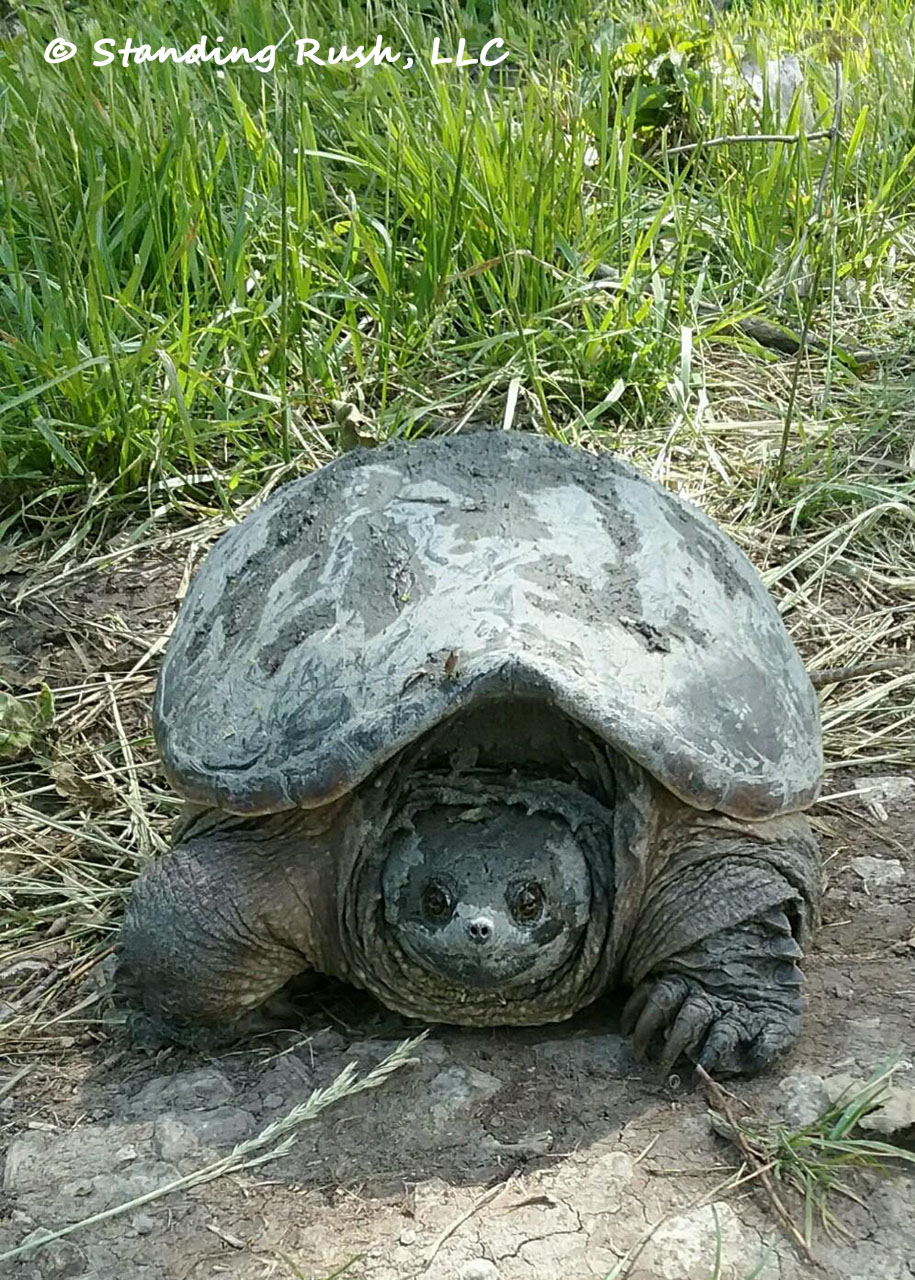
Julie caught this snapper up on the dike recently.
She was likely seeking high ground to lay eggs.
Another source of some of the smaller "potholes" that I encountered today likely came from still other digging mammals -- namely raccoons and opossums. Roy has seen this time and time again over his years in the marsh, but he has recently been pointing out these shallow depressions all over the tops of the dikes where clay had remained exposed (devoid of vegetation).

These locales are magnets for a broad diversity of nesting turtles like the snapper shown to the left. This is especially true on warm, rainy nights in the spring and early summer, when many turtles make their way out of nearby water, dig shallow holes, and lay several to several dozen round eggs that are then recovered with a few inches of soil to incubate (much like sea turtles).

Unfortunately, opossums and even more so raccoons are very wise to this behavior, so much so that coons are known to dig on fresh clay without any other visual or olfactory cue. They are unbelievably adept at raiding nests, and when you witness the quantity of destroyed sites, just on our property, it seems a miracle any single turtle prevails. But they do. And to a certain extent, this is just a natural part of nature's "checks and balances" system.

A raided turtle nest. Note dark hole right off the point of the burdock leaf and the small, broken shells to the upper left of the hole
(they look almost like dried white rose petals).

ASIDE: Ohio is home to 10-12 species of turtle (depending on interpretation of "wild" vs. "introduced") and as many as eight of them likely call our marsh home. We hope to focus on turtle monitoring over the balance of the summer to document as many as possible. Our #1 MOST WANTED is the Blanding's turtle -- hopefully more on them soon!